
Dry Tooth Paste Explained: Types, Use and Who Needs It
When you search for dry tooth paste, the results treat three different products as if they were one. A tin of tooth powder, a jar of chewable tablets and a tube of dry-mouth gel share almost nothing except the absence of a wet paste, yet the advice online blends them into a single category. So start with the question that cuts through the noise. If two products print the same fluoride number on the label, does either of them deliver that fluoride to your teeth? The answer depends on the product, not on the word dry.
The confusion isn't your fault. Sellers borrow the same language across formats, and a tablet marketed as "toothpaste" sits two clicks away from a moisturising gel sold for xerostomia. Untangling them takes about thirty seconds once you know what to look for.
What Dry Toothpaste Means in Practice
Three rows, three products. A tin of loose tooth powder, a jar of chewable tablets, and a tube of dry-mouth gel get lumped under the same search term, but only two of them are dentifrices. Powder and tablets are the formats usually meant by dry tooth paste. Dry-mouth gels and moisturising pastes are comfort products for a mouth that lacks saliva, and they don't clean teeth at all, so they sit in a separate category that shoppers often buy by accident.
Match your product to a row before reading any further.
| Format | What it is | Water needed | Fluoride check | Main trade-off |
|---|---|---|---|---|
| Tooth powder | Loose abrasive dentifrice, traditional format | Dampen brush before dipping | Many contain fluoride, but some traditional powders contain none, so look for a stated fluoride amount | Oldest format, abrasive if overused |
| Compressed toothpaste tablet | Solid tablet chewed or wetted, then brushed | Saliva or water to break it down | Look for stated total and soluble fluoride | Less water and packaging, texture may not suit everyone |
| Conventional toothpaste | Wet paste from a tube | None needed | Stated fluoride concentration, with an ISO maximum of 0.15% for total fluoride | Most studied format |
| Dry-mouth gel or paste | Moisturising formula for dry mouth | None, applied directly | Usually no fluoride, so keep a fluoride toothpaste alongside it | Eases dryness, does not replace cleaning |
Instant coffee and brewed coffee start from the same core ingredient in different physical forms, and the dry form still has to be prepared before it does its job. A tablet needs saliva or water to break down. A powder needs a damp brush. Neither format skips the brushing itself.
Powdered dentifrices are also far older than paste. The NYU College of Dentistry virtual museum of oral care traces them back thousands of years, records silver tooth-powder boxes selling on the London market by the 1780s, and notes that toothpaste had captured about 75% of the American dentifrice market by 1949, leaving powder roughly a quarter of that market at the time. Collapsible tubes arrived in 1892 and finished the job, because a tube travelled better than a jar of loose powder.
Format tells you how a product is delivered. The fluoride line and the ingredient list tell you whether it does its job.
Does a Dry Format Clean as Well as Paste?
Short answer: the short trials say a tablet can clean about as well as paste, and nobody has yet shown that it prevents cavities equally well. That distinction matters more than any claim on the packaging.
The short trials point the same way. A two-week trial of 40 adults found no significant difference in plaque or gingival scores between a fluoride toothpaste tablet and a conventional paste from the same brand. A separate four-week comparison of 100 children aged 8 to 12 reported a chewable tablet and conventional toothpaste equally effective for plaque removal, with the authors noting the limited sample size. Both come from DentalRoundup's review of the tablet evidence, which also reports one market estimate of USD 115.0 million for global toothpaste tablets in 2025, projected to reach USD 524.8 million by 2036, a 14.8% compound annual growth rate from 2026 to 2036.
Neither result settles the cavity question. The same review identified no human tablet trial measuring cavity outcomes, so anticaries protection still rests on fluoride concentration and how long fluoride stays in contact with enamel. If you want the mechanism in detail, how fluoride toothpaste prevents tooth decay walks through it.
The honest verdict: a tablet passing a plaque test is not the same as a tablet passing a decay test. Nobody has run the second one yet.
Larger work is under way. A registered six-week randomized study compares toothpaste tablets with conventional fluoride dentifrice in 50 participants, scoring plaque index, gingival index and DMFT. That design asks whether tablet delivery changes practical hygiene performance rather than whether users liked the flavour.
What decides your result is narrower than the format argument. Fluoride concentration sets the ceiling on protection. Disintegration speed sets how much of that fluoride is available while the brush is moving. Chew once and start scrubbing and you're brushing a partly intact disc, with patchy contact and uneven cleaning.
How to Use Dry Toothpaste Step by Step
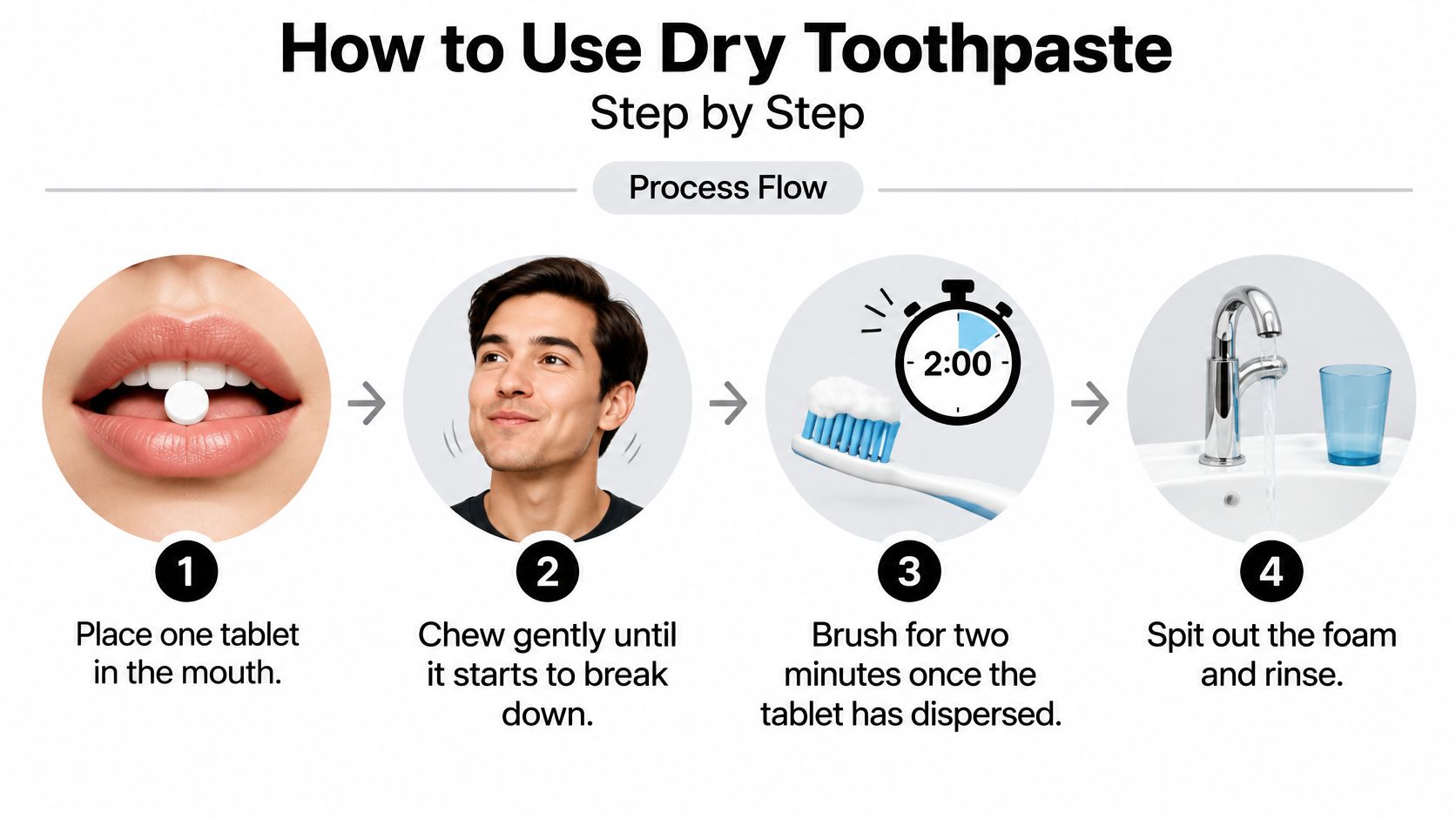
“Dry tooth paste” can mean a tablet you chew, a powder you load onto a damp brush, or a dry-mouth gel you apply for comfort. Judge each one by its fluoride label and use conditions, not by how dry it feels in the package. The sequence below gives a practical tablet routine, with two minutes of brushing once the tablet has dispersed.
The tablet routine, in order
- Place one tablet in your mouth. Dry hands and a dry mouth are fine, because saliva starts the breakdown.
- Chew gently until it begins to break apart. Aim for dispersion rather than large fragments, since hard crunching leaves solid pieces behind.
- Brush for two minutes once it has dispersed. If the core is still solid, contact stays patchy and some enamel gets little attention.
- Spit out the residue rather than swallowing it. The point is keeping fluoride on the teeth for that brushing window.
- Repeat at least twice daily. Protection estimates assume regular use, so one careful session cannot carry the whole day.
The following demonstration runs through the same sequence, including the pause while the tablet breaks down.
Tooth powder needs a different hand
Dampen the brush first, then tap a small amount of powder into the bristles rather than dipping the whole head into the tin. Brush for two minutes and spit. Volume is the caution here: powder is abrasive by design, so pressing hard or reloading mid-brush can wear enamel and irritate gum margins over time. A small pinch and a light touch do the work.
Dry-mouth gel stays outside the brushing step
Apply the gel to teeth and gums as the label directs, and keep brushing with a fluoride toothpaste separately. These products target moisture and comfort. Treat one as part of your protection only when its label lists fluoride and its directions fit alongside brushing.
A four-year-old makes the edge case clear. She cannot spit reliably, part of the dose may go down, and a tablet is easy to crunch and swallow before it disperses. Brush her teeth yourself with a child-appropriate fluoride product, keep the tablet out of reach, and ask your dentist which concentration suits her age. The same logic applies to anyone with a swallowing difficulty.
Good brushing looks the same in every format: a full two minutes, no gritty fragments left on the teeth, and a mouth that feels clean rather than chalky. Follow the product's reconstitution or application directions instead of assuming fluoride is available the instant it touches your tongue. For timing, rinsing and dose, see how to use fluoride toothpaste.
Fluoride Limits to Check on a Dry Toothpaste Label
Two numbers decide whether a dry product is worth your money, and they aren't the same number. Here's the reference set to hold against any label.
| Check | Reference value | Why it matters |
|---|---|---|
| Total fluoride, maximum | 0.15% by mass | ISO dentifrice limit, with exceptions for professionally supervised products |
| Total fluoride per single-unit container | 300 mg maximum | Caps the dose contained in one pack |
| Soluble fluoride after set water ratio and mixing time | Measured by ion-selective electrode | Shows what actually reaches saliva |
| Fluoride after accelerated humidity aging | Retest and compare with the release value | Shows whether moisture cuts availability |
| Children's fluoride concentration | Set by age and fluorosis risk, so confirm with a dentist | A child's swallowing control changes the calculation |
The ISO standard for dentifrice testing and fluoride limits sets that 0.15% by mass ceiling on total fluoride and caps single-unit containers at 300 mg total fluoride, with exceptions for products used under professional supervision. Those are the outer edges. Within them, the practical question is how much fluoride is bioavailable when you brush, and the standard's method for that is an ion-selective electrode reading taken on an aqueous sample prepared at a defined water-to-product ratio and mixing time.
Why the label number isn't the whole story
Compression, storage humidity, excipient interactions and incomplete dissolution can all slow how quickly fluoride becomes available in saliva, even when the printed amount is accurate. A tablet listing a conventional toothpaste concentration has not thereby proved that the same fluoride dissolves in your mouth at the same rate.
Practical rule: if a brand can't tell you how its tablet disperses and how much soluble fluoride it releases, you're comparing a number on a box, not a product you can evaluate.
A serious quality programme tests fluoride at release and again after accelerated humidity aging, then measures soluble fluoride after that fixed water ratio and mixing time. Packaging has to limit moisture ingress, because hydration changes tablet hardness, disintegration and chemical stability before you ever open the lid. If you're comparing ingredient lists across formats, what goes into fluoride toothpaste explains which excipients do what.
The one thing to look for is a manufacturer that states soluble fluoride and reconstitution instructions next to the total. That combination tells you the company tested the product as used, not just as manufactured.
Which Mouths Suit Dry Toothpaste
Suitability depends on the person and the product, not on the word dry. A healthy adult with a confirmed fluoride tablet and a careful two-minute brush is in a different position from a child who swallows most of what goes in.
| Situation | Dry format fit | What to check |
|---|---|---|
| Healthy adult, brushes twice daily | Suitable if fluoride is confirmed | Total and soluble fluoride on the label |
| Child who cannot spit reliably | Use with caution | Ingestion risk and fluorosis guidance |
| High caries risk | Only with clinically meaningful fluoride | Concentration and twice-daily use |
| Orthodontic braces or appliances | Discuss with a dentist first | Brushing technique and fluoride form |
| Dry mouth (xerostomia) | Dry-mouth gels target symptoms | Whether moisture or cleaning is the goal |
| Sensitive teeth | Use only if a desensitising agent is listed | Desensitising agent listed on the label |
The fluoride case is well established. A federal evidence summary of the Cochrane review on fluoride toothpastes reports that fluoride toothpaste prevents decay in children, adolescents and adults compared with non-fluoride toothpaste, and that higher fluoride concentrations generally provide greater protection, while children's products need to account for fluorosis risk. The International Association for Dental Research adds that fluoride toothpastes are generally safe when properly used, and flags ingestion as the specific concern for young children and anyone unable to spit reliably.
So the child row is not about tablets being dangerous. It's about dose control. A child who swallows a fluoride tablet twice a day is getting a different exposure from a child who spits, and that's a conversation to have with a dentist rather than a decision to make from a product page.
For high caries risk, concentration and twice-daily use carry most of the protection. A tablet that tastes pleasant but delivers a low fluoride dose is a worse choice than a plain paste at a proven concentration, however good the packaging story is.
No dry format can be judged apart from brushing technique, twice-daily use and swallowing control.
Braces and aligners complicate things further, because cleaning around brackets is a technique problem before it is a product problem. People with dry mouth often buy a tablet hoping for comfort and end up with a cleaning product that doesn't address the dryness at all, while a moisturising gel alone leaves the teeth unprotected. Sensitive teeth need the label to name a desensitising agent. And none of this makes natural, fluoride-free or tablet-based products automatically safer, since no human tablet trial has yet measured cavity outcomes.
Limits of Texture, Waste and Durability
Texture is where the sustainability argument meets a real mouth. In a 2025 peer-reviewed study published by the Journal of Contemporary Dental Practice, 152 participants used toothpaste tablets twice daily for one week, and 59.9% reported disliking the tablets' texture. More than half of a willing group, using the product as directed, didn't enjoy the feel of it.
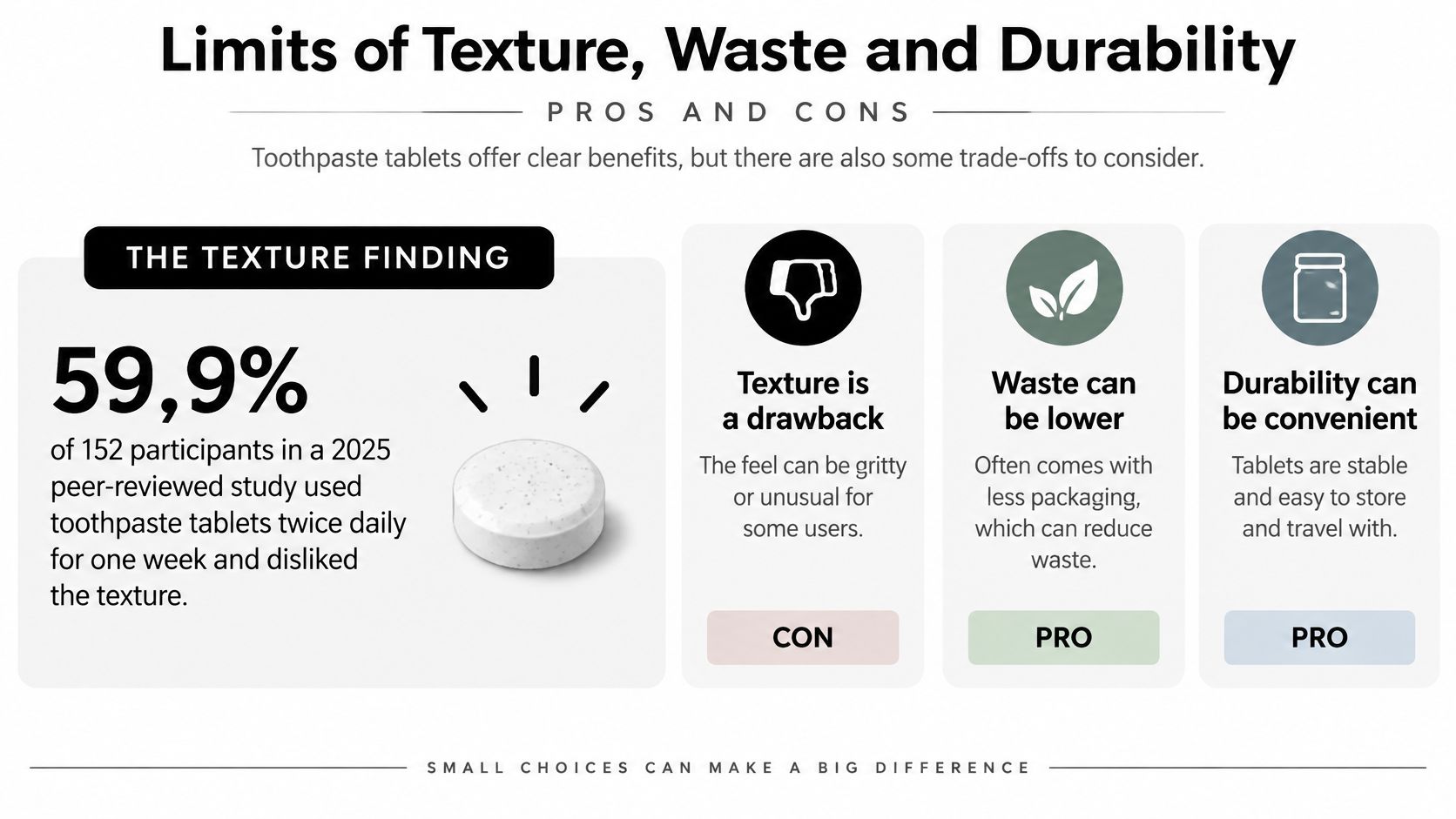
Durability is the second unknown. A 2025 materials study indexed on PubMed found that tablet breaking force varied substantially between formulations, and that fluoride-free tablets showed the lowest reported friability in that experiment. Translation: whether a tablet survives shipping, a humid bathroom shelf and a week in a travel bag depends on the specific formula, not on the category. The same body of work found generally positive consumer perceptions of eco-friendly tablets while identifying texture as a major factor in acceptance.
Weigh the trade-offs candidly.
- Travel and convenience against texture. A tablet wins in a carry-on and loses if you dread using it, so buy a small pack first.
- Less water and packaging against moisture and breakage. A crumbled tablet is wasted product and wasted money, whatever the tube count says.
- Consumer interest against long-term outcome data. The studies assess perceptions and physical properties, not whether everyone keeps using the product for a year.
Sustainability should be judged by lifecycle and by whether you finish the pack. A plastic tube you use to the end can beat a refillable system you abandon in three weeks.
Confirm a Dry Toothpaste Fits Your Routine
A twice-daily product earns its place the way a pair of shoes does: fit decides whether it stays. Judge each candidate on its fluoride label and its conditions of use, because the format alone tells you little about what it does for enamel. Work through these checks before you switch.
- Name the product. Powder, compressed tablet and dry-mouth gel are three different products sharing one search term, and each answers a different question.
- Read the fluoride line. Check for total and soluble fluoride and for reconstitution instructions, not just a familiar percentage.
- Time the dispersion. Chew one tablet and start a timer. If it has not broken down well before the two-minute mark, your brush is doing less work than you think.
- Match it to your situation. A child who cannot yet spit, orthodontic appliances or a high caries risk all call for a dentist conversation before a switch.
- Keep the fluoride toothpaste if dryness is the main problem. A moisturising gel handles comfort while your regular paste keeps handling the enamel.
- Give it one to two weeks. If the texture or the routine has not settled by then, it will not settle in month three.
DentalHealth.com stocks sensitivity and remineralising lines such as Fluoridex and MI Paste alongside whitening brands, so you can compare real labels across product types in one place. For mouths that need moisture rather than more scrubbing, GC Dry Mouth Gel Mint is priced at $15.99. Every USA order ships free, and every item is stored in a temperature-controlled environment.
Browse the categories at DentalHealth.com, then take the shortlist to your dentist before the switch becomes a habit. A product that suits your mouth is worth more than one that suits a trend.