
How to Use Fluoride Toothpaste the Right Way
You're standing at the bathroom sink with a toothbrush in one hand and a toothpaste tube in the other. You've brushed for years, but the instructions suddenly don't seem so straightforward: your dentist says not to rinse, a children's toothpaste has a different fluoride strength, and an online guide gives a different age cutoff.
Learning how to use fluoride toothpaste means sorting out a few separate decisions: the strength in the tube, the amount on the brush, and what you do afterward. You don't need an elaborate routine. You need clear instructions that fit your age, your ability to spit, and your dentist's advice.
Why Fluoride Toothpaste Works Differently Than You Think
Reaching for water immediately after brushing is an understandable habit. You've finished cleaning, so rinsing feels like the final step. With fluoride toothpaste, though, the material left on your teeth serves a purpose.
Fluoride works topically, meaning it acts at the tooth surface rather than needing to be swallowed. It helps strengthen enamel and interrupt the decay process. The World Health Organization's fluoride toothpaste guidance identifies twice-daily use as an effective cavity-prevention measure and recommends 1,000–1,500 ppm fluoride, equivalent to approximately 1.0–1.5 milligrams per gram of toothpaste.
Think surface treatment, not just cleaning
Brushing and fluoride have related but different jobs. Your brush provides physical cleaning; fluoride provides protection at the enamel surface. A clean-feeling mouth doesn't tell you whether you've chosen an appropriate fluoride toothpaste or left it in contact with your teeth.
That distinction also explains why extra scrubbing isn't a substitute for the right toothpaste. The useful question isn't whether your teeth feel smooth. It's whether your routine combines careful brushing with regular exposure to fluoride.
This diagram separates those roles.
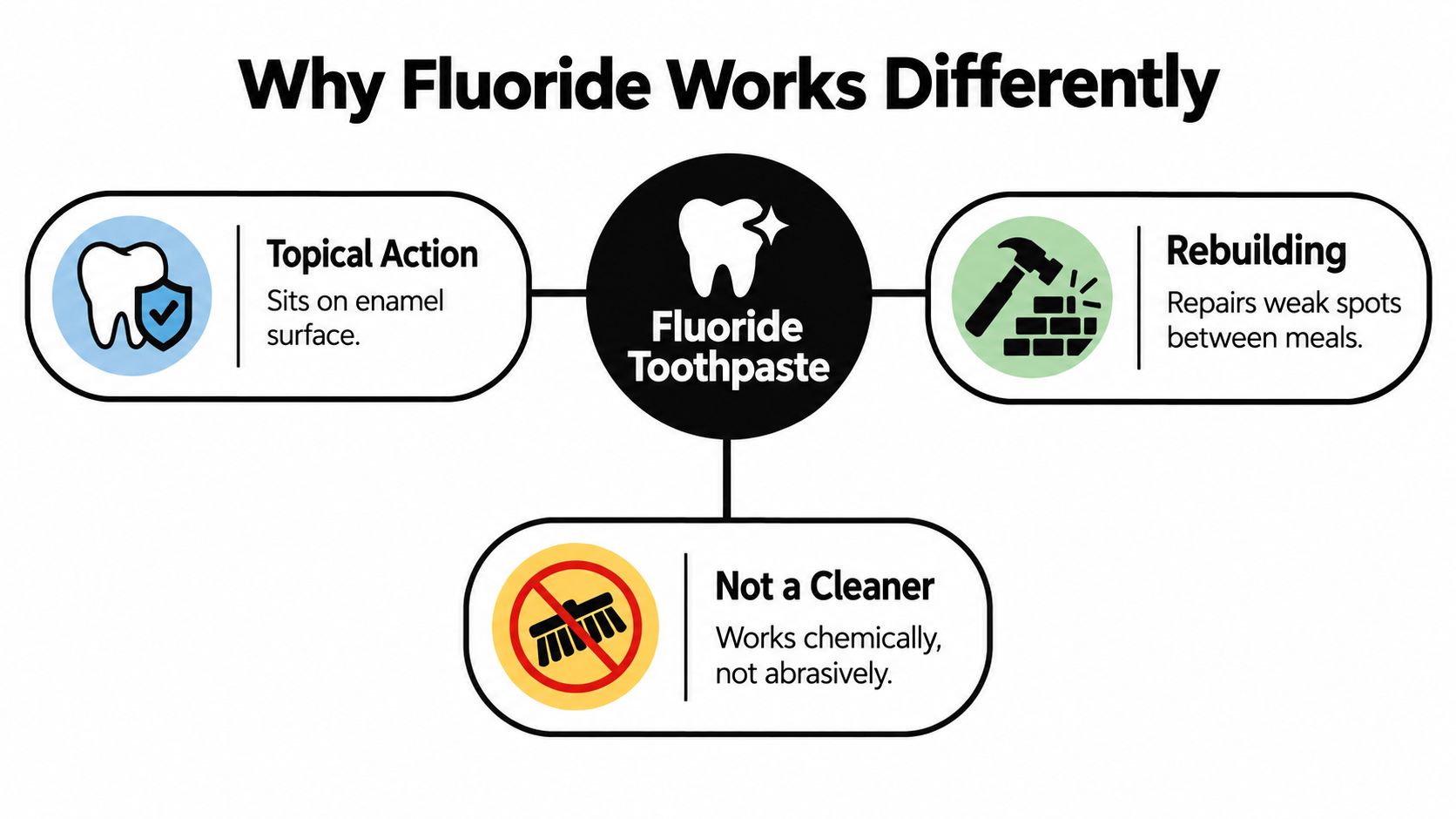
Practical rule: Treat the toothpaste left after spitting as part of your routine, not something you must completely wash away.
Understand what prevention can and can't do
For a closer explanation of enamel protection, read how fluoride strengthens teeth. Think of fluoride as a preventive tool, not permission to ignore a tooth that hurts.
If you're searching for toothpaste because you have an urgent dental concern, arrange professional assessment rather than experimenting with stronger products. Readers looking for local care can browse NYC urgent dental options through Bornbir as a starting point for finding services. A brushing change and a dental appointment answer different needs.
The Actual Brushing Routine Step by Step
Set out a soft-bristled toothbrush, your fluoride toothpaste, and a timer. Before starting, look at the brush head: you're applying a measured amount, not covering every bristle with a thick ribbon.
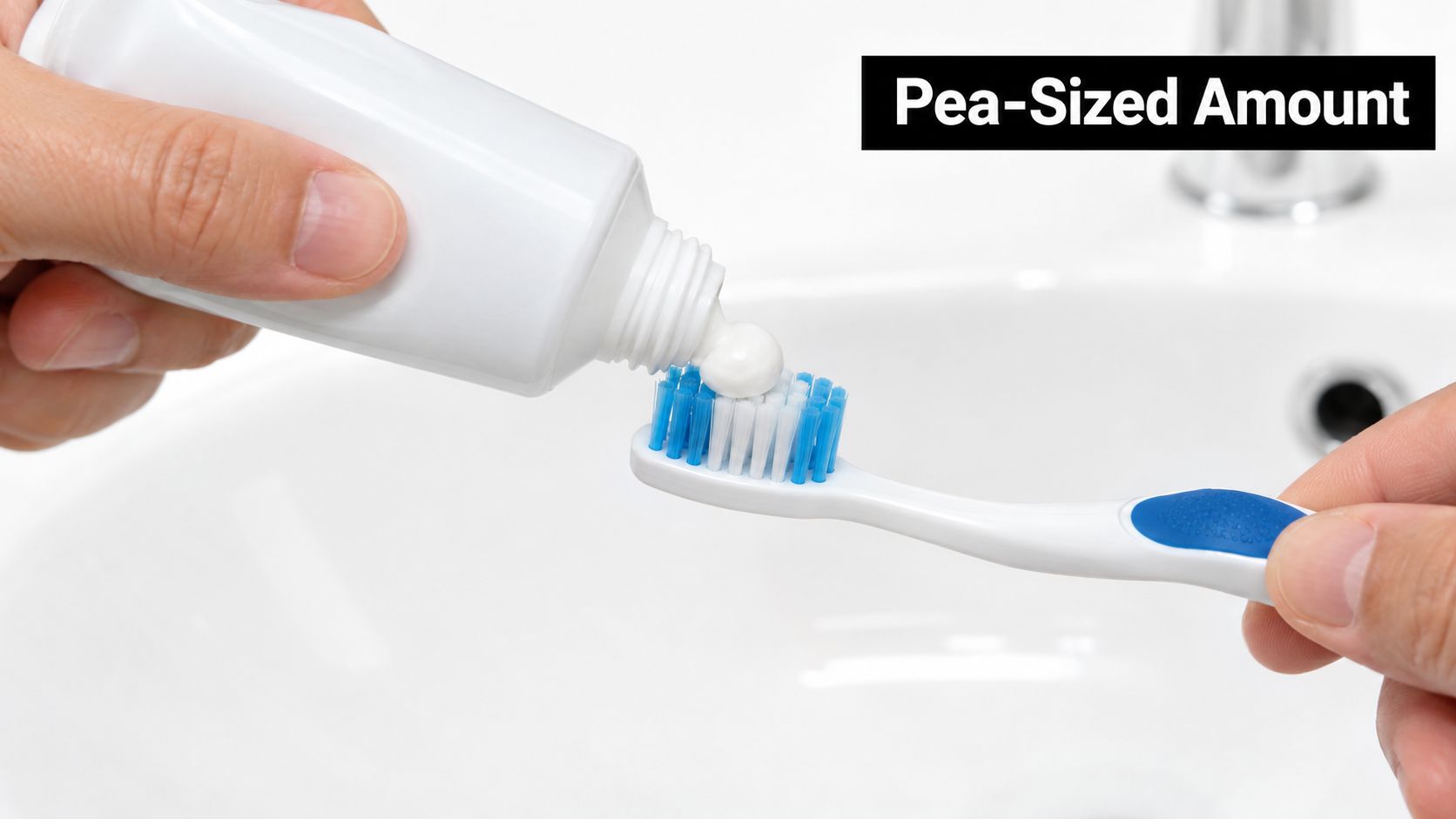
For adults, WHO's guidance described above uses a pea-sized amount. The picture gives you a practical visual reference.
Give every surface a turn
Use the same route each time so you don't rely on memory halfway through. Start at the back of your mouth and work around the outside surfaces, then the inside surfaces, then the chewing surfaces.
- Start beside the gums. Direct the bristles toward the gumline and use controlled movements. Don't turn the routine into a hard, hurried scrub.
- Change the brush position as needed. Behind the lower front teeth, try holding the brush more upright so you can reach the narrow inner surfaces.
- Visit the back teeth deliberately. Move the brush far enough back to reach the last tooth, rather than stopping wherever the brush feels easiest to hold.
- Finish by checking your route. Ask yourself whether you covered the inner surfaces as carefully as the visible ones.
The American Dental Association's fluoride overview supports brushing twice daily for about two minutes with fluoride toothpaste. The evidence it summarizes includes an analysis in which 1,500-ppm toothpaste reduced the increase in affected primary-tooth surfaces by an average of 1.86 surfaces, compared with non-fluoride toothpaste, across 998 participants.
That finding concerns children's primary teeth; it isn't a promise about an individual adult's results. Its practical relevance is that fluoride toothpaste offers preventive benefit beyond brushing with a fluoride-free product.
Use a timer as a coverage cue
A timer should help you slow down and cover your mouth, not encourage you to keep scrubbing the same front teeth until it rings. If you finish your route early, revisit an area you rushed.
For a visual companion to these instructions, use the brushing video below.
If you're also reviewing gumline care, Eric Wiitala DDS's Scottsdale gum health routine offers a related resource to discuss with your dental team. Ask your hygienist to watch your technique if reaching particular surfaces feels awkward.
Choosing the Right Fluoride Strength
Ppm means parts per million. It describes the fluoride concentration in the toothpaste, not how much toothpaste you should squeeze onto the brush. Those are separate decisions.
A family toothpaste and a children's toothpaste may have different packaging without giving you enough information on the front label to make a choice. Turn the tube or carton over and find the fluoride concentration.
Why WHO and NHS numbers differ
WHO's range, described earlier, provides a broad global recommendation. The NHS tooth-cleaning guidance advises adults to use toothpaste containing at least 1,350 ppm fluoride and says children can use family toothpaste containing 1,350–1,500 ppm.
Those recommendations overlap. The NHS adult recommendation sits within WHO's broader range rather than contradicting the idea that standard fluoride toothpaste helps prevent decay. The confusing part is treating a global range, a national recommendation, and an individual dental prescription as interchangeable instructions.
Fluoride Strength Ranges and Who They're For
| Fluoride Concentration | Typical Use | Notes |
|---|---|---|
| Below the WHO range described above | Products to assess carefully before choosing for cavity prevention | Don't assume a children's label establishes an effective fluoride strength. |
| Within the WHO standard range | General preventive brushing | Match the product to local guidance and use an age-appropriate amount. |
| Within the NHS adult and family range described above | Adult use and appropriate family use | Children still need measured quantities and supervision. |
| Prescription-strength formulations | Dentist-directed care for elevated decay risk | Don't treat these as a routine upgrade. |
Match the product to the person
For an adult without a special prescription, start with the applicable standard guidance. If your dentist recommends something different, ask what problem the recommendation addresses and whether it changes your brushing instructions.
For a child, concentration and swallowing risk must be considered together. Choosing a weaker product doesn't remove the need to measure the amount or supervise brushing. Likewise, using family toothpaste doesn't mean a child should receive an adult-sized ribbon.
A useful shopping comparison is fluoride toothpaste options for adults, but take any specialized recommendation back to your own dental needs. If you're considering a product such as Fluoridex, check its particular label and whether professional direction is required.
Stronger toothpaste should answer a specific dental need, not a general feeling that more protection must always be better.
Tell your dentist about frequent cavities, difficulty accessing dental care, and your usual water source. Those details can help them explain why their recommendation fits you rather than repeating the number on a leaflet.
Fluoride Toothpaste for Kids by Age
A child who can hold a toothbrush isn't necessarily ready to manage the toothpaste. Caregivers should control the amount and stay involved while children learn to brush and spit.
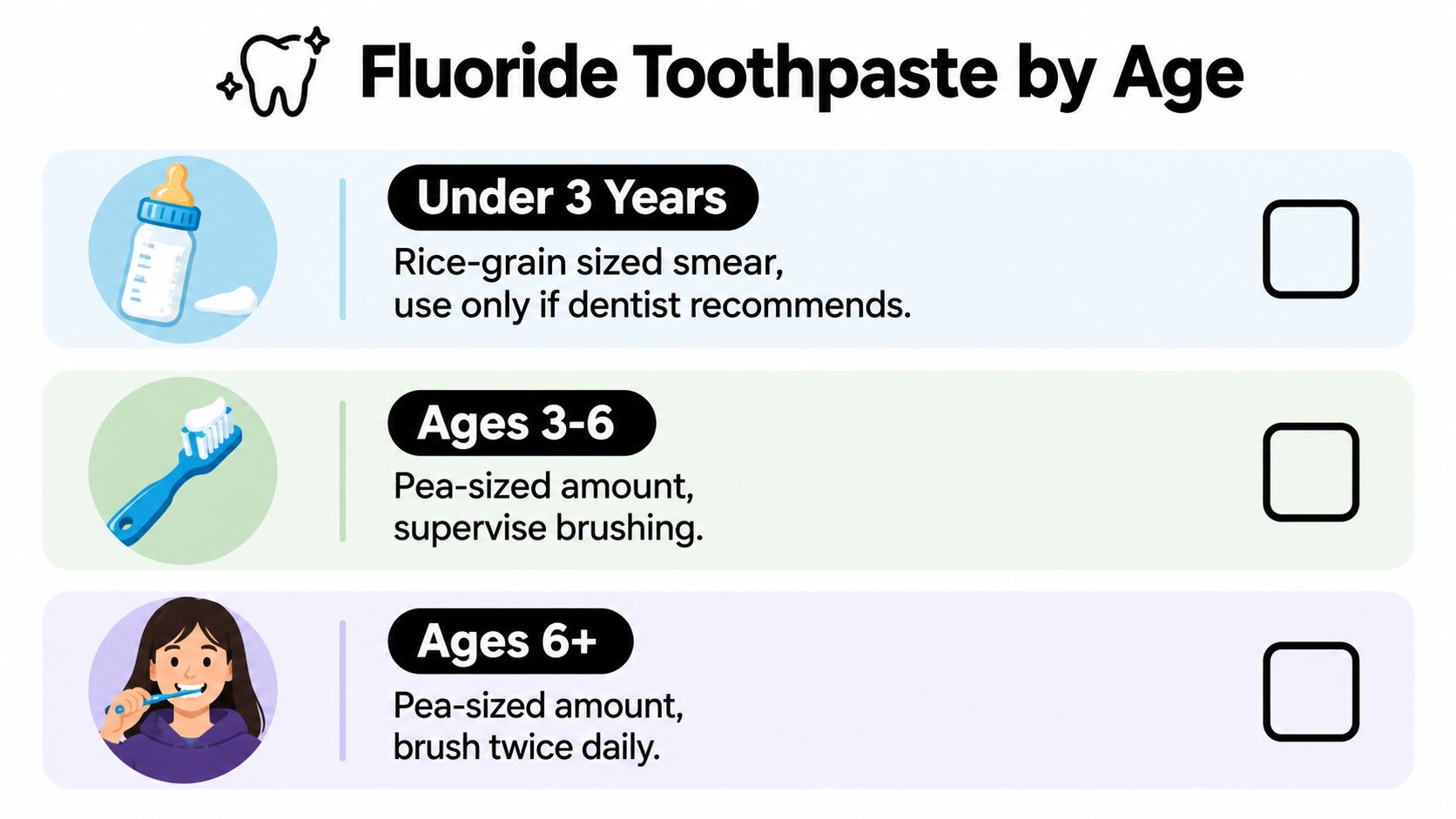
The CDC's guidance on toothpaste use in children recommends a rice-grain-sized smear for children younger than 3, and no more than a pea-sized amount, approximately 0.25 grams, for ages 3–6. It advises supervised, twice-daily brushing in the latter age group and encouraging children to spit rather than swallow.
Separate the starting-age question from the amount
CDC advises consulting a dentist or physician before introducing fluoride toothpaste to a child younger than 2, because children at that age are more likely to swallow it, as explained in the CDC guidance above. WHO guidance, by contrast, supports regular fluoride toothpaste from tooth eruption in carefully measured amounts.
These approaches give caregivers different starting instructions, but both require attention to the amount used and swallowing. If your local leaflet says to consult first, contact your child's clinician rather than trying to choose between websites yourself. You can still ask how to clean erupted teeth while you clarify the toothpaste plan.
The age bands below offer a visual reminder. The consultation wording is a simplified precaution, not a universal requirement for every child below the youngest cutoff.
Make supervision practical
Let your child try brushing, then help them finish. Keep the toothpaste tube in your own hand until you've put the measured amount on the brush.
- For children who swallow toothpaste, ask the clinician to demonstrate the intended smear and explain how to handle spitting practice.
- For children learning independence, supervise the whole routine rather than checking only when they announce they're finished.
- For older children, base the handover on how well they cover their teeth and manage toothpaste, not just their birthday.
Excessive toothpaste swallowing while teeth are developing can increase the risk of mild dental fluorosis. That's why the small quantities matter; the goal isn't to frighten children away from brushing.
If you're weighing fluoride-free alternatives, the Amanda OH parent guide to kids toothpaste provides a related reading topic, not a replacement for personalized advice. You can also review pediatric dentist-recommended toothpaste considerations and bring the actual tube to your child's appointment.
Spit, Don't Rinse and Other Habits That Change Everything
Spit out the excess toothpaste, then leave the remaining residue alone. You don't need to hold a mouthful of foam, and you shouldn't deliberately swallow it.
The NHS guidance cited earlier advises against rinsing immediately after brushing because it removes and dilutes the concentrated fluoride left on teeth. This is a timing instruction, not a warning that water is generally bad for your mouth.
What to do when your mouth still feels foamy
Spit again if you need to. If you've been using a long ribbon of toothpaste, return to the measured amount recommended for your age.
A different after-brushing sensation doesn't necessarily mean you've left your mouth unclean. The habit you're changing is the automatic final rinse, not the thoroughness of your brushing.
At the sink: Spit out what's loose. Don't deliberately swallow the remainder, and don't follow immediately with a mouthful of water.
Give mouthwash its own time
Mouthwash doesn't need to be the final step after toothpaste. Using it immediately afterward can wash away the toothpaste residue, including when the rinse itself contains fluoride, as explained in the earlier NHS guidance.
If mouthwash is part of your routine, use it at a separate time rather than automatically after brushing. If a dentist has prescribed a rinse with particular instructions, follow that plan and ask how it fits around your toothpaste.
- For everyday routines, separate mouthwash from the brushing session.
- For prescribed treatment, confirm the timing instead of improvising.
- For children, ask whether a rinse is appropriate before adding another product they must manage without swallowing.
The bedtime session deserves special attention. As noted in the ADA guidance earlier, salivary flow is lower at night, making that session important for prolonged fluoride exposure.
Make brushing your final oral-care task before bed where practical, rather than brushing and then returning to a snack. There isn't a universal eating-or-drinking waiting interval established by the guidance discussed here, so don't invent a countdown. Follow any product-specific or dentist-provided instructions, and avoid treating a forgotten evening brush as something mouthwash can replace.
Your Fluoride Toothpaste Routine at a Glance
A workable fluoride routine connects product choice, measured quantity, careful coverage, and the finish after brushing. Paying attention to only one part leaves the others to chance.
Keep the summary below near your bathroom mirror if it helps. Use your dentist's individualized instructions whenever they differ from a general checklist.
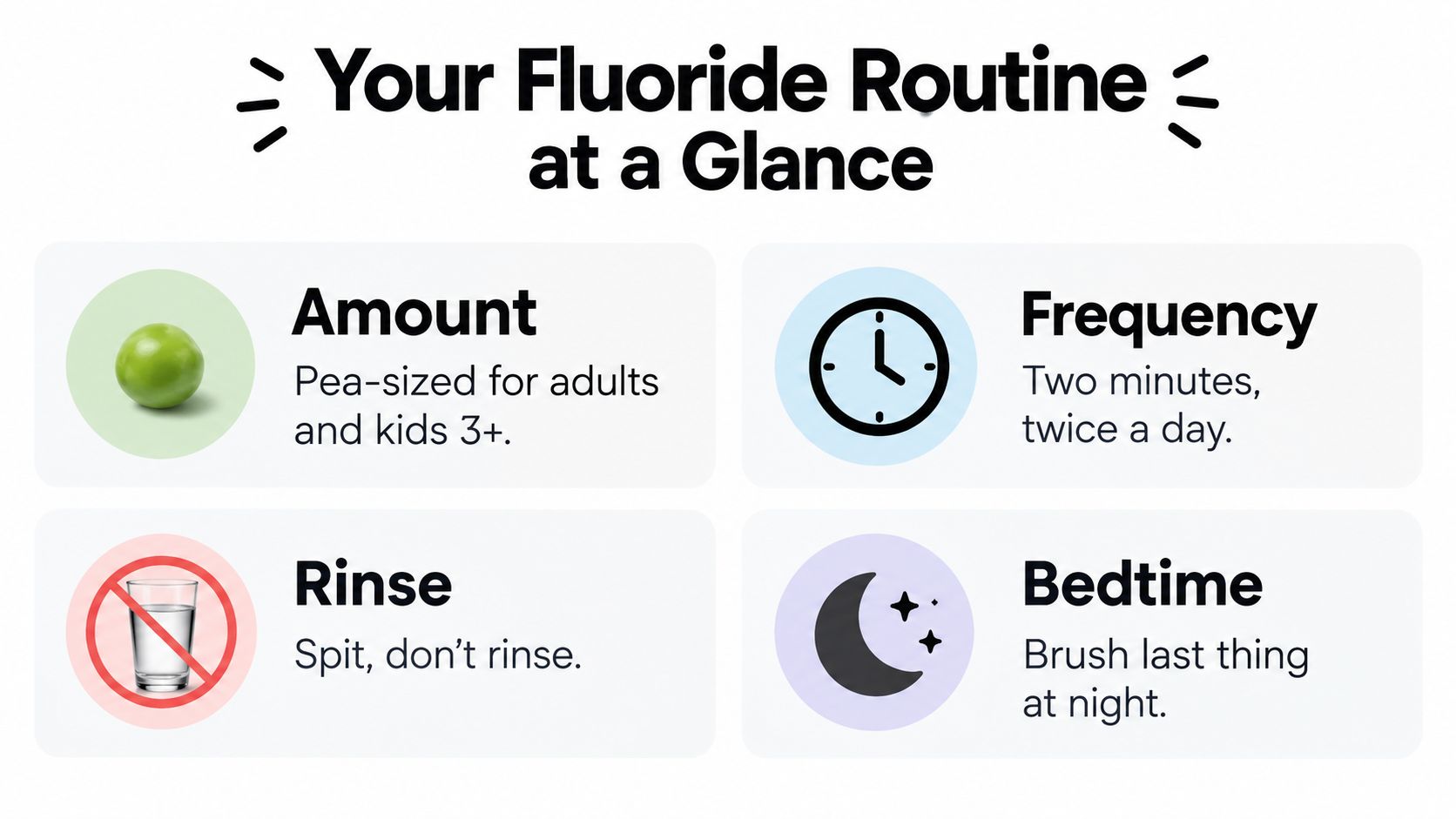
Check the routine without overcomplicating it
- Read the label. Confirm that the fluoride strength matches the standard guidance or the plan your dentist gave you.
- Measure before brushing. Use the age-based amount explained above, not the generous ribbon shown in advertising.
- Follow a complete route. Include the gumline, inner surfaces, chewing surfaces, and back teeth.
- Keep the regular schedule. Use your timer and protect the bedtime session.
- Finish thoughtfully. Follow the spitting and rinsing guidance rather than reaching automatically for water or mouthwash.
- Stay involved with children. Keep supervising until they can manage both the toothpaste and the brushing reliably.
Know when to ask for help
Contact your dentist if you develop sudden sensitivity, notice white spots that don't brush off, experience dry mouth while taking medication, or keep needing treatment for cavities. Don't diagnose the cause from the toothpaste aisle or switch yourself to a prescription-strength product.
Bring your toothpaste, or a clear photo of its label, to the appointment. Ask your dentist to confirm the strength, demonstrate the amount, and explain any instruction that differs from the leaflet you've read. That conversation can turn conflicting general advice into a routine you understand and can follow.
For an at-home product option, DentalHealth.com offers professional-grade dental care products, including sensitivity toothpastes, rinses, and remineralizing pastes, alongside practical oral-care articles. Visit to compare product descriptions with your dentist's recommendations and choose supplies that fit your fluoride routine.