
Fluoride Toothpaste Tablets: Dose, Use and Safety
If a toothpaste tablet contains fluoride, does that mean it protects your teeth just like toothpaste from a tube? Not necessarily. The fluoride concentration, the named fluoride compound, and how completely the tablet breaks apart matter more than the shape of the product or the packaging it comes in.
Fluoride toothpaste tablets can make brushing supplies easier to portion and carry. But choosing one means checking the formula first, then deciding whether its use instructions suit your mouth, your age, and your ability to spit.
What a Fluoride Toothpaste Tablet Is
A fluoride toothpaste tablet is a solid, premeasured dentifrice that you soften or chew before brushing. It isn't the older kind of fluoride supplement intended to be swallowed.
Say you're brushing in a hotel bathroom. Instead of squeezing paste onto your toothbrush, you take the labeled portion from a tin, break it down with saliva, and use your brush to distribute it across your teeth. The tablet replaces the paste, not the toothbrush, and chewing isn't the cleaning routine.
Think of a single-serve coffee pod compared with a full pot. The portion and preparation change, but the contents still determine what you get. Similarly, a neatly measured toothpaste tablet doesn't prove that the fluoride inside becomes available where it's needed.
Topical care rather than a swallowed supplement
Topical fluoride means fluoride applied directly to tooth surfaces. With toothpaste tablets, saliva helps turn the solid into a brushable mixture, and brushing moves that mixture around the mouth.
That distinction matters when shopping. A bottle labeled fluoride tablets could describe a supplement rather than a dentifrice. Look for explicit brushing directions and instructions to spit, not just a familiar ingredient name.
Practical rule: A toothpaste tablet belongs in a brushing routine, not in a vitamin organizer.
The history explains why the terminology can be confusing. A historical review of fluoride use traces manufactured fluoride tablets to 1874, while describing the later shift toward understanding fluoride's topical, post-eruptive benefits.
The important development wasn't merely putting fluoride into another object. It was recognizing the value of fluoride exposure at the tooth surface after teeth have emerged.
Modern toothpaste tablets apply that established principle in a newer format. The useful question isn't whether a tablet looks like toothpaste. It's whether the product reliably delivers its declared fluoride during actual brushing.
Tablets Against a Regular Fluoride Paste
A fluoride toothpaste tablet can be a reasonable daily dentifrice only after its concentration, compound, and breakup behavior pass inspection. Even then, matching a paste's label isn't the same as demonstrating equivalent cavity prevention in people.
The comparison below separates a promising format from evidence of dependable delivery.
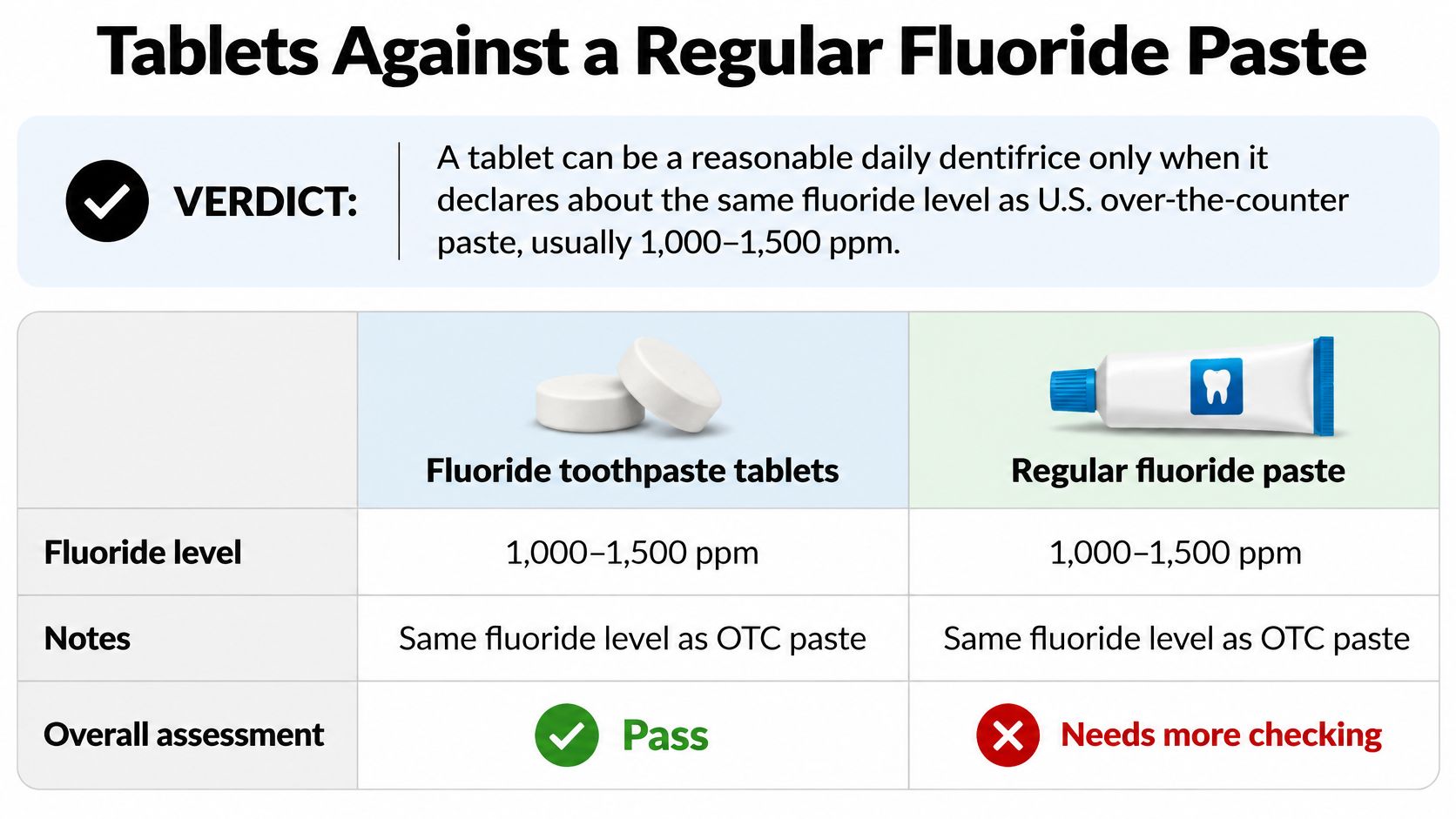
Fluoride toothpaste tablets versus tube toothpaste
| Check | Regular fluoride paste | Fluoride toothpaste tablet |
|---|---|---|
| Target fluoride level | Established over-the-counter fluoride concentration | Confirm the declared ppm rather than assuming equivalence |
| Active compound | Common examples include sodium fluoride and sodium monofluorophosphate | Must identify its fluoride compound clearly |
| Caries evidence | Extensive evidence supports conventional fluoride toothpaste | Product-level delivery and clinical equivalence need support |
| Breakup in the mouth | Already dispersed as a paste | Must break down sufficiently during brushing |
| Portion | Caregiver or user controls the amount squeezed out | A fixed unit that may not suit a child's prescribed portion |
| Water and pack | Water-containing paste, commonly supplied in a tube | Low-water solid, potentially supplied in a reusable container or refill |
Ppm means parts per million, a measure of concentration rather than the amount a person should swallow. The American Dental Association's fluoride overview describes U.S. over-the-counter fluoride toothpastes as generally containing 1,000–1,500 ppm fluoride.
The concentration evidence isn't interchangeable across every strength. Cochrane comparisons summarized in that overview found high-certainty benefit for 1,000–1,250 ppm toothpaste versus fluoride-free toothpaste, with 1,450–1,500 ppm producing greater reductions in new decay than the lower range.
Next, read the compound name. Sodium fluoride and sodium monofluorophosphate identify fluoride ingredients; mint, charcoal, and essential oils don't. A percentage attached to an ingredient also isn't automatically the fluoride-ion ppm, so don't compare unlike label measurements.
A label concentration isn't a delivery test
The tablet must wet, soften, and disperse. A formulation can contain an appropriate ingredient yet leave chunks that make distribution less consistent. Ask the manufacturer for disintegration testing and available-fluoride or fluoride-release results, not just the total ingredient amount.
Conventional fluoride toothpaste has a much larger evidence base. The introduction to a dentifrice-tablet microbial study cites the World Health Organization's estimate that about 1.5 billion people use fluoride toothpaste globally, but that scale doesn't validate every tablet formulation.
That 2025 study tested tablets containing 5% nanohydroxyapatite against sodium-fluoride paste containing 1,100 ppm fluoride, with comparable demineralization results in its laboratory model. However, the tested tablet wasn't a fluoride tablet, so the finding doesn't establish clinical equivalence for this category.
For a familiar comparison product, our guide to fluoride toothpaste for adults can help you identify the features you're trying to preserve. Keep a tablet under consideration only when the fluoride details and breakup evidence are clear. Foam isn't a pass criterion.
How to Brush With One Tablet
These instructions are for an adult using a product explicitly labeled for adult brushing. If the manufacturer specifies a different portion or preparation method, resolve that difference before using it rather than improvising.
The illustration shows the basic preparation sequence. For the finish, follow the spitting guidance below rather than treating rinsing as a requirement.
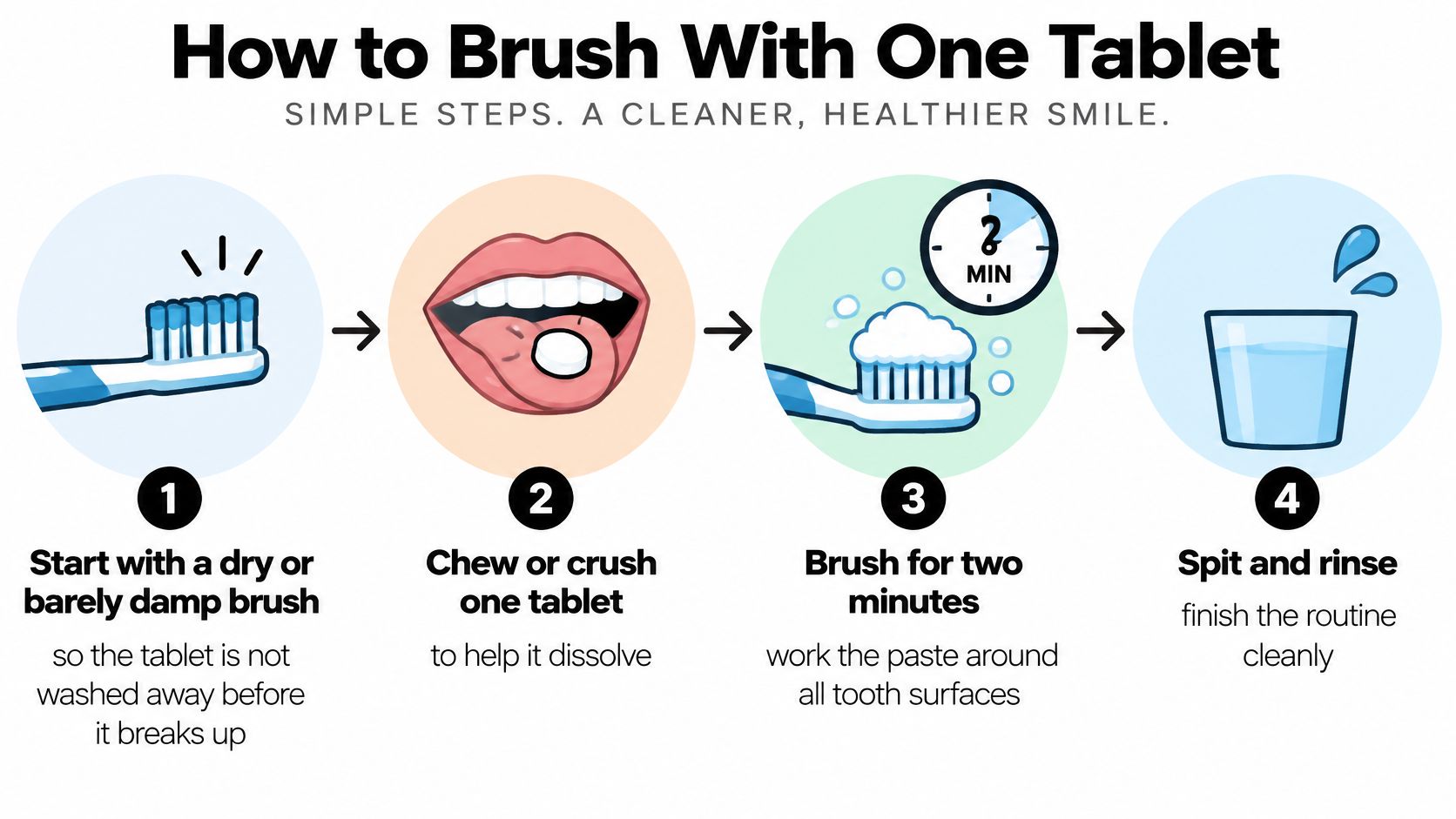
Prepare, disperse, brush, and spit
- Start with a dry or barely damp brush. Keep the tablet in your mouth rather than trying to balance it on wet bristles. Don't run water over the tablet and wash material into the sink before brushing begins.
- Chew or soften the labeled portion. Let saliva form a soft mixture before you start moving the brush around. If you're left with hard fragments, work them gently with the brush rather than adding another tablet or biting forcefully against dental restorations.
- Brush methodically across every surface. Work along the outer surfaces, inner surfaces, chewing surfaces, and gumline. Follow a complete brushing routine rather than stopping as soon as the mint flavor spreads, and don't scrub harder to compensate for a gritty texture.
- Spit out the mixture thoroughly. Don't swallow the slurry or follow brushing with a large mouthful of water. Spitting without a full rinse helps avoid immediately washing away the fluoride you've just applied.
- Close the container and keep it dry. Use dry fingers to take out the next portion. If tablets become stuck together or crumble extensively, don't guess at a replacement serving from loose powder.
Common slips that change the routine
Chewing and swallowing a toothpaste tablet like a mint defeats its intended use. So does giving your teeth a quick sweep because the product already feels fresh.
Adding more tablets to create more foam is another mistake. Foaming reflects the formulation's surfactants, not a measurement of fluoride reaching enamel. A low-foam product doesn't automatically require a larger portion.
For a broader explanation of brushing and fluoride retention, use our guide to how to use fluoride toothpaste. Tablet preparation should fit into good brushing habits rather than replace them.
This demonstration provides another way to visualize the handling sequence.
A travel tin can remove the nuisance of a leaking tube, but it doesn't shorten the brushing job. Afterward, check for undispersed pieces and spit them out. A clean feel and absence of grit are useful handling checks, not proof of adequate fluoride delivery or cavity protection.
Fluoride Amounts by Age and Risk
Estimated daily fluoride intake from toothpaste is about 0.1–0.25 mg for children aged 0–5 and 0.2–0.3 mg for children aged 6–12, according to the National Institutes of Health fluoride fact sheet. These are exposure estimates, not recommended swallowed doses and not permission to give a child an adult toothpaste tablet.
Concentration and intake answer different questions. Ppm describes the formulation; swallowed intake also reflects how much product the child uses, how often it's used, and how much the child swallows.
Fluoride exposure rules by age and risk
| Who | Relevant fluoride figure | Rule for tablets |
|---|---|---|
| Young children | Toothpaste ingestion contributes to total exposure | Don't substitute a whole adult tablet for a dentist-directed small amount of paste |
| School-age children | Swallowed amount remains important | Use only an age-appropriate product with adult supervision and reliable spitting |
| Teens and adults who can spit | The declared fluoride concentration must suit routine care | Use the labeled portion, without swallowing or adding extra tablets |
| People with dry mouth or high root-caries risk | A dentist may prescribe higher-strength fluoride | Don't replace a prescribed product with an ordinary consumer tablet |
| Everyone's whole-day exposure | Water, supplements, rinses, and other dental products contribute | Have a professional review combined use when supplements or special-strength products are involved |
The NIH fact sheet also notes an association between starting fluoride toothpaste at or below 12 months and higher fluorosis risk in the evidence reviewed. That finding calls for careful dosing and supervision, not a blanket conclusion that appropriate topical fluoride care should be withheld.
Dental fluorosis relates to excessive fluoride ingestion while teeth are developing. The household problem is a child repeatedly swallowing product, not fluoride touching the teeth.
A tablet isn't automatically a child-sized portion
A caregiver can place a deliberately small amount of paste on a brush. A tablet presents a different challenge: the child may chew part, drop part, swallow part, and then request another.
Don't split an adult tablet into guessed child portions unless the manufacturer provides validated directions and the child's dentist agrees. A score line, pleasant flavor, or small appearance doesn't establish an appropriate dose.
Store the tin as a dental product that must not be eaten, not as a container of breath mints.
Keep it out of children's reach and avoid describing tablets as candy. Supervise the entire routine, including taking the product from its container and spitting afterward.
Our explanation of fluoride toothpaste health risks can help you separate intended topical use from avoidable ingestion. Ask the child's dentist before combining toothpaste tablets with fluoride supplements.
If a child swallows a toothpaste tablet, contact poison control or a medical professional promptly for product-specific advice, especially if the amount is uncertain or several are missing. Keep the tin available so the professional can assess its ingredients, strength, and possible amount consumed. Don't wait for symptoms or attempt to induce vomiting.
Labels Prices and Packaging Worth Checking
Shop for fluoride toothpaste tablets by reading the ingredient and directions panels before the environmental claims. A reusable tin can be useful, but it doesn't establish what the tablet delivers.
Use the label illustration as an initial screen, not as a certification of any particular brand.
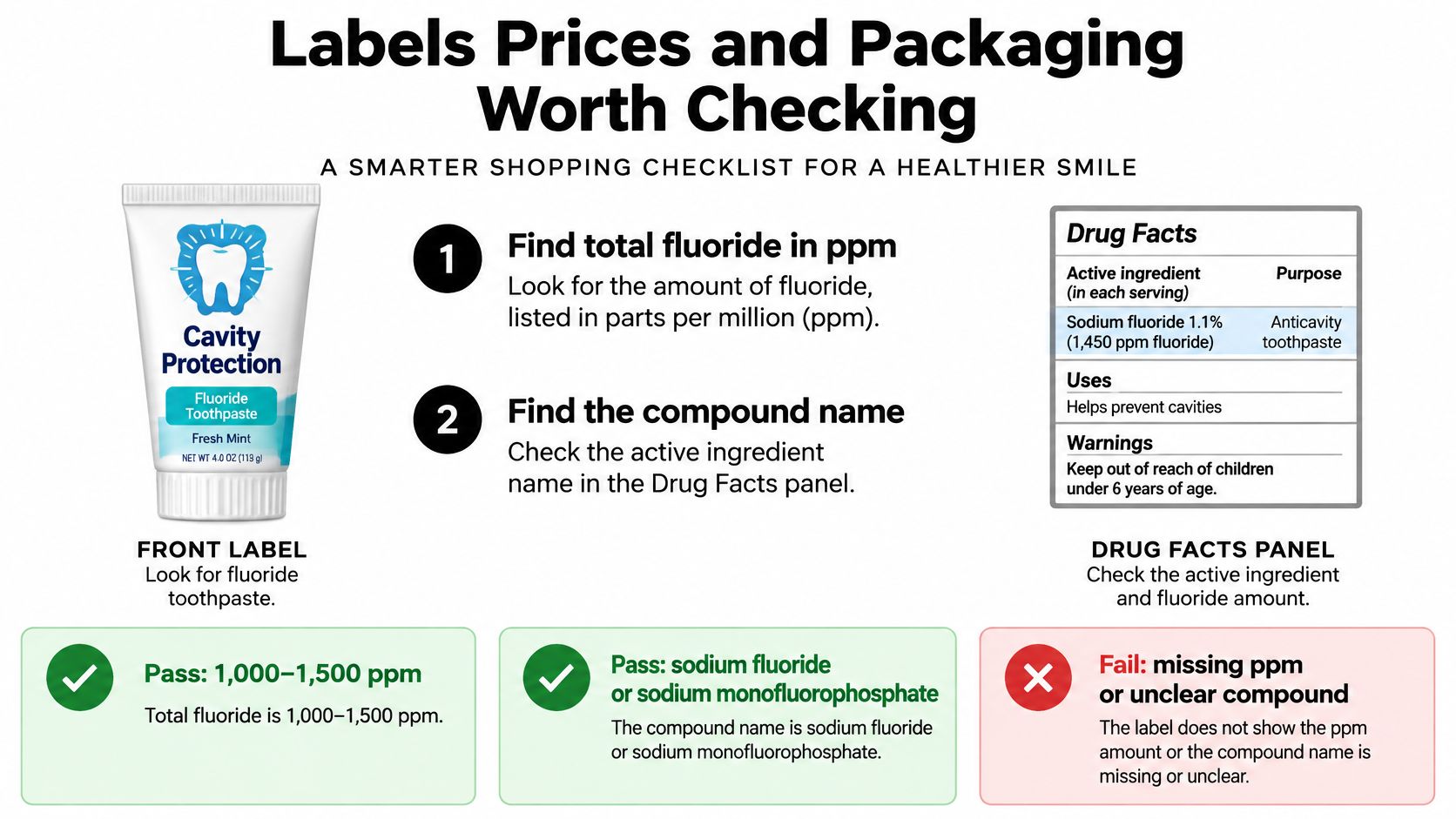
Read the formula before the front-of-pack promise
- Find the fluoride declaration. Look for a clearly stated fluoride-ion concentration. If the label gives only an ingredient percentage, ask the manufacturer to explain the corresponding fluoride concentration rather than calculating from an unclear description.
- Identify the active compound. The ingredient panel should tell you which fluoride compound the product contains. A vague mineral blend isn't enough information to evaluate a fluoride dentifrice.
- Request delivery evidence. Ask whether the company publishes disintegration testing or available-fluoride results for the finished tablet. An ingredient supplier's general brochure doesn't test the product in your tin.
- Read the intended-user instructions. Look for age guidance, preparation directions, spitting instructions, and storage warnings. Don't assume every flavor in a product line carries identical directions.
A claim that a tablet remineralizes teeth doesn't answer all those questions. Nor do references to charcoal, essential oils, or abundant foam replace a clear fluoride declaration.
If the manufacturer can't explain the product's fluoride availability, keep that uncertainty visible in your buying decision. A disintegration claim is weaker than a documented test, and neither alone proves long-term clinical equivalence.
Compare useful portions rather than attractive containers
Check the tablet count and labeled serving size together. A larger-looking jar isn't necessarily a longer-lasting supply, and a refill isn't useful if you need to replace the original container each time.
For price context, DataIntelo's toothpaste-tablet market report estimated an average retail price of USD 9.40–11.50 per unit for fluoride toothpaste tablets. Because the report's unit isn't a standardized tablet count, treat that range as broad retail context, not a cost-per-brushing benchmark.
Use the actual package in front of you to compare value. Divide its price by its labeled brushing portions, and include refill costs where relevant.
Packaging deserves a practical inspection too. Check that the lid closes securely, that the opening lets you remove tablets with dry hands, and that the manufacturer explains how to protect the contents from humidity. Plastic-free packaging doesn't by itself demonstrate lower overall environmental impact.
Buying decision: Accept a clearly named fluoride compound, an appropriate declared concentration, credible breakup information, and packaging you can keep dry.
If an essential detail is missing, don't pay a premium to resolve the uncertainty yourself. Staying with a familiar, appropriate fluoride paste is a reasonable choice.
Who Should Switch and Who Should Stay
The strongest reason to switch is that tablets make a suitable brushing routine easier to maintain. Portability and portioning are practical advantages, not evidence of superior cavity prevention.
The performance benchmark comes from established fluoride care. A review of fluoride's preventive role reports the American Dental Association's estimate that conventional fluoride dentifrices prevent roughly 16%–31% of caries per tooth or surface in children and adolescents, compared with placebo or no dentifrice.
That finding concerns conventional fluoride dentifrices in those populations. It isn't a tablet-specific effectiveness estimate, and a sustainable container can't substitute for evidence that a formulation works.
Readers who may benefit from switching
The commuter who brushes at the office. A securely closed tin may be easier to keep with a toothbrush than a tube that gets squeezed inside a work bag. Switching makes sense if the product passes the formula checks and the commuter can comfortably prepare and spit out the mixture.
The tablet still needs a real brushing opportunity. It isn't a discreet chew-and-swallow substitute for using a toothbrush at a sink.
The adult with stable dental health who wants less disposable packaging. A refillable format can fit that preference without requiring a new reason to use fluoride. Check the refill system, the actual packaging materials, and whether the product remains easy to use when away from your usual bathroom.
Someone who dislikes the gritty preparation stage may brush less carefully or abandon the routine. In that case, keeping an appropriate tube toothpaste is the more useful choice.
Readers who should preserve a treatment plan
The patient using dentist-directed high-fluoride toothpaste. The fluoride review reports that prescription 5,000 ppm toothpaste arrests significantly more root-caries lesions than standard 1,000–1,500 ppm products. An ordinary consumer tablet isn't an equivalent replacement for that prescription.
Dry mouth, exposed roots, recurrent decay, and difficulty maintaining oral hygiene deserve individualized advice. Don't trade a prescribed treatment for a convenient format without the prescriber's agreement.
Sensitivity needs its own assessment too. Fluoride content alone doesn't make a tablet a treatment for every cause of sensitive teeth, and persistent pain shouldn't be managed by repeatedly changing toothpaste. Likewise, don't choose a routine fluoride tablet expecting it to perform the job of a peroxide whitening gel.
For readers considering broader treatment approaches, Longevity Medical Institute's overview of dental care with a regenerative focus is a resource for framing questions at a consultation. It shouldn't be read as evidence that toothpaste tablets can regenerate lost tooth structure or replace needed treatment.
- Consider switching for convenience. Choose tablets when the formula is transparent, handling is comfortable, and the format supports consistent brushing.
- Stay with directed care when risk is the issue. Preserve prescribed fluoride, sensitivity treatment, and child-specific dosing unless your dental professional recommends a change.
At DentalHealth.com, we store every item in a temperature-controlled environment. Whatever format you choose, protect it appropriately after delivery rather than leaving it in a damp bathroom or hot travel bag.
Before changing an established routine, bring the tablet tin or a clear photo of its ingredient and directions panels to your next dental visit. Ask whether its formulation, portion, and preparation suit your cavity risk and any existing treatment.
DentalHealth.com offers professional-grade at-home care, including Fluoridex and MI Paste sensitivity products, whitening options from Opalescence, Zoom, PolaNight, and PolaDay, and retainer-care supplies. Visit DentalHealth.com to compare product descriptions with your dentist's recommendations and choose care for your actual needs, not just a preferred format. We offer free shipping on all USA orders.