
How to Strengthen Enamel Naturally for a Resilient Smile
Strengthening your tooth enamel isn't just about damage control; it's a proactive strategy. It involves a smart combination of a mineral-rich diet, the right oral hygiene habits, and steering clear of the acidic foods that cause erosion in the first place.
The goal is two-fold: protect the enamel you have while giving your body the raw materials it needs to remineralize weakened spots. This all starts with understanding what actually puts your enamel at risk day in and day out.
What Is Tooth Enamel and Why Does It Weaken?
Think of your tooth enamel as your smile's personal body armor. It's the hard, almost translucent outer layer of your teeth, and impressively, it's the single hardest substance in the human body. Its primary job is to shield the sensitive inner layers—the dentin and pulp—from the daily grind of chewing, intense temperatures, and damaging acids.
But for all its strength, enamel isn't invincible. It contains no living cells, which is a critical point. Once it’s physically chipped or significantly worn away, your body can't just grow it back. This is why knowing how to strengthen enamel naturally is so important—it’s all about preservation and repair, not regeneration.
The Primary Causes of Enamel Erosion
While sugar gets a bad rap, the real enemy of your enamel is acid. This acid can come from external sources, like the food and drinks you enjoy, or internal ones, such as acid reflux. When your mouth's pH level drops into the acidic zone, it begins to pull essential minerals right out of your enamel. This process is called demineralization.
Some of the most common culprits that weaken enamel include:
- Acidic Foods and Drinks: Things like citrus fruits, coffee, sodas, and even some "healthy" sports drinks can directly dissolve the enamel surface.
- Frequent Snacking: Constantly grazing, especially on sugary or starchy foods, gives the bacteria in your mouth a non-stop buffet, allowing them to produce more acid and keep your teeth under constant attack.
- Aggressive Brushing: Using a hard-bristled toothbrush or simply scrubbing with too much force can physically wear down your enamel over time. This is often most visible right along the gumline.
- Chronic Dry Mouth: Saliva is your body’s built-in defense system. It masterfully neutralizes acids and washes away food particles. When you don't have enough of it, your teeth are left defenseless.
The key takeaway is that enamel erosion isn't a sudden event. It's a gradual weakening caused by repeated exposure to acids and physical wear, which slowly strips away your teeth's protective shield.
Understanding these daily threats is the first step toward building a proactive defense. You can learn more about specific strategies in our detailed guide on how to prevent enamel erosion.
As your enamel thins, you might start to notice things like increased sensitivity to hot and cold, or maybe your teeth look a bit more yellow as the underlying dentin shows through. Recognizing these early signs gives you the power to make targeted changes to stop the damage and support your body’s amazing natural remineralization process.
Building an Enamel-Friendly Diet
When it comes to strengthening your enamel naturally, what you put on your plate is your first line of defense. Sure, cutting back on sugar is a good start, but a truly effective strategy means actively choosing foods packed with the building blocks your teeth need to remineralize and stay tough.
This isn't about some restrictive, joyless diet. It's about a simple, mindful shift toward nutrient-dense foods. Think of it this way: your saliva is on duty 24/7, trying to deposit crucial minerals like calcium and phosphate back onto your teeth. When you eat the right things, you’re essentially creating a mineral-rich environment in your mouth, giving your saliva the best possible supplies to do its job.
Key Nutrients for a Stronger Smile
To really fortify your enamel, you’ll want to focus on foods high in a few key vitamins and minerals. These nutrients work as a team to support tooth structure and fight back against demineralization.
- Calcium: This is the big one. As the primary component of enamel, calcium is absolutely non-negotiable. Dairy products like cheese and yogurt are fantastic sources, and they have the added bonus of being low in acid.
- Phosphorus: This mineral is calcium's partner in crime, working alongside it to build the strong crystalline structure of your enamel. You can find it in protein-rich foods like eggs, fish, and lean meats.
- Vitamin D: Often called the "sunshine vitamin," Vitamin D is essential because it helps your body actually absorb and use the calcium you're consuming. Fatty fish and fortified milk are excellent dietary sources.
The infographic below really drives home some of the biggest dietary and lifestyle threats to your enamel’s integrity.
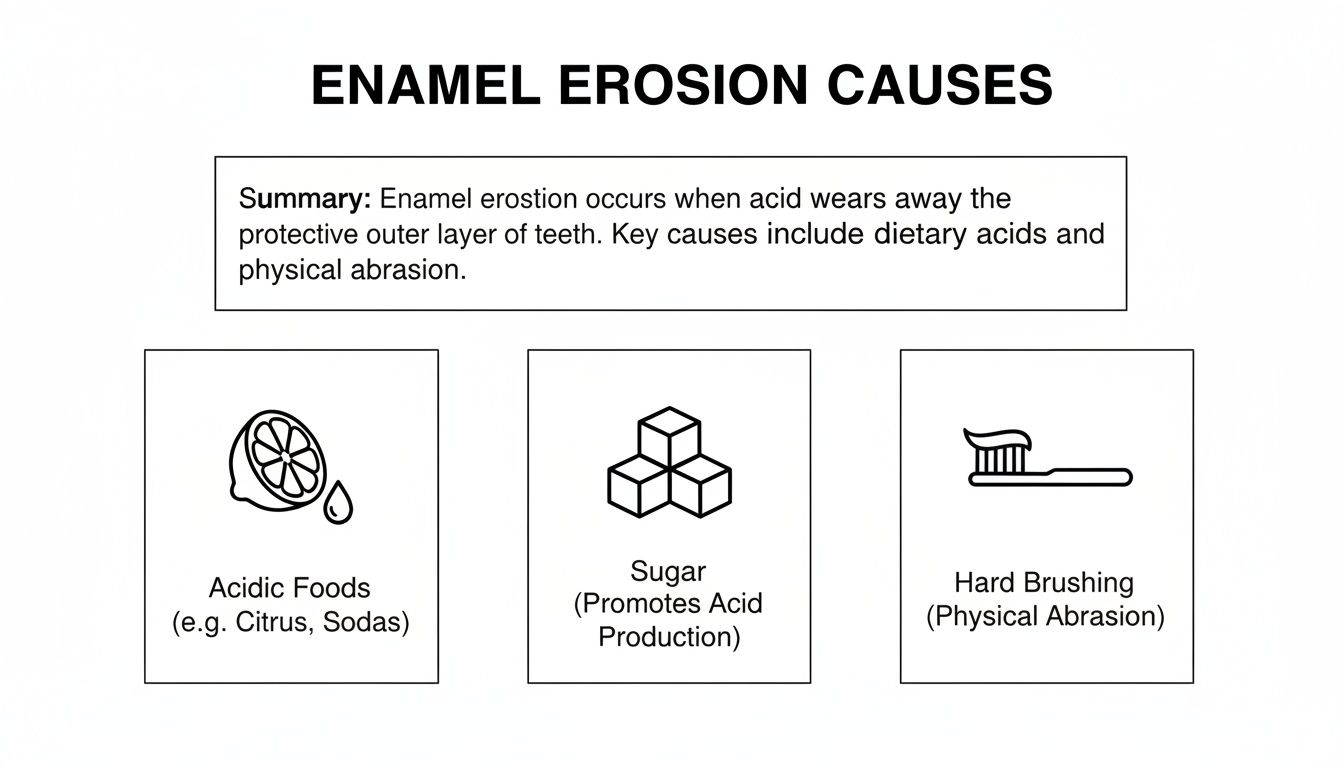
It’s a great visual reminder that beyond just sugar, direct acid attacks from certain foods and physical damage from brushing too hard are major players in enamel erosion.
Smart Swaps and Practical Meal Ideas
Making your diet more enamel-friendly can be surprisingly simple. Instead of grabbing a sugary granola bar for a snack, try a handful of almonds and a piece of cheese. Swap out acidic citrus fruits for a crisp apple, which does double-duty by naturally helping to clean your teeth and stimulating saliva flow.
Staying hydrated is just as important. Sipping water throughout the day, especially right after meals, is a powerhouse habit. It washes away leftover food particles and neutralizes harmful acids, helping to maintain a balanced, healthy environment in your mouth.
To make things even clearer, here’s a quick reference guide to help you identify which foods to add to your diet and which to limit for optimal enamel health.
Enamel-Boosting Foods vs Enamel-Eroding Foods
| Enamel-Boosting Foods (Incorporate) | Why It Helps | Enamel-Eroding Foods (Limit) |
|---|---|---|
| Cheese, Milk & Yogurt | Rich in calcium and phosphates; low in acid. | Sodas & Sports Drinks |
| Leafy Greens (Kale, Spinach) | Packed with calcium and folic acid. | Citrus Fruits (Lemons, Oranges) |
| Crunchy Vegetables (Celery, Carrots) | Stimulates saliva flow; acts as a natural scrubber. | Hard & Gummy Candies |
| Lean Proteins (Fish, Eggs, Tofu) | Excellent sources of phosphorus. | Wine (Red and White) |
| Nuts & Seeds | High in calcium and healthy fats. | Vinegar-Based Dressings |
| Water (especially fluoridated) | Neutralizes acids and rinses away food particles. | Starchy Foods (Chips, White Bread) |
By keeping these food types in mind, you can easily make choices that actively support your teeth instead of working against them.
A simple yet powerful habit is to finish a meal with a glass of water or a small piece of cheese. This helps neutralize any lingering acids and provides an immediate boost of calcium, directly supporting the remineralization process.
Diving deeper into these choices is key, and understanding how diet can impact your oral health in the bigger picture is crucial for building a strong, enamel-friendly regimen. Making these small but consistent changes gives your body the tools it needs to strengthen enamel from the inside out, creating a more resilient and healthier smile for years to come.
Fine-Tuning Your Daily Oral Hygiene Routine
What you eat is only half the battle; how you clean your teeth is just as crucial for protecting your enamel. It's surprisingly easy to scrub away that precious protective layer with an aggressive approach or the wrong tools, completely undoing all your other good efforts. Simply refining your technique is one of the most powerful changes you can make for your long-term dental health.
Many of us grew up thinking that harder scrubbing means cleaner teeth. But in reality, that kind of mechanical abrasion is a leading cause of enamel wear and gum recession. The goal isn't to scour your teeth—it's to gently disrupt and remove plaque.
Master the Right Brushing Technique
Switching to a gentler, more effective method is key. The best approach involves just a few small adjustments that make a huge difference in protecting your enamel while still getting a thorough clean.
- Go for a Soft-Bristled Brush: This is non-negotiable. A brush with soft or extra-soft bristles is all you need. Hard bristles are far too abrasive for daily use and can cause serious damage over time.
- Get the Angle Right: Position your brush at a 45-degree angle to your gumline. This simple trick allows the bristles to sweep away plaque from both the tooth surface and that little crevice right under the gums where it loves to accumulate.
- Use Gentle, Circular Motions: Forget that aggressive back-and-forth sawing motion. Instead, use short, gentle, circular strokes. This technique is incredibly effective at lifting plaque away without putting unnecessary force on your enamel.
A solid daily routine is your best defense, and you can learn more about how to prevent tooth decay naturally to protect your enamel from the inside out. Of course, the right toothpaste is another piece of the puzzle. For more on that, check out our guide to choosing the best fluoride toothpaste for adults.
Why Timing Is Everything
When you brush matters just as much as how you brush. After you have something acidic—like orange juice with breakfast or a salad with vinaigrette—your enamel temporarily softens. If you brush right away, you're essentially scrubbing away minerals while your teeth are in that vulnerable state.
Wait at least 30 to 60 minutes after an acidic meal before you brush. This gives your saliva—your body’s amazing natural defense system—time to neutralize the acids and allow the enamel surface to reharden.
If you can't stand the feeling and want to clean your mouth right after eating, just rinse and swish with plain water. It will help wash away acids and leftover food particles without causing any mechanical damage, keeping your smile strong and intact.
Using Advanced Products for Natural Remineralization
Sometimes, your daily routine needs a powerful ally. While diet and proper hygiene are the foundation of enamel health, modern dental science has given us some incredible products that work with your body’s natural processes to remineralize your teeth.
These aren't just your average toothpastes. They're targeted treatments, specifically designed to deliver the essential minerals your enamel is missing—right where they're needed most.
Think of it like fertilizing a garden. Your saliva does a pretty good job of spreading nutrients around, but a specialized formula can deliver a concentrated dose of minerals to patch up weakened spots and encourage more robust strength. Two of the most effective ingredients leading this charge are nano-hydroxyapatite (nHA) and casein phosphopeptide-amorphous calcium phosphate (CPP-ACP).
Understanding the Key Ingredients
Nano-hydroxyapatite (nHA) is a game-changer. It's a synthetic version of the exact mineral that makes up the bulk of your natural enamel and dentin. Because it’s biocompatible and mimics your tooth’s natural structure, it can bond directly to the enamel surface. When you use it in a toothpaste or mouthwash, these tiny particles fill in microscopic scratches and pits, effectively smoothing and rebuilding that outer layer.
Then you have casein phosphopeptide-amorphous calcium phosphate (CPP-ACP). It’s a milk-derived protein that acts as a mineral super-transporter. It stabilizes calcium and phosphate ions and keeps them soluble. When you apply a product with CPP-ACP, it releases this bio-available mineral payload right onto your teeth, bathing your enamel in the building blocks it craves for remineralization.
Putting CPP-ACP to Work with MI Paste
One of the most well-known products that uses this technology is MI Paste. It’s a topical tooth crème you apply directly to your teeth after brushing. The CPP-ACP technology, which is branded as RECALDENT™, delivers that concentrated dose of calcium and phosphate that can penetrate the enamel and help rebuild its mineral density from the inside out.
MI Paste is especially helpful in situations where enamel is most vulnerable. For instance, it’s excellent for managing the sensitivity that can flare up after a professional whitening treatment. It's also great for helping prevent the white spot lesions that are so common during orthodontic care with braces.
Did you know tooth enamel is the hardest substance in your body? But once it's gone, it can't regenerate. It can, however, be remineralized. Products like MI Paste Plus, which combines CPP-ACP with fluoride, are remarkably effective at this. A review of studies found that over three months, MI Paste Plus reduced the area of early enamel defects (those white spot lesions) by an impressive 65%. The control group? Just 7%.
Choosing the Right Product for Your Needs
Bringing these advanced products into your routine can give your efforts to strengthen enamel a serious boost. Here’s a quick guide to help you decide what might be right for you:
- For General Enamel Strengthening: A daily toothpaste containing nano-hydroxyapatite is a fantastic choice for everyday maintenance and repair.
- For Post-Whitening Sensitivity: Applying a product like MI Paste can soothe that zinging sensitivity by plugging the microscopic tubules in your dentin that have become exposed.
- For Orthodontic Patients: Using a CPP-ACP crème helps prevent demineralization around brackets where plaque loves to accumulate.
By understanding these powerful ingredients, you can make smarter choices for your oral care. To dive deeper into how MI Paste works, check out our guide on the benefits of this remineralizing crème. These products bridge the gap between everyday prevention and professional treatments, giving your teeth the extra support they deserve.
The Future of Enamel Regeneration Technology
While all the strategies we’ve covered focus on protecting and remineralizing the enamel you already have, the world of dental science is chasing a much bigger goal: true regeneration.
Current methods are fantastic for repair work, but they can't bring back enamel that's been completely worn away. That might be about to change, thanks to some groundbreaking research that feels like it’s straight out of science fiction.
Biomimetic Gels and Peptides
One of the most exciting frontiers involves biomimetic materials—substances engineered to mimic natural processes in the body. Researchers are developing special gels that, when painted onto a tooth, can actually kickstart the growth of a brand-new layer of enamel-like crystals. This new layer fuses with your existing tooth structure, essentially rebuilding the damaged surface from the ground up.
Another incredible development is coming out of the University of Washington. Picture a simple lozenge that rebuilds your enamel as it dissolves. It's not a dream. Researchers there are running clinical trials on a genetically engineered peptide made from amelogenin, the essential protein your body uses to form enamel in the first place.
The idea is that taking just two of these lozenges a day could deposit several micrometers of new enamel. This new layer binds to damaged spots and even integrates with the dentin underneath. You can read more about this groundbreaking lozenge research here.
These advancements are incredible, but it's important to remember they are still on the horizon. For now, protecting the enamel you have with a smart diet, proper hygiene, and proven remineralizing products is the most powerful thing you can do for your smile.
These emerging technologies signal a major shift in dentistry, moving from defense and repair to outright regeneration. Knowing what’s coming just reinforces how important it is to preserve your natural enamel today, keeping your smile healthy and strong for the next generation of treatments.
Knowing When to Consult Your Dentist
While you can do a lot at home to strengthen your enamel, it’s important to know when it’s time to call in a professional. At-home care has its limits, and ignoring the signs that you need a dentist can lead to bigger, more complex problems down the road.
Think of it as a partnership. Your daily habits are your first line of defense, but your dentist has the tools and treatments to step in when enamel loss becomes more serious. If you notice any of these persistent or concerning symptoms, it’s time to schedule an appointment.
Signs It’s Time for a Dental Visit
Some symptoms are clear red flags that your enamel is compromised and needs a professional eye. Don't make the mistake of waiting for the pain to become severe before you pick up the phone.
Keep an eye out for these key warning signs:
- Persistent Sensitivity: A sudden, sharp pain when you eat or drink something hot or cold is the classic sign of thinning enamel. If it sticks around, it’s not something to ignore.
- Visible Changes: Take a close look at your teeth. If you see small chips, cracks, or little indentations (what we call cupping) on the chewing surfaces, it points to structural weakness.
- Yellowing Appearance: As enamel wears away, the yellowish layer underneath, called dentin, starts to show through more. This can make your smile look discolored and dull.
A proactive visit for something as simple as sensitivity can be the difference between a quick fluoride treatment and needing more extensive restorative work later on. These early warnings are your teeth asking for help.
During your exam, your dentist can figure out exactly how much damage has been done. For moderate enamel loss, they might suggest something simple like a high-concentration fluoride varnish to rapidly remineralize the surface.
If things are more advanced—like if you have chips or significant wear—they might look at treatments like dental bonding (where a tooth-colored resin is applied) or veneers. These options not only restore your tooth’s shape but also provide a strong, protective shield for the future. Knowing these signs empowers you to get the right care at the right time.
Answering Your Top Questions About Strengthening Enamel
When you're trying to improve your enamel health, a few questions always seem to pop up. Let's tackle some of the most common ones I hear so you can feel more confident about your daily routine.
Can You Actually Regrow Tooth Enamel?
This is probably the number one question people have. The straightforward answer is no, you can't regrow enamel that has been physically worn away. Unlike bone, enamel has no living cells, so once it's gone, your body can't make more.
But—and this is a big but—you absolutely can repair and strengthen weakened spots. This process is called remineralization, and it's your best defense against cavities. You're essentially rebuilding the mineral structure in areas that have started to break down.
Will Whitening Toothpaste Damage My Enamel?
It's a valid concern. Some older whitening formulas relied on harsh abrasives that could wear down enamel over time, especially with aggressive brushing.
Thankfully, most modern whitening toothpastes are much gentler and focus on lifting surface stains without scrubbing your teeth raw. The key is to always pair them with a soft-bristled brush. If your teeth are already sensitive, a great strategy is to alternate between a whitening paste and a dedicated remineralizing toothpaste.
The Big Picture: Think of enamel care as a game of defense and repair, not replacement. The goal is to halt the demineralization process and give your teeth the minerals they need to patch up weakened areas before they become cavities.
Is a Healthy Diet Enough on Its Own?
Diet is the foundation, but it can't do the job alone. While eating mineral-rich foods provides the raw materials—like calcium and phosphate—it's only half the battle.
Your oral hygiene routine and the products you use are the "construction crew" that puts those building blocks to work. Consistent, gentle brushing and targeted products like MI Paste or a high-fluoride toothpaste are what actually help those minerals get back into the tooth structure. They create a powerful synergy that makes your healthy diet far more effective.
At DentalHealth.com, we take the guesswork out of finding professional-grade products that support your natural remineralization efforts. We've curated a selection of top-rated sensitivity toothpastes and remineralizing pastes from the brands dentists trust.
Find the perfect products to protect your smile today at DentalHealth.com.