
Is Zoom Whitening Worth It? Costs and Results
You've got a wedding, interview, holiday, or important photograph coming up, and your smile looks darker than you'd like. A dental office offers Philips Zoom whitening and promises a dramatic result in one appointment. Online kits cost less upfront and let you whiten privately at home. The question isn't just “is Zoom whitening worth it?” It's whether the speed and supervision justify the premium once you account for sensitivity, maintenance, and the cost spread across the months you enjoy the result.
Zoom can make sense for a fast, noticeable change, especially when a dentist has confirmed that your teeth and gums are suitable for whitening. A professionally supervised take-home protocol can be the more practical choice when you have time, want greater control over sensitivity, or plan to maintain the shade gradually.
| Decision factor | In-office Zoom | Professional take-home whitening |
|---|---|---|
| Main advantage | Fast, supervised shade improvement | Flexible treatment and easier maintenance |
| Delivery | Dentist-applied gel with soft-tissue protection | Custom trays and dentist-selected gel |
| Best fit | An approaching event or immediate cosmetic priority | Gradual whitening, sensitivity control, and upkeep |
| Main trade-off | Higher upfront cost and possible temporary sensitivity | Requires consistency and patience |
| Long-term value | Strongest when paired with take-home maintenance | Strong when trays can be reused for appropriate touch-ups |
The In-Office Versus At-Home Whitening Dilemma
A patient with an event approaching often wants certainty. They don't want to remember a tray routine every evening or wonder whether a strip is reaching the back teeth evenly. They want to leave the practice with a visibly brighter smile and no unfinished treatment plan hanging over the calendar.
That's where an in-office system such as Zoom has a clear practical advantage. The dental team checks for untreated problems, protects the gums, applies the whitening gel, and controls the exposure. You trade a higher upfront fee for speed, supervision, and a result delivered in a defined appointment.
Another patient may have no deadline at all. They might prefer professional take-home trays because they can whiten in shorter, controlled sessions and stop temporarily if the teeth become uncomfortable. For that person, gradual progress isn't a compromise. It's a way to manage the process around work, meals, travel, and sensitivity.
Practical rule: Choose the appointment for urgency. Choose professional take-home trays for control and repeatable maintenance.
Start with the reason you want whitening
Ask yourself what problem you're solving:
- An imminent event: In-office treatment may justify its premium because the timeline matters more than flexibility.
- A general cosmetic refresh: Take-home whitening can provide a measured routine without paying primarily for speed.
- A history of sensitivity: A supervised plan, often with a gentler take-home schedule, gives you more opportunities to adjust exposure.
- Uneven or complex discoloration: A dental examination matters before choosing a product, since whitening won't correct every cause of darkening.
The color of existing fillings, crowns, and veneers also affects expectations. Natural enamel can respond to peroxide, but restorations generally won't change shade in the same way. A dentist may recommend whitening before replacing visible restorations so the new shade can be selected after whitening.
If you're researching the procedure itself, this overview of Zoom teeth whitening can help you understand how professional and at-home approaches differ. If the concern is exposed roots or gum recession rather than enamel color, whitening may not be the first priority. A periodontal consultation, including information about soft tissue grafting solutions, may be more relevant.
Clinical Efficacy and Shade Improvement Data
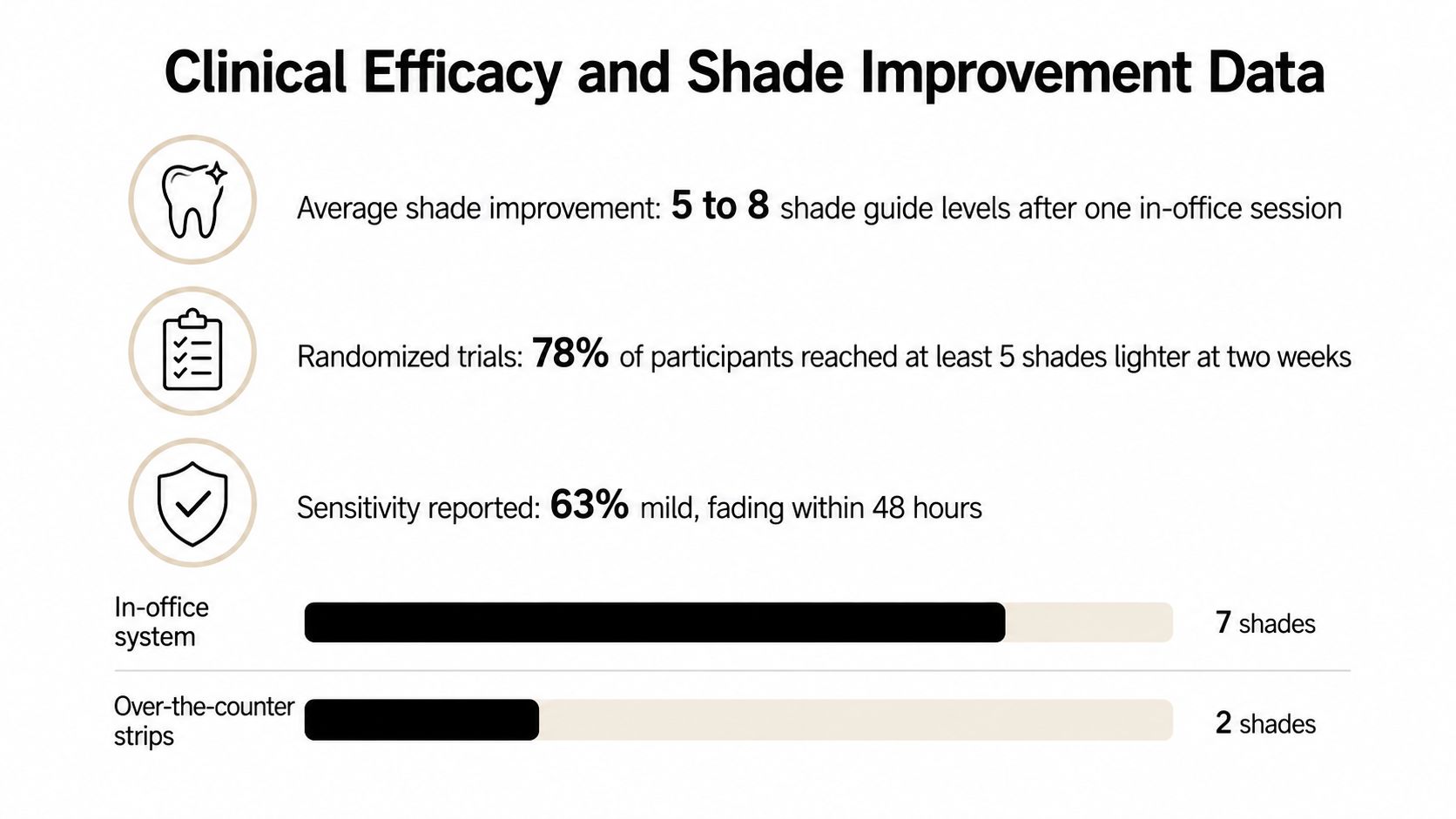
The clinical case for Zoom is stronger than a simple claim that a lamp makes teeth whiter. In a 2018 randomized clinical trial, Philips Zoom WhiteSpeed produced statistically better results than Opalescence Boost. The reported mean change was -7.8 shades for Zoom at Day 7, compared with -6.8 shades for Opalescence Boost, according to the published Philips clinical trial.
Both products produced whitening of between 6 and 9 shades, and Zoom remained approximately 1 to 2 shade-guide steps ahead at the measured time points in that trial. That distinction matters. It shows a measurable advantage, but it doesn't support the idea that competing professional systems fail to work. The premium buys a stronger result within the comparison, not an entirely different category of outcome.
What the trial results mean in practice
Shade-guide movement is useful, but patients don't experience a number in isolation. They notice contrast with existing restorations, the visibility of stains, the shade of the lower teeth, and how the smile looks under ordinary lighting. A person starting with deep external staining may see a more dramatic visual change than someone whose teeth are already relatively light.
A separate Philips comparison also reported that Zoom was about 1 to 2 shade-guide steps better than Opalescence Xtra Boost at all measured time points, while both systems delivered roughly 6 to 9 shades of improvement and showed no statistical difference in induced sensitivity. The comparative in-office whitening study therefore supports a balanced conclusion: Zoom performs very well, but the gap between reputable professional systems is narrower than many advertisements imply.
The evidence is most persuasive for patients who value maximum immediate improvement in one appointment. It's less decisive for someone who can tolerate a slower routine, because the alternative may produce a satisfactory shade without paying for chairside speed.
Immediate brightness isn't the entire outcome
A clinical summary reported minimal shade fade-back immediately after Zoom treatment and maintenance of that result at 7 and 14 days when the protocol was paired with take-home carbamide peroxide. That pairing is important. It suggests the strongest value may come from a coordinated system, not from treating the office appointment as a completely standalone cosmetic event.
The practical question is therefore not, “Does Zoom work?” It does. The better question is, “How much do I value the incremental shade improvement and speed compared with a professionally guided home plan?” For some patients, that difference is worth paying for. For others, the financial advantage lies in using the dental appointment to establish a result and the trays to maintain it.
Comparing Professional Take-Home Alternatives
Professional take-home whitening uses the same broad chemistry as chairside treatment, but the delivery method changes the experience. A dentist or dental retailer may provide custom trays and a selected gel such as carbamide peroxide or hydrogen peroxide. The tray holds the material against the tooth surfaces, while the patient controls when to wear it and when to pause.
Custom fit matters because excess gel can irritate the gumline, while poor coverage can create uneven whitening. A properly made tray also gives the patient a repeatable way to maintain the result later, provided the dentist confirms that continued use is appropriate.
| Feature | In-Office, such as Zoom | Take-Home, such as Opalescence or PolaDay |
|---|---|---|
| Treatment setting | Dental practice | Patient's home |
| Application | Clinician places and manages the gel | Patient loads and wears the tray |
| Timing | Concentrated appointment | Spread across a prescribed routine |
| Control | Dentist controls isolation and exposure | Patient can pause or shorten use |
| Main benefit | Speed and supervised delivery | Flexibility and maintenance potential |
| Main limitation | Higher upfront premium | Requires adherence and correct application |
| Best use | Fast cosmetic change | Gradual whitening and ongoing touch-ups |
Why gradual whitening can be clinically useful
At-home treatment gives sensitivity-prone patients more control. If a tooth reacts, the patient can stop, use a dentist-recommended desensitizing product, and resume only after the discomfort settles. That doesn't remove the need for professional advice, but it makes the routine easier to adjust than a single concentrated appointment.
The tray also supports maintenance. Once the initial whitening phase is complete, the same appliance may be used for appropriate touch-ups, although the dentist should determine the product, frequency, and exposure time. Store-bought strips can be convenient, but they may not cover every tooth evenly and don't provide the same individualized fit.
Take-home whitening isn't automatically gentle or risk-free. Strong gels can still cause sensitivity or gum irritation, especially when the tray is overloaded or worn longer than directed. The advantage is control, not permission to improvise.
For patients comparing Zoom products with other professional options, the important details are the active ingredient, concentration, wear instructions, tray quality, and maintenance plan. A lower or moderate concentration used correctly may offer a better overall experience than a stronger product used inconsistently.
Managing the Sensitivity Trade-Off
Sensitivity is the most common reason patients reconsider whitening. The discomfort usually feels like a brief sharp response to cold air, water, or food. It can occur because peroxide moves through enamel and dentin toward the pulp, where the tooth's nerves respond to temporary changes.
Higher concentration doesn't automatically mean better value. An independent umbrella review found that hydrogen peroxide in approximately the 25% to 35% range produced whitening outcomes comparable to higher 35% to 40% concentrations, while the higher concentrations mainly increased the incidence and intensity of sensitivity. The independent review of whitening evidence supports a more useful principle: the delivery protocol and exposure control can matter as much as chasing the strongest available formula.
How the two formats handle discomfort
In-office treatment allows the clinician to isolate soft tissue and monitor the application. Professional systems commonly use controlled cycles lasting approximately 20 to 30 minutes, which can make the session efficient while limiting unnecessary exposure. Philips states that sensitivity remains a possible risk, although it usually fades within 1 to 3 days or 24 to 48 hours, as described in its teeth-whitening safety guidance.
Take-home treatment offers a different advantage. You can stop as soon as discomfort starts rather than completing a fixed chairside cycle. The trade-off is that you must follow the instructions accurately, keep gel away from the gums, and avoid extending wear time in an attempt to accelerate the result.
A workable sensitivity plan
Before whitening, tell the dentist if you already react to cold, have gum recession, cracked teeth, recent fillings, or untreated decay. Whitening can make an existing problem more noticeable, and peroxide won't repair the underlying cause.
During treatment, use a desensitizing toothpaste or gel if your dental professional recommends it. Products containing potassium nitrate can reduce nerve response, while fluoride may help support the enamel surface. Don't combine several strong whitening products without guidance, and don't treat lingering or severe pain as a normal cosmetic side effect.
For a practical discussion of why some patients say Zoom whitening hurts, focus on exposure, tray fit, baseline sensitivity, and the condition of the teeth rather than assuming every reaction reflects a product failure.
Longevity and True Cost-Per-Month Analysis
A whitening decision becomes clearer when the calendar replaces the mirror. The day-one shade is only one part of value. You also need to consider how often you'll need maintenance, whether the original trays can support that maintenance, and how quickly diet, smoking, coffee, tea, or natural aging affect the color.
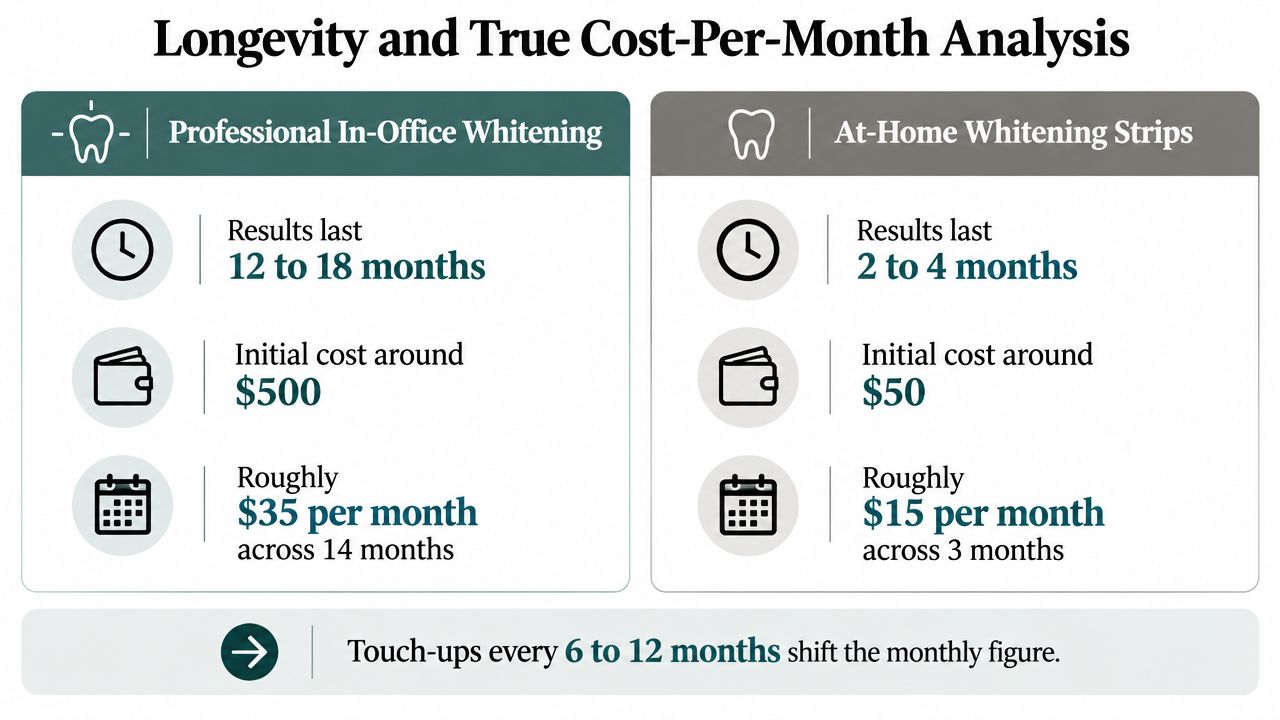
A retrospective study of a combined Philips Zoom in-office and take-home protocol reported that 99.1% of participants' teeth reached very light final shades. Within that group, 80.2% reached B1 and 18.9% reached A1, while 0.9% reached A2. The study also reported immediate post-whitening sensitivity in 1.8% of patients and concluded that the results lasted up to 12 to 15 months after whitening, as documented in the clinical publication record.
Why published durability doesn't equal a guarantee
The study supports the durability of a combined protocol, not a promise that every standalone Zoom appointment will remain unchanged for the same period. Individual results depend on the original stains, enamel, diet, oral hygiene, tobacco exposure, and whether the patient follows the recommended maintenance plan.
That's why cost-per-month should be calculated from the full protocol. Add the office treatment, any take-home gel, replacement trays if needed, and later touch-ups. A cheaper product can become less attractive if you need repeated purchases to preserve a shade, while a premium treatment can lose value if you never use the maintenance system provided.
A better financial question: What will I spend to maintain a satisfactory shade, not merely to achieve the first bright result?
Build the maintenance plan before treatment
Ask the practice whether the package includes take-home trays or gel. Ask how long the dentist expects the result to remain noticeable for someone with your staining habits, and ask what to do if sensitivity appears during a touch-up.
The professional whitening cost discussion is useful for framing the purchase, but your own quote and maintenance schedule will determine the actual monthly figure. Don't use generic pricing as a substitute for a written treatment plan.
The most economical strategy for many patients is a combined protocol. The office session supplies the immediate change, while professional take-home materials help preserve it without repeating the full chairside fee every time the shade softens. That approach makes Zoom more defensible as a long-term purchase, provided you use the maintenance products responsibly.
Situational Recommendations for Every Patient
The right protocol depends less on the product label than on your deadline, sensitivity history, and willingness to maintain the result. Use the following profiles as a starting point, then have a dental professional confirm that whitening is safe for your mouth.

If an event is close
Choose in-office Zoom when the priority is a rapid, supervised improvement and you accept that temporary sensitivity is possible. Schedule early enough to discuss your dental history and allow time to manage any reaction before the event. Don't wait until the last moment if you have untreated dental concerns or a history of strong sensitivity.
If you have a flexible timeline
Choose professional take-home trays when you'd rather control the pace than pay for speed. Follow the prescribed wear schedule, use only the recommended amount of gel, and keep the trays clean. This option is especially practical when you want an appliance that can support future maintenance under dental guidance.
If your budget is limited
Ask for a staged plan rather than comparing only the first invoice. A dentist may recommend take-home whitening first, followed by selective maintenance, instead of an immediate chairside appointment. The key is to compare the total treatment and upkeep plan, not just the price of one box or one visit.
If sensitivity is your main concern
Start with an examination and a conservative protocol. Your clinician may recommend desensitizing toothpaste, fluoride support, shorter exposure, lower concentration, or a pause between applications. Don't whiten over unexplained pain, exposed roots, cracks, or untreated decay.
Over-the-counter products can serve as occasional maintenance for some people, but they aren't a substitute for diagnosis or custom fit. If you buy professional-grade gels or sensitivity products online, follow the product instructions and any advice from your dentist. DentalHealth.com is one retailer that offers professional brands including Philips Zoom, Opalescence, PolaDay, Fluoridex, and MI Paste for at-home oral care.
Frequently Asked Questions About Whitening Protocols
Can I combine Zoom in-office treatment with take-home trays?
Often, a combined plan is intentional rather than redundant. The office treatment creates the initial change, while dentist-approved take-home gel supports maintenance. Wait for the schedule your dental professional provides, because applying more peroxide immediately doesn't guarantee a better result and may increase irritation.
Will whitening change my crowns, veneers, or fillings?
Whitening affects natural tooth structure, not most existing restorations. If a visible crown or veneer matches your current teeth, whitening may create a mismatch. Dentists commonly assess the desired final shade before recommending replacement of a visible restoration.
What should I eat after whitening?
Follow your practice's post-treatment instructions. Many clinicians recommend avoiding strongly colored foods and drinks for a short period after treatment, while also limiting very hot or cold items if sensitivity is present. Don't treat a generic food list as more important than advice based on your teeth and the specific protocol used.
How do I know whether Zoom is worth it for me?
Zoom is most defensible when immediate shade improvement and professional supervision matter more than the upfront premium. A professional take-home system may offer better practical value when you have time, want to adjust exposure, or expect to maintain your smile over the long term.
DentalHealth.com offers professional-grade at-home whitening gels, kits, sensitivity products, and practical guidance for maintaining a brighter smile between dental visits. Visit DentalHealth.com to compare dentist-associated whitening options and build a maintenance routine that fits your sensitivity needs and timeline.