
Oral Care Subscription: A Practical 2026 Guide
You're getting ready for bed, squeezing the toothpaste tube from the bottom, and getting nothing. The spare you thought was under the sink isn't there. Tomorrow, you'll buy whatever's available rather than the product you meant to use.
The Moment Your Toothpaste Runs Out and What Comes Next
An oral care subscription promises to remove that scramble. Your chosen products arrive on a schedule, and you stop relying on memory, last-minute shopping, or a reminder from an empty tube.
That's a useful service. It's also a narrower service than some subscription marketing suggests. A delivery can put toothpaste in your bathroom, but it can't tell whether you're using the right amount, whether your whitening routine should stop, or whether new sensitivity needs a dental examination.
Buy continuity, not an overflowing cabinet
Consider a household sharing toothpaste but using separate whitening and retainer-care products. The toothpaste may need steady replenishment, while the whitening gel gets used intermittently and the retainer cleaner follows another schedule entirely. Shipping everything together at the same frequency is convenient for the seller, not necessarily for that household.
The sensible starting point is your existing routine, not the subscription bundle. Keep the products you use, identify which ones run out predictably, and leave occasional purchases outside the recurring order.
Practical rule: Subscribe to a demonstrated need, not an intended habit.
Before committing, look at what's already in your cabinet:
- Nearly empty essentials: These are the strongest candidates for scheduled delivery.
- Unopened duplicates: These suggest your buying frequency already exceeds your use.
- Treatment-specific products: Keep these tied to professional instructions rather than automatic replacement.
The promise should be dependable access to the products you've chosen, including dentist-recommended brands where appropriate. It shouldn't be a growing collection of products you feel obliged to finish.
A good plan solves the replenishment problem. You notice that your usual toothpaste is available when you need it, not that another box has arrived.
What an Oral Care Subscription Actually Is
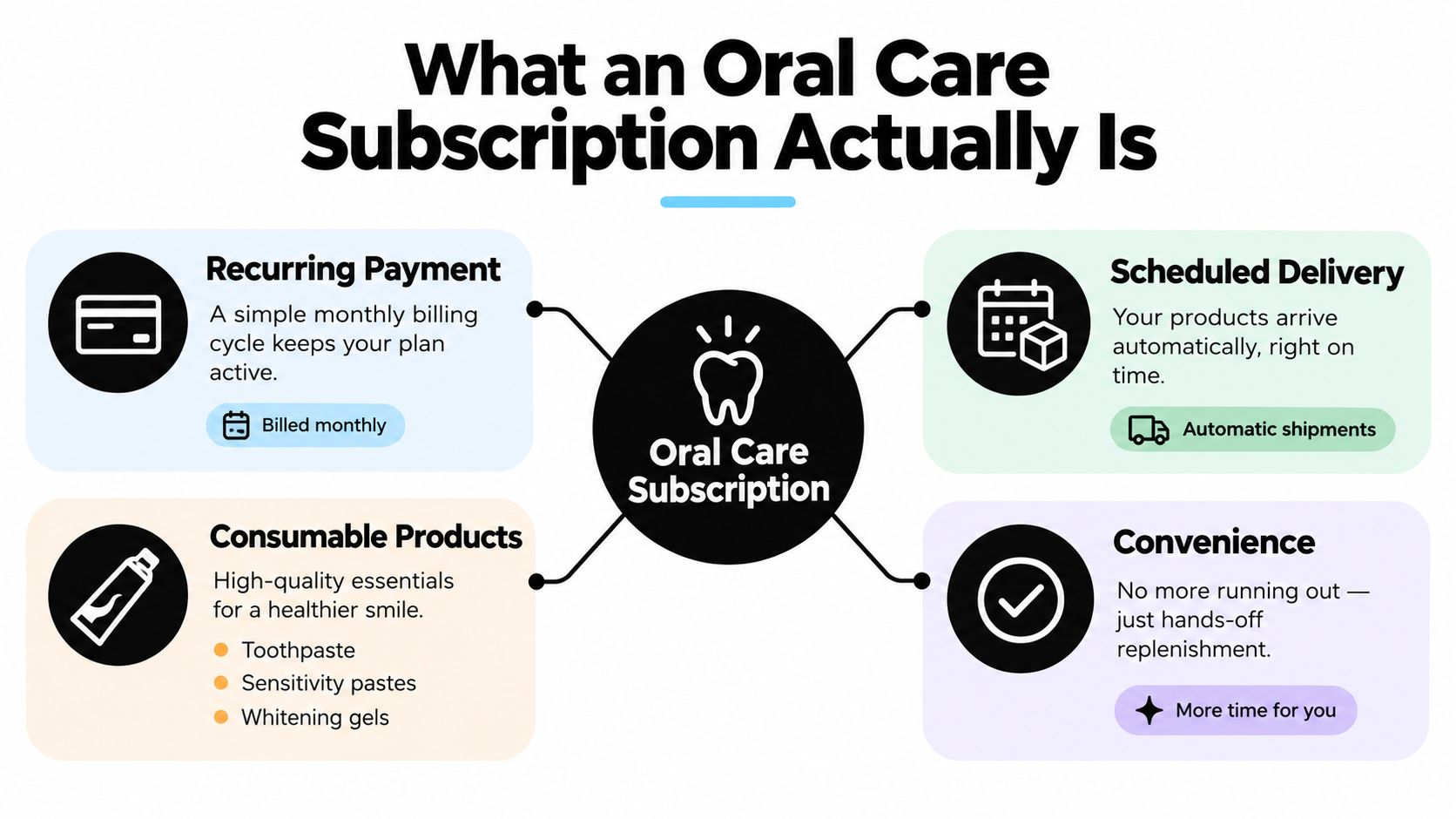
An oral care subscription is a recurring payment for scheduled delivery of consumable dental products. Depending on the retailer, that might mean toothpaste, sensitivity pastes, rinses, whitening gels, remineralizing products, or aligner and retainer maintenance supplies.
It belongs to the broader subscription economy, not to a separate category of clinical treatment. Commercial industry estimates describe oral-care subscription growth alongside the expansion of direct-to-consumer purchasing, but those estimates shouldn't be mistaken for official measures of preventive care or patient outcomes (subscription use cases and industry estimates).
Read the operating terms before the product description
Every plan comes down to a small set of practical variables:
- Frequency: How does the seller determine the delivery interval, and can you change it?
- Customization: Can each item follow its own schedule, or must the entire bundle renew together?
- Shipping: What will delivery cost, when does an order become final, and what happens if it's delayed?
- Cancellation and account control: Can you skip, pause, edit quantities, or end recurring charges without a drawn-out support exchange?
Don't treat those details as administrative fine print. They determine whether the service can follow your routine when your household changes, you travel, or you stop using a particular product.
Also distinguish the billing date from the shipment date. Knowing when a charge happens isn't enough if you don't know the deadline for changing the order.
My recommendation is to review the account controls before enrolling, just as carefully as you review the ingredients. If the seller explains automatic renewal clearly but makes stopping it difficult to understand, choose another arrangement.
A subscription remains a replenishment service even when it's configured well. Thoughtful controls can help support preventive habits, but they don't convert product delivery into clinical care.
Benefits and Drawbacks Worth Naming Out Loud
The strongest reason to subscribe isn't the box or the discount. It's maintaining access to an appropriate product without repeated shopping decisions.
For fluoride toothpaste, the preventive benefit belongs to the product and its correct use. The ADA summarizes studies in children and adolescents showing caries prevention ranging from 16% per tooth to 31% per surface compared with placebo or no dentifrice; its guidance also specifies no more than a smear for children under three and a pea-sized amount for ages three to six, with supervision to spit rather than swallow (ADA toothpaste evidence and age-specific guidance).
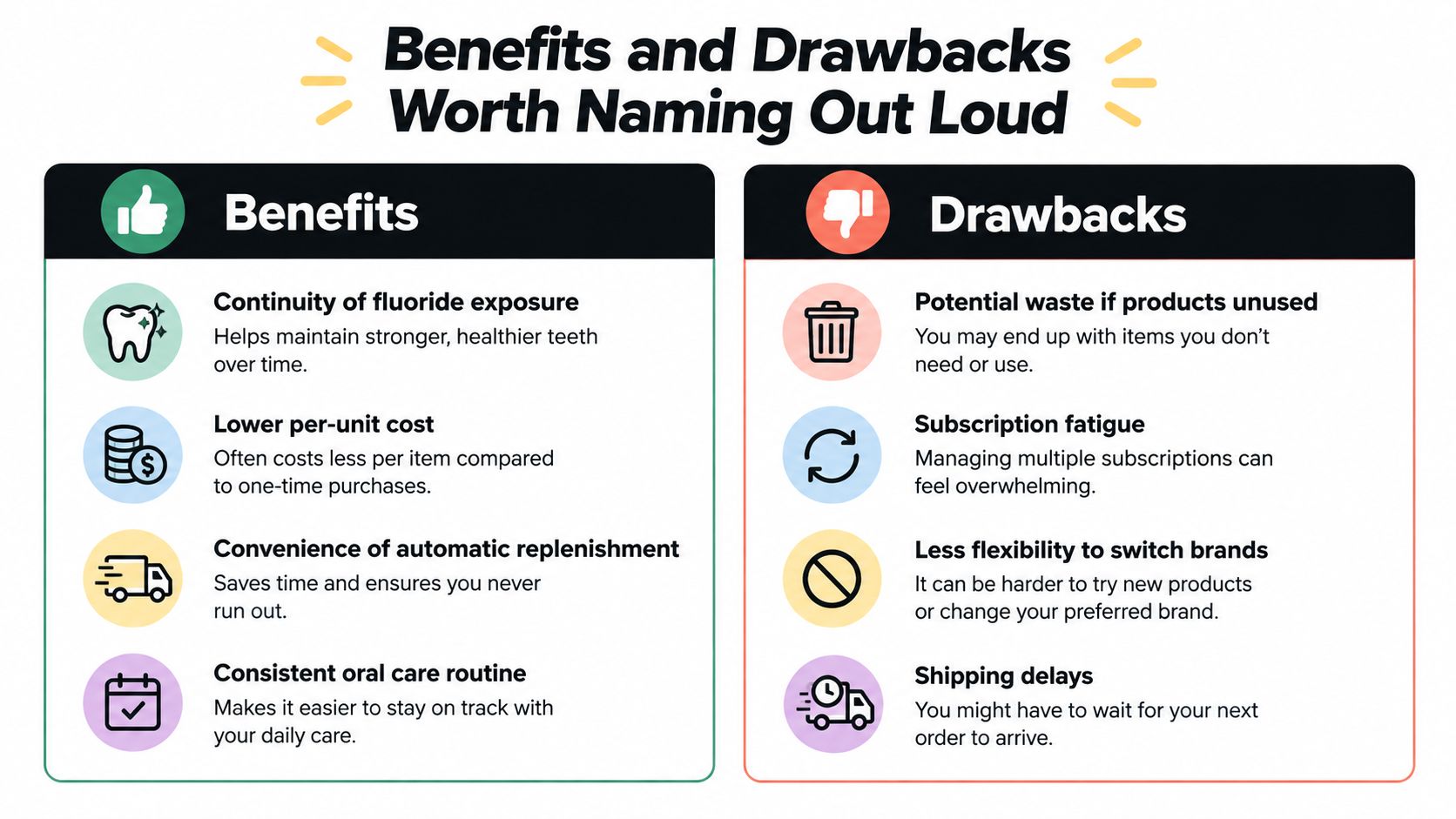
| Potential benefit | Trade-off to examine |
|---|---|
| Product continuity: Your selected toothpaste stays available. | A full cabinet doesn't prove that anyone is using it correctly. |
| Potentially lower unit prices: A bundle may cost less than separate purchases. | Unused items can erase the apparent saving. |
| Predictable purchasing: You know which essentials are coming. | Recurring charges become a burden when cancellation is awkward. |
| Convenient brand access: You can reorder a chosen professional-grade product without another shopping trip. | Automatic substitutions may change the formulation you intended to receive. |
| Fewer separate orders: Compatible items can arrive together. | Extra packaging and unwanted products still create waste. |
Separate product benefit from delivery benefit
A subscription can make an established routine easier to maintain. It doesn't establish that routine for you, and it shouldn't encourage you to increase product use because another shipment is coming.
That distinction matters most for whitening and dentist-directed products. Their value isn't proportional to how quickly you finish them.
A subscription discount is useful only when you would have bought and used the same product anyway.
I'd favor a modest order with flexible controls over an ambitious bundle with a larger advertised saving. Start with a product you already use consistently. Expand only when the additional items have earned a place in your routine, not because the checkout page offers a bundle.
How a Well-Built Plan Actually Works
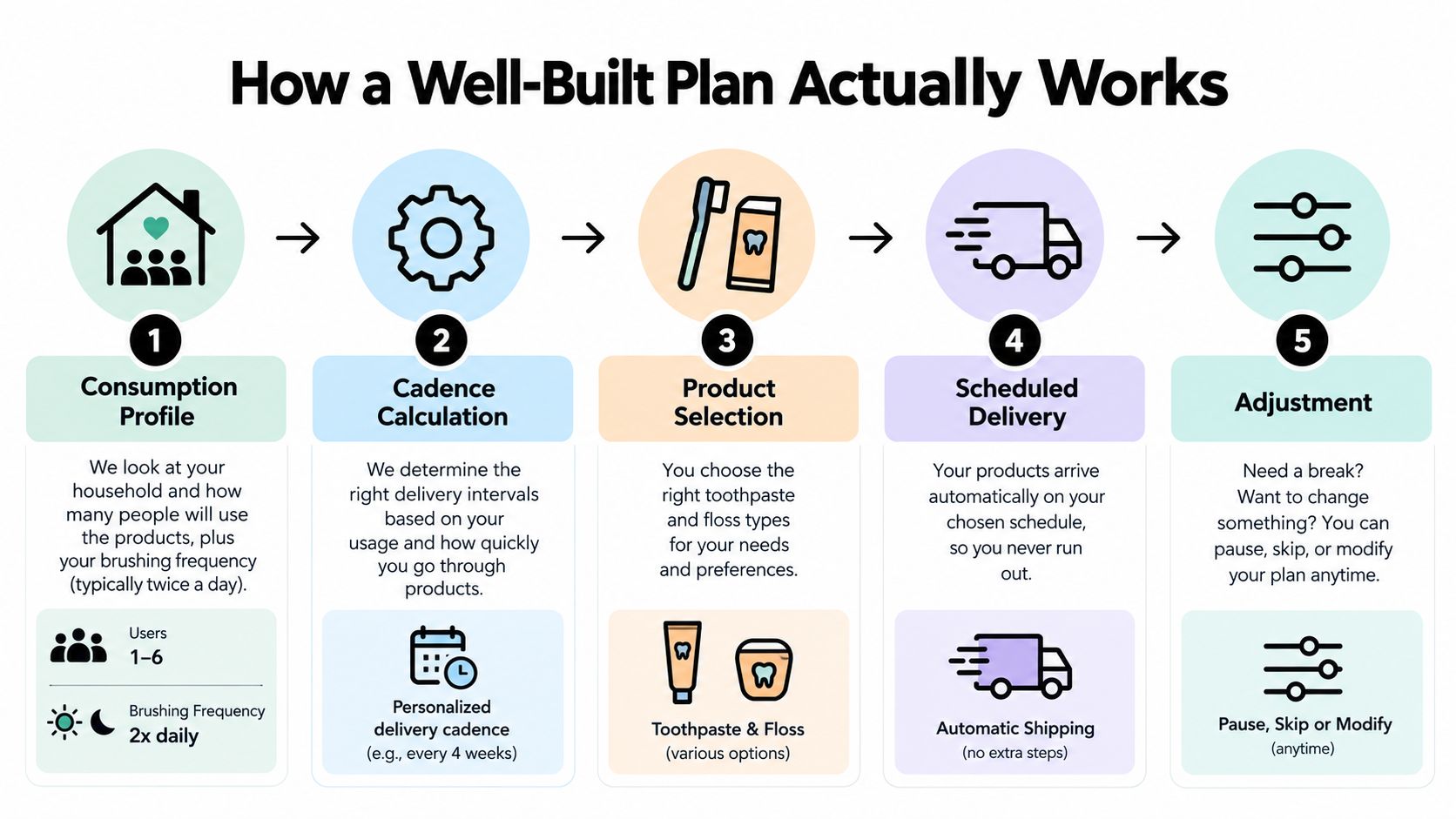
A serious subscription should estimate consumption before it suggests a delivery date. A default monthly shipment is a sales setting, not a household assessment.
The ADA recommends brushing twice daily for two minutes, notes that standard U.S. fluoride toothpastes generally contain 1,000–1,500 ppm fluoride, and identifies 5,000-ppm toothpaste for twice-daily use only on professional advice (ADA guidance on topical fluoride and professional-use products).
Build the household profile first
The account should distinguish adult products, children's products, and dentist-directed products. Use the age-specific amounts described earlier, the product's labeled instructions, and the number of people sharing it to estimate demand.
Don't increase the dose to make an order interval work. Adjust the order to match appropriate use.
A useful plan should expose these controls:
- Consumption-based timing: Estimate from users, package contents, and intended use, then refine the interval after observing actual consumption.
- Item-level quantity edits: Change toothpaste quantities without automatically increasing whitening gel or rinse.
- Skip and pause options: Provide both a way to miss an upcoming order and a way to suspend renewal.
- Advance renewal notices: Show the contents, charge, shipping details, and edit deadline before processing.
- Lot and expiration visibility: Make it possible to identify received products and avoid accumulating stock beyond its usable life.
Preserve the formulation, not just the brand
A product swap should require your approval when the active ingredient or concentration changes. Sodium fluoride, sodium monofluorophosphate, and stannous fluoride shouldn't be treated as interchangeable checkout labels because each appears in a toothpaste catalog.
For dentist-directed products, the account should preserve the selected formulation and remind you to follow your clinician's instructions. It shouldn't replace an unavailable item with something that looks similar.
This is what a dosing-and-adherence system should mean in retail: the seller helps you obtain the appropriate quantity of the selected product, while the label and dental professional remain responsible for use instructions. The subscription supports the routine rather than rewriting it.
Matching Subscription Formats to Real Routines
Choose the format after you identify the products you need. A large bundle isn't an upgrade if your routine only requires a dependable toothpaste refill.
Commercial estimates put multi-product plans at 42.3%, customized plans at 35.4%, and single-product plans at 22.3% of oral-care subscription revenue in 2025; these are directional market estimates, not evidence that the most popular format produces better dental outcomes (oral-care subscription market format estimates).
Subscription Format Compared to Real Routine Needs
| Format | Market Share | Best Fit For |
|---|---|---|
| Single-product | Smallest share in the cited estimate | Someone with a stable, established need, such as a selected sensitivity toothpaste |
| Multi-product bundle | Largest share in the cited estimate | Households using compatible essentials that can sensibly share a shipment |
| Customized routine | Between the other formats in the cited estimate | People whose whitening, sensitivity, breath-care, or retainer-maintenance needs follow different schedules |
A single-product plan is my default recommendation for a first subscription. It's easier to evaluate whether the timing works when you're tracking one established essential rather than sorting through a mixed box.
Bundles make more sense when their components are coordinated. Toothpaste and breath-care products might fit together; whitening gels and maintenance products should share a shipment only when your actual use supports it. Don't assume that a whitening kit creates an ongoing need for every component.
Customized routines suit shoppers who need independent controls for products such as Opalescence gel, MI Paste Plus, or Retainer Brite. Product availability and subscription eligibility must be checked separately, and inclusion in a routine doesn't establish that the products should be used together.
For a broader product shortlist, consult this guide to teeth-cleaning products before deciding what belongs on repeat.
Choose the smallest recurring commitment that reliably covers your established routine.
If your consumption is irregular, consider the purchasing decision before the dental details. Fillaree's discussion of subscription or one-time purchase offers another perspective on that choice. Buying as needed remains a sensible option, especially while you're testing a product or following a temporary treatment plan.
When a Subscription Stops Being Preventive Care
A paid renewal isn't evidence of better oral health. That distinction matters because research about subscription-based dental care doesn't automatically apply to boxes of home-use products.
A 2025 survey of 230 dental professionals found that 60% were familiar with subscription-based preventive-care models; among those familiar, 72% saw potential to reduce reliance on traditional insurance, while 45% had recommended plans to patients (survey of dental professionals on subscription-based preventive care). Those findings concern preventive-care models, not proof that automatic toothpaste or whitening deliveries improve outcomes.

Set clinical stop points before renewing
My recommendation is straightforward: don't put treatment decisions on autopilot. High-concentration carbamide peroxide gels, dentist-directed fluoride pastes, and products selected in response to active decay or post-whitening sensitivity need a clinical plan, not merely a reorder history.
For example, receiving MI Paste Plus regularly shouldn't become a reason to postpone an examination for suspected decay. Likewise, having whitening gel left over isn't an instruction to continue treatment.
Build a review into the routine when circumstances change:
- New sensitivity: Seek advice rather than automatically adding more products to manage it.
- Changed whitening frequency: Reassess the next gel order against the treatment instructions.
- Orthodontic treatment or recent dental work: Ask which existing products still fit the updated care plan.
- Pregnancy or new medications: Tell your dental professional and review the routine instead of relying on old checkout selections.
A clinician can evaluate context that a retailer's account settings can't. Dental Professionals of Fair Lawn's information on personalized dental exams in Fair Lawn is a useful resource for readers considering an individualized preventive-care assessment.
An account should make changing course easy. If the only response to a changed clinical situation is another scheduled shipment, the plan is functioning as order automation, not care support.
Cost, Access, and Sustainability Tradeoffs
Judge value by what you use, not what arrives. Add the recurring product charges, shipping, and other applicable fees, then compare that total with buying the same usable products separately.
For toothpaste, assess the quantity your household finishes. For whitening, assess the treatment you've been instructed to complete rather than assuming every delivered syringe represents value. Keep home-product spending separate from the cost of professional teeth cleaning, because a replenishment order doesn't replace a clinical service.
Affordability is more than a discount
A 2025 WHO African-region framework reported access to essential oral-health interventions for 17% of the region's population in 2021, compared with 23% globally, and identified affordable fluoride toothpaste in only three countries in the region (WHO oral-health access and affordability context). Premium delivery bundles aren't an answer to every access problem.
For a household that can't comfortably commit to recurring charges, a cancellable subscription may still be the wrong purchasing model. Reliable delivery also matters. A discount has little practical value if receiving the parcel is difficult or unpredictable.
Use these tests before calling a plan affordable:
- Normal price: Compare the ongoing charge, not just the introductory offer.
- Exit terms: Identify cancellation deadlines and any remaining commitments.
- Essential-only option: Check whether you can buy the necessary toothpaste without adding optional products.
- Usable inventory: Include unwanted or expired stock in your assessment of the deal.
Don't assume recurring delivery is greener
Consolidating compatible orders is worth considering, but it doesn't establish an environmental advantage by itself. Examine the actual packaging, local recycling options, delivery arrangements, and amount of unused product.
Ask the seller what can be recycled and where. Avoid accepting broad sustainability claims as a substitute for practical disposal information.
My preference is simple: fewer unnecessary products, sensible shipment grouping, and no stockpile. A subscription earns its place when its cost and material footprint fit the household, not when the marketing calls it convenient.
Choosing the Right Plan Without Regret
Choose the product first, then decide whether recurring delivery deserves a place in your routine. If the toothpaste itself is still an open question, start with what toothpaste dentists recommend and confirm any individualized needs with your dentist.
Use this checklist before authorizing renewal:
- Match the format to your routine. Choose a single essential, a useful bundle, or independently adjustable products. Don't pay for complexity you don't need.
- Set timing from consumption. Check what your household finishes rather than accepting the default shipping interval.
- Inspect the controls. Find skip, pause, quantity editing, and cancellation before entering an ongoing commitment.
- Protect the formulation. Confirm how the seller handles substitutions and whether ingredient or concentration changes require approval.
- Know your review point. Decide when a treatment product should stop renewing and when your dentist should reassess its use.
Make the first renewal a checkpoint
When the renewal notice arrives, compare the proposed order with what's left in the cabinet. Keep the schedule if it fits, change it if it doesn't, and remove anything that no longer belongs in your routine.
You don't owe a subscription consistency. The subscription owes you useful service.
The objective is modest and worthwhile: the right product remains available without excess purchasing or treatment decisions made by default. Set it up that way, and the empty-tube scramble becomes less likely without turning your bathroom into a stockroom.
As one retail option, DentalHealth.com offers professional-grade at-home dental products, including whitening gels, sensitivity toothpastes, remineralizing pastes, and retainer-care supplies. Visit to compare product descriptions and select what fits your established routine, then check recurring-purchase terms where available before committing.