
Oral Microbiome Toothpaste: How to Choose in 2026
A 2025 clinical trial showed that zinc citrate toothpaste significantly shifted oral microbiome profiles within two weeks, and the effect held at six weeks. That matters because it suggests formulation can change the plaque ecosystem, not just foam and freshen.
You're probably standing at the sink with a familiar choice in front of you, one tube promising “clean,” another promising “whitening,” and a third covered in words like gentle, natural, or antibacterial. Many have been taught to judge toothpaste by how much bacteria it kills. The newer science asks a better question, whether the formula supports a balanced oral ecosystem.
The Hidden World in Your Mouth
You brush, spit, and rinse, and it feels like a simple cleaning habit. In reality, you're tending a living neighborhood that never really shuts down. Plaque isn't just leftover debris, it's a community of microbes arranged on tooth surfaces, gums, and tongue, and the way you brush can nudge that community toward balance or disruption.
The easiest way to picture it is a city. Some residents are helpful, some are disruptive, and the goal is not empty streets, it's order. If you want a plain-language refresher on the role of bacteria in mouth and dental health, Grand Parkway Smiles has a useful overview that matches that idea well: bacteria in mouth and dental health.
Why balance matters more than blitzing bacteria
A toothpaste that wipes out everything sounds powerful, but strength isn't the same as wisdom. Oral tissues need a stable microbial environment, because the mouth is not supposed to be sterile. When the community becomes lopsided, plaque can build differently, gums can become more reactive, and breath can change.
Practical rule: if a product only markets “kills germs” and says nothing about the oral environment, it's probably describing force, not balance.
That's why this topic has become so interesting. A formulation can do more than scrub away residue, it can interact with the ecosystem itself. The question is no longer just “Does it clean?” but “What kind of microbial city does it leave behind?”
Understanding Your Oral Microbiome
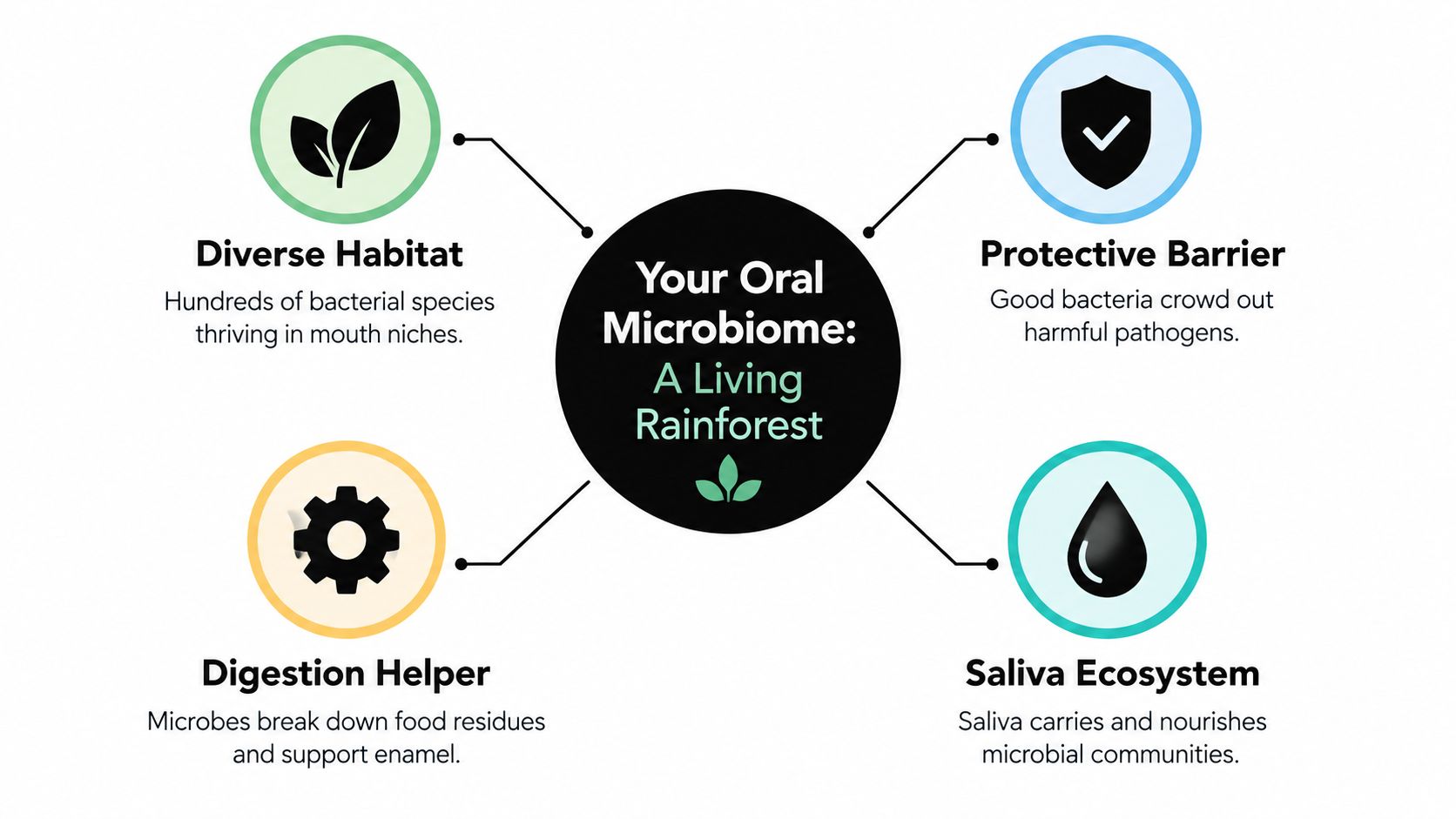
Think of the mouth like a rainforest, not a tiled bathroom counter. Different surfaces support different species, and those species interact constantly. Some help maintain pH, some compete with less helpful organisms, and some just live there without causing trouble unless the balance shifts.
The 2025 randomized, double-blind clinical study makes that idea concrete. In 115 participants who brushed twice daily for six weeks, zinc citrate toothpaste significantly shifted oral microbiome profiles at two weeks, with p = 0.002, and at six weeks, with p = 0.001. The control toothpaste showed no meaningful community shift, with p = 0.899 and p = 0.936 at those same time points, which means the formulation itself helped drive ecological change rather than brushing alone. Nature study on zinc citrate toothpaste and plaque microbiome shifts
What changed and why that matters
Researchers also identified significant changes in 38 microbial taxa, with 30 linked to the zinc formula and 8 linked to the control. That doesn't tell us the toothpaste “killed bad bacteria” in a simple one-to-one way. It tells us the formula altered the community structure, including microbial activity, which is a different and more interesting claim.
A second detail is easy to miss but important. The zinc group didn't keep changing dramatically between week two and week six, because the comparison between those two zinc measurements wasn't significant, with p = 0.973. In plain English, a lot of the ecological shift happened early and then stabilized.
The useful takeaway is modest but powerful, toothpaste can influence the oral ecosystem, but a microbiome shift is not the same thing as proven disease prevention.
That distinction protects people from overpromising. A mouth can look ecologically different without that automatically meaning lower caries, less gingivitis, or less periodontitis risk. Those outcomes need longer follow-up, because biology in the mouth doesn't always reward quick assumptions.
A helpful way to think about it
The oral microbiome works more like a garden than a battlefield. Good gardening doesn't mean erasing every plant, it means shaping the conditions so the right things thrive. That frame also explains why some “antibacterial” products can sound impressive while still missing the bigger job.
For readers who like the gut-health analogy, Yuve has a clear primer on the broader idea of microbial balance here: how your microbiome works. The mouth follows the same basic logic, local environment shapes who can live there.
For a related clinical angle on beneficial oral microbes, this resource on oral probiotic lozenges is worth a look: https://dentalhealth.com/blogs/news/oral-probiotic-lozenges
Ingredients That Shape Your Mouth Ecosystem
A toothpaste formula can push the oral ecosystem in very different directions. Some ingredients act like a strong rinse that strips away many microbes at once. Others are built to leave the community more stable, which matters because a lower bacterial count does not always mean a healthier balance.
Broad suppression versus ecological support
A 2024 study showed that sodium lauryl sulfate, or SLS, killed bacteria in developing and mature biofilms in vitro, but it also altered community structure in a way that increased the relative presence of pathogenic bacteria. In the same investigation, postbiotic formulations supported bacterial homeostasis and normal biofilm development in vitro, and they reduced gingivitis- and periodontitis-related outcomes in an animal model. 2024 PMC study on SLS and postbiotic formulations
That does not make every SLS-free formula microbiome-friendly. It shows that chemistry matters more than slogans. Words like “gentle,” “natural,” or “advanced” do not tell you how a toothpaste behaves in the mouth. The ingredient strategy does.
| Toothpaste Ingredient Strategies Compared | Common Ingredients | Effect on Microbiome | Evidence Level |
|---|---|---|---|
| Broad antimicrobial approach | SLS and other aggressive cleansing systems | Can suppress many bacteria but may disturb community structure | Strong laboratory evidence, limited ecological nuance |
| Modulating approach | Zinc compounds, postbiotics, selected probiotic or prebiotic systems | Aims to support balance rather than total wipeout | Human clinical data exists for some formulas, but it is ingredient-specific |
| Supportive maintenance approach | Mild bases, lower-irritation formulas | May be easier on tissues and compatible with daily use | Depends on the full formulation and clinical testing |
For a practical comparison with another common ingredient pattern, see toothpaste with xylitol and fluoride.
How to read the label like a clinician
Read the active strategy first, then the marketing copy. If the ingredient list leans on strong detergent action, ask what that means for your gums, dry mouth, or sensitivity. If it mentions zinc, postbiotics, or probiotic-related systems, check whether the evidence comes from human studies, not only test tubes or animal models.
The best label is the one that matches your mouth, not the one that sounds most dramatic. A formula that fits daily use is often more useful than one that promises to wipe everything clean.
How to Choose Microbiome-Friendly Toothpaste
Start with the problem you want to solve. Sensitivity calls for a formula that is gentle on tissue. Bleeding gums or plaque buildup call for ingredients with human evidence tied to those outcomes. If your goal is everyday maintenance, choose the product with the clearest clinical support and the least irritating profile for your mouth.
The 2025 systematic review gives a useful starting point. It assessed 12 randomized controlled trials of lactic-acid-bacteria-based toothpaste, and 4 of those studies could be pooled for analysis. At three months, the pooled plaque result favored the test toothpaste with a mean difference of -0.64, and bleeding on probing improved with a pooled mean difference of -1.49. Frontiers systematic review of lactic-acid-bacteria toothpaste
A simple decision sequence
- Name the main issue. Bleeding gums, plaque control, and maintenance are different targets, so do not choose by scent or foam alone.
- Check the active concept. Zinc, postbiotic, probiotic, and lactic-acid-bacteria systems all point to different ways of shaping the oral ecosystem.
- Look for human clinical data. Human randomized trials matter more than a polished ingredient story.
- If detergent-heavy formulas bother you, consider SLS-free options. Comfort affects daily use, and daily use is what makes results hold.
- Treat absolute claims carefully. No toothpaste should promise to solve every oral problem on its own.
The same systematic review also reported that in periodontitis patients using interventions for at least six months, probing-pocket depth decreased by 1.32 mm on average and clinical attachment level improved by 0.79 mm. That is encouraging, but total bacterial counts did not differ significantly between probiotic and control groups. The practical lesson is simple, oral-care gains can come from selective balance, not blanket sterilization.
For another common ingredient pattern, what is antibacterial mouthwash helps show the same kill-versus-balance question in rinse products too.
Benefits and Realistic Expectations
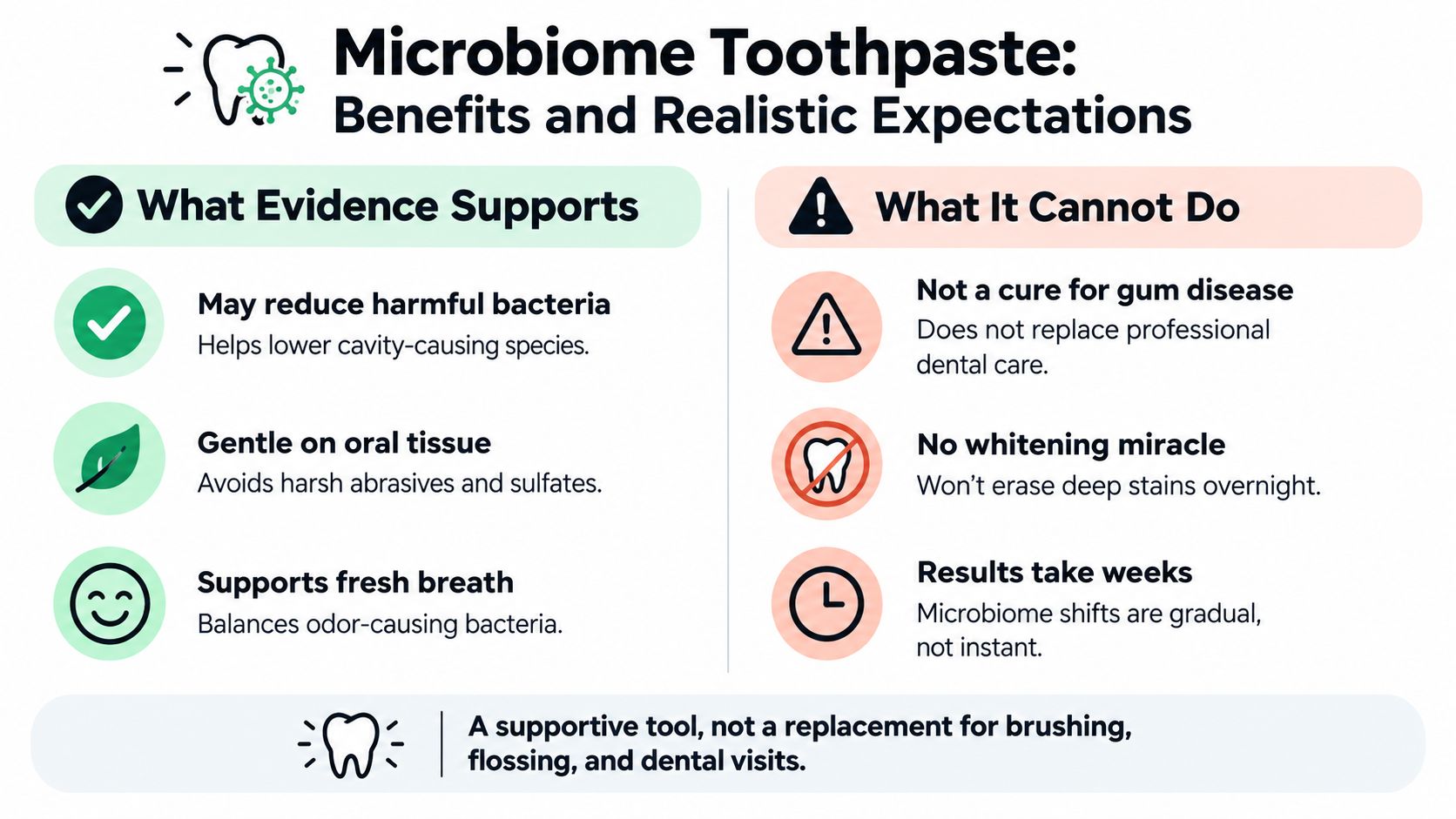
Microbiome-friendly toothpaste can do useful things, but it's not magic. The best evidence points to better plaque control, improved gum-health markers, and reduced bleeding in some settings. That's meaningful, especially for people who notice inflammation but don't want harsh formulas.
What the evidence supports
The strongest practical message from the current research is selective influence. The oral ecosystem can shift toward a healthier pattern without every bacterial count dropping across the board. That's why a toothpaste may improve visible plaque or gum signs even when it doesn't reduce total bacterial counts in a dramatic way.
Useful expectation: changes tend to come from steady use, not a dramatic overnight reset.
The zinc citrate trial suggests that the ecological change can appear relatively early and then stabilize. The broader review shows that some clinical outcomes improve over months, especially when the formula is used consistently. That timeline fits real life better than the advertising fantasy of instant whitening, instant healing, or instant gum repair.
What it cannot do
It can't replace professional treatment for active gum disease, and it can't clean around missed brushing or flossing. It also can't guarantee that the microbiome itself will always translate into disease prevention, because the studies we have are stronger on ecological and clinical markers than on long-term disease endpoints.
So the right mental model is support, not substitution. Microbiome-friendly toothpaste can be a smarter daily tool, but it still lives inside the bigger oral-care routine of brushing, interdental cleaning, and dental visits.
Common Misconceptions About Oral Microbiome Toothpaste
A toothpaste that acts harder on bacteria is not automatically better for the mouth. Oral care works more like tending a garden than sterilizing a surface. Some ingredients reduce microbes, but they can also shift the balance in a direction that is less friendly to the community as a whole.
One common mistake is assuming every “antibacterial” label means healthier gums. The question to ask is whether a formula helps the ecosystem stay stable while still controlling plaque. That is also why a product can feel active, foam well, or taste strong without offering any special microbiome benefit. For a clearer comparison of product claims, see how antibacterial mouthwash differs from microbiome-focused oral care.
Another myth is that probiotic toothpaste always delivers the same result. As the 2025 systematic review of lactic-acid-bacteria toothpaste noted, results varied widely across studies, so broad promises are not justified. Natural ingredients can be useful, but “natural” alone says nothing about dose, formulation, or the way the product was tested.
A final misconception is that microbiome modulation proves disease prevention. Current studies are stronger on ecological shifts and clinical markers than on long-term protection claims. The better test is simple: look for human randomized trials, product-specific evidence, and a formula that supports balance instead of only trying to kill more bacteria.
Your Next Steps for Microbiome-Smart Oral Care
At the shelf, choose the tube that matches your goal, not the loudest claim. If you want support for plaque control or gingival comfort, look for ingredient strategies with human evidence, especially zinc- or probiotic-related formulas that have clinical backing. If your mouth feels irritated by harsh detergents, pay attention to whether the product is SLS-free.
Give any new toothpaste a fair trial of consistent use. Microbiome shifts aren't instant, and the clinical studies that matter here measured change over weeks and months, not one brushing. If you have ongoing bleeding, pain, or bad breath that doesn't improve, a dentist should look for the cause instead of letting a product become a substitute diagnosis.
For readers who want a practical way to compare professional-grade oral-care options, DentalHealth.com carries trusted brands and helpful product details for people who want evidence-driven choices. If you're trying to build a smarter daily routine around oral microbiome toothpaste, start there and use the labels with a more clinical eye.