
Remineralizing Toothpaste Ingredients: What Works and Why
If two toothpastes both advertise enamel repair on the front of the box, why can one meaningfully harden weakened teeth while the other barely moves the needle? Most shoppers assume the answer sits in a single binary choice between fluoride and fluoride-free formulas. That framing leaves out the four variables that govern performance: active concentration, full-tube formulation, the type of enamel damage present, and the specific problem you want to solve.
Evaluating remineralizing toothpaste ingredients starts with looking past front-panel buzzwords. A strong headline mineral can lose its impact when paired with the wrong supporting chemistry, diluted to a weak level, or applied to a cavity that has already broken through the tooth surface. Understanding how each active behaves, where clinical evidence holds firm, and where non-active ingredients override the formula puts you in control of the shelf.
Remineralizing Ingredients at a Glance
Before examining dosages or brushing habits, compare the six main actives used to support tooth enamel side by side.
| Ingredient | How It Supports Enamel | Evidence Strength | Best Suited For |
|---|---|---|---|
| Sodium fluoride | Forms fluoridated apatite that resists acid better than natural enamel | Best established across standard consumer strengths | Routine caries prevention |
| Stannous fluoride | Delivers fluoride while adding antibacterial activity on plaque and gums | Well established as a fluoride salt for cavity prevention, with added gum and sensitivity support in stabilized pastes | Users wanting fluoride paired with gum and sensitivity care |
| Nano-hydroxyapatite | Deposits calcium phosphate directly onto partially demineralized enamel | Favorable for early lesions, yet mixed in pooled clinical reviews | Early non-cavitated lesions and fluoride-averse users |
| CPP-ACP | Supplies bioavailable calcium and phosphate ions to the tooth surface | Moderate, with clearest short-term mineral gains when paired with fluoride | Sensitivity routines and mineral-support care (check for dairy avoidance) |
| Calcium glycerophosphate | Adds a calcium-phosphate partner to fluoride toothpastes | Laboratory in-vitro support showing extra mineral uptake alongside fluoride | Fluoride formulas aiming for added mineral support |
| Bioactive glass | Releases calcium and phosphate ions that help form an apatite-like layer on enamel | Emerging, built mostly on laboratory and sensitivity research rather than long-term cavity trials | Fluoride-free users seeking surface mineral and sensitivity support |
How to Read an Ingredient Comparison
A row in this chart tells you what an ingredient is designed to do on tooth mineral, not whether a particular tube on the store shelf will deliver that outcome. Sodium fluoride holds the deepest clinical record for everyday cavity prevention, whereas hydroxyapatite and calcium-based partners rest on a narrower body of evidence aimed mainly at early surface mineral loss.
A "remineralizing" badge on the front carton only states the manufacturer's intent; the active concentration and surrounding formula determine what actually reaches your enamel.
Two tubes can list the same headline active and still behave differently in your mouth. Particle size, pH, abrasives, and how long the paste stays on your teeth all shift the final result. Flip the box over, locate the exact active ingredient you want, and check whether the rest of the label matches your oral health needs.
How Enamel Repairs Itself With Help From Toothpaste
Picture an ordinary afternoon at your desk. You sip sparkling lemon water, eat a handful of crackers, and head into a meeting without brushing. Every time sugars, starches, or acidic drinks touch your teeth, enamel faces a chemical tug-of-war.
Think of tooth enamel as a tightly laid wall of ceramic tiles held together by mineral mortar. Dietary acids and the acids produced by plaque bacteria dissolve that mortar, pulling calcium and phosphate out of the surface. That mineral loss is demineralization, and its earliest visible warning sign is a dull, chalky white patch rather than a dark hole.
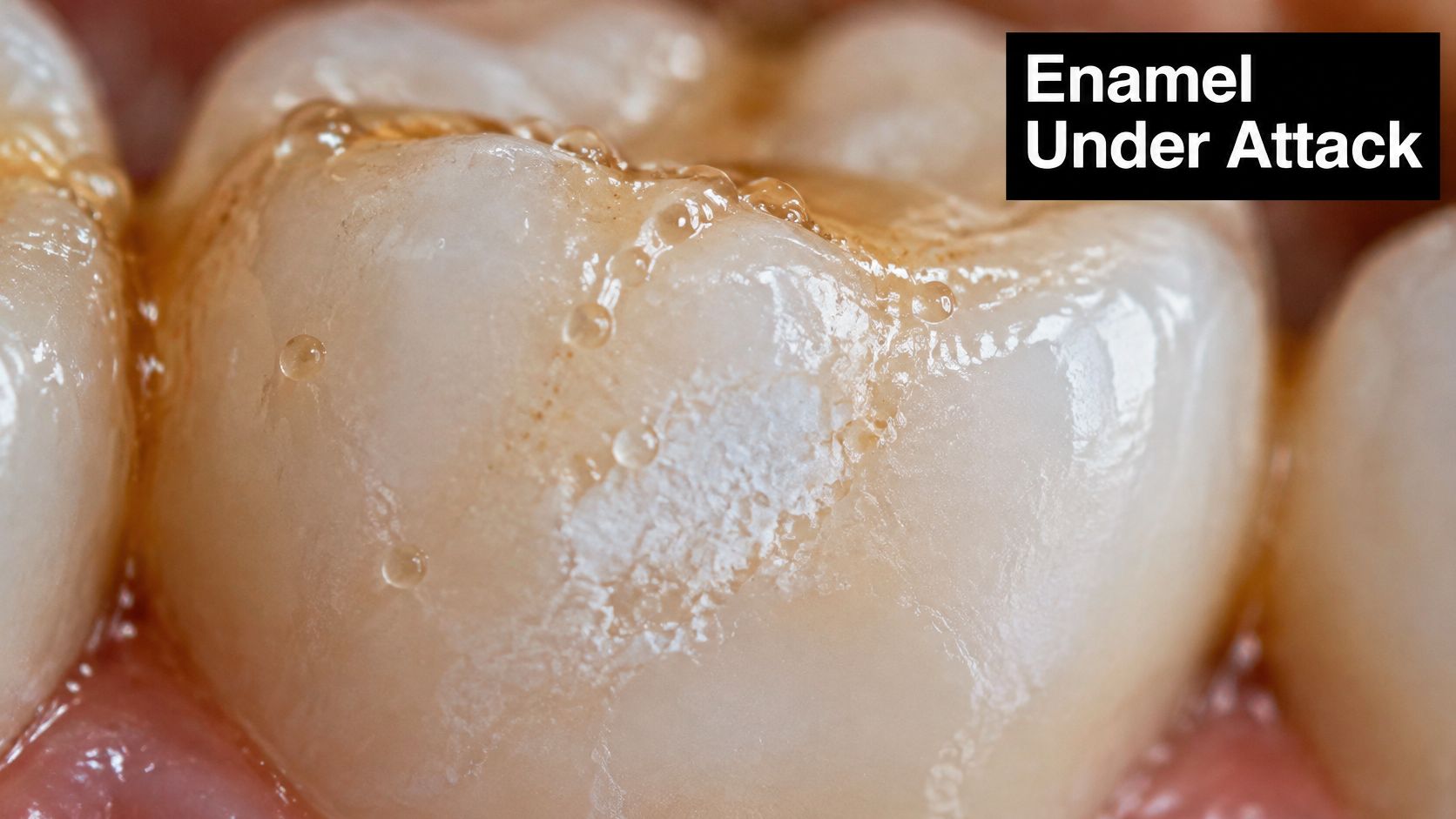
Your mouth already runs a built-in maintenance crew: saliva. Saliva neutralizes leftover acid and bathes the tile wall in dissolved calcium and phosphate so fresh mortar can settle back into microscopic pores. If you want the full biological mechanism behind this cycle, read our breakdown of what tooth remineralization is.
Four Stages From Acid Attack to Hardened Enamel
Remineralizing toothpaste ingredients do not replace saliva; they assist it in three ways by supplying extra mineral mortar, locking new mineral into a tougher structure, or making the tile surface more receptive to deposits. In everyday life, the cycle unfolds in four steps:
- Acid strips the surface mortar. After an acidic beverage or carbohydrate snack, hydrogen ions pull calcium and phosphate out of the outer enamel lattice.
- An early lesion appears. Beneath an intact outer layer, microscopic gaps widen into a chalky white spot that usually causes no pain at all.
- Saliva and toothpaste refill the pores. Once acidity drops, dissolved ions from saliva and calcium-phosphate actives re-enter those empty spaces and rebuild mineral density.
- Fluoride upgrades the repaired mortar. When fluoride is present during rebuilding, the fresh deposit incorporates it into a tighter crystal lattice that resists the next acid challenge better than original enamel.
That repair window has a firm structural boundary. When acid loss outpaces recovery long enough for the outer tiles to collapse inward, a physical cavity forms. No toothpaste can regrow missing tooth structure across an open hole; once cavitated decay exists, a dentist has to clean and restore the tooth.
Fluoride Strength, Forms and Safe Use
Concentration separates a token fluoride label from a clinically useful one. A PubMed Central evidence review on fluoride toothpaste concentrations documents a clear concentration-response relationship across consumer and prescription strengths, summarized in the table below.
| Fluoride Level (ppm) | Reported Effect | Use Guidance |
|---|---|---|
| 440-550 | No statistically significant benefit over placebo in children and adolescents | Not a reliable caries-prevention choice on its own |
| 1000-1500 | Clinically meaningful caries prevention | Standard consumer range; follow local age labeling |
| 2400-2800 | Larger preventive effect than 1000-1250 ppm formulations | Risk-based use only; watch for fluorosis risk in young children |
Fluoride earns its lead status because it drives the formation of fluoridated apatite, a mineral phase that dissolves less easily under acidic conditions than native enamel hydroxyapatite. To see how cleanly fluoride alters mineral recovery on its own, a 2024 Scientific Reports study by Nature Portfolio researchers compared a toothpaste containing 1450 ppm sodium fluoride directly against a fluoride-free 0 ppm placebo in enamel remineralization models.
That gap explains why reading the parts-per-million (ppm) figure matters far more than trusting an "anticavity" tagline. Low-strength formulas sitting at 440-550 ppm failed to outperform a placebo statistically in children and adolescents, whereas everyday toothpastes in the 1000-1500 ppm band deliver clinically meaningful cavity protection. Stepping up to 2400-2800 ppm yields larger preventive gains than 1000-1250 ppm pastes, yet higher exposure carries a real trade-off: young children who swallow foam face dental fluorosis risk while permanent teeth are still developing.
Chemical Forms and Retention Habits
Packaging lists both the declared concentration and the specific fluoride salt on the Drug Facts or active-ingredient panel. Three chemical forms dominate the aisle:
- Sodium fluoride (NaF): Dissociates quickly in saliva to deliver free fluoride ions for rapid enamel uptake during standard brushing.
- Stannous fluoride (SnF2): Combines fluoride delivery with tin ions that help curb plaque bacteria and shield exposed dentin against sensitivity.
- Sodium monofluorophosphate (MFP): Releases fluoride through enzymatic breakdown in saliva and pairs smoothly with certain calcium-based abrasives that would bind free sodium fluoride.
If you want to compare how those three salts behave across different brands and brushing goals, review our guide to fluoride toothpaste ingredients. Even the right chemical form loses half its potential if it washes straight down the drain.
Three daily habits govern how much fluoride stays anchored to your enamel: brushing frequency, post-brushing rinsing, and saliva contact time. Swishing aggressively with a full glass of water right after brushing flushes away the thin fluoride film your teeth need to absorb over the next half hour.
Practical rule: Reserve high-strength prescription fluoride toothpastes for high-caries-risk adults under direct dental supervision, and select routine consumer tubes strictly by local regulatory labeling and age guidance.
Hydroxyapatite and Calcium-Based Actives
Non-fluoride actives draw heavy marketing hype, so start with their biological and statistical limits before deciding where they fit. Hydroxyapatite (HAP), including nano-hydroxyapatite, is a biomimetic calcium-phosphate compound designed to deposit mineral onto partially demineralized enamel and dentin. According to an updated ScienceDirect review of hydroxyapatite toothpastes, clinical studies have commonly tested concentrations around 5-10% HAP, with some trials showing performance comparable to fluoride controls on early lesions such as pediatric caries and orthodontic white-spot lesions.
The pooled evidence, however, is not uniformly decisive. That same review found favorable yet statistically nonsignificant overall caries comparisons when clinical data were combined, while in-situ models demonstrated a modest average lesion-depth advantage alongside reductions in oral bacterial load.
Just as important is what HAP cannot override. Hydroxyapatite can deposit mineral only when your mouth chemistry already allows precipitation. It is not an unlimited stand-in for saliva, which still supplies the pH buffering and background calcium and phosphate ions required for steady repair. If severe dry mouth leaves the oral environment chronically acidic, any surface mineral paste will struggle until saliva flow and acid exposure are addressed.
Calcium Boosters and Laboratory Limits
Beyond hydroxyapatite, several formulations rely on calcium-phosphate complexes to feed extra raw mineral to enamel:
- Casein phosphopeptide-amorphous calcium phosphate (CPP-ACP): A milk-protein complex that stabilizes calcium and phosphate at the tooth surface so ions remain available during acid dips.
- Beta-calcium glycerophosphate: A calcium-phosphate supplement tested directly inside fluoride pastes to see whether extra mineral boosts repair.
A 2024 Journal of Applied Oral Science in-vitro study tested toothpastes containing 1100 ppm fluoride supplemented with beta-calcium glycerophosphate at 0.125%, 0.25%, 0.5%, and 1.0%, reporting that 0.25% nanosized beta-calcium glycerophosphate produced an additional remineralizing effect. Treat that number with appropriate caution: in-vitro results happen on extracted enamel blocks in a lab, not inside living mouths over multi-year trials, so laboratory synergy is not automatic proof of clinical cavity reduction.
When shopping for hydroxyapatite or calcium-based remineralizing toothpaste ingredients, apply three strict filters:
- Demand disclosed HAP details: Look for a stated HAP percentage and particle technology on the packaging rather than trusting the generic word "calcium" buried in the ingredients list.
- Match the active to realistic targets: HAP is most rational for early, non-cavitated lesions, sensitivity-support routines, and shoppers who avoid fluoride.
- Respect the cavity boundary: Deep structural decay still requires professional dental restoration regardless of how biomimetic a paste claims to be.
Fluoride or Fluoride-Free Alternatives or Partners
Choosing between fluoride and hydroxyapatite starts with your goal: cavity prevention, early enamel repair, or sensitivity relief. Online debates often treat them as rival camps, but an ingredient name alone cannot predict results. Concentration, full-tube formulation, exposure time, and lesion stage all affect what a toothpaste can do.
The formula works as a system. A headline active cannot compensate automatically for supporting ingredients that undermine performance or make regular brushing uncomfortable.
The chart below compares fluoride systems and fluoride-free options, highlighting factors that can change their performance.
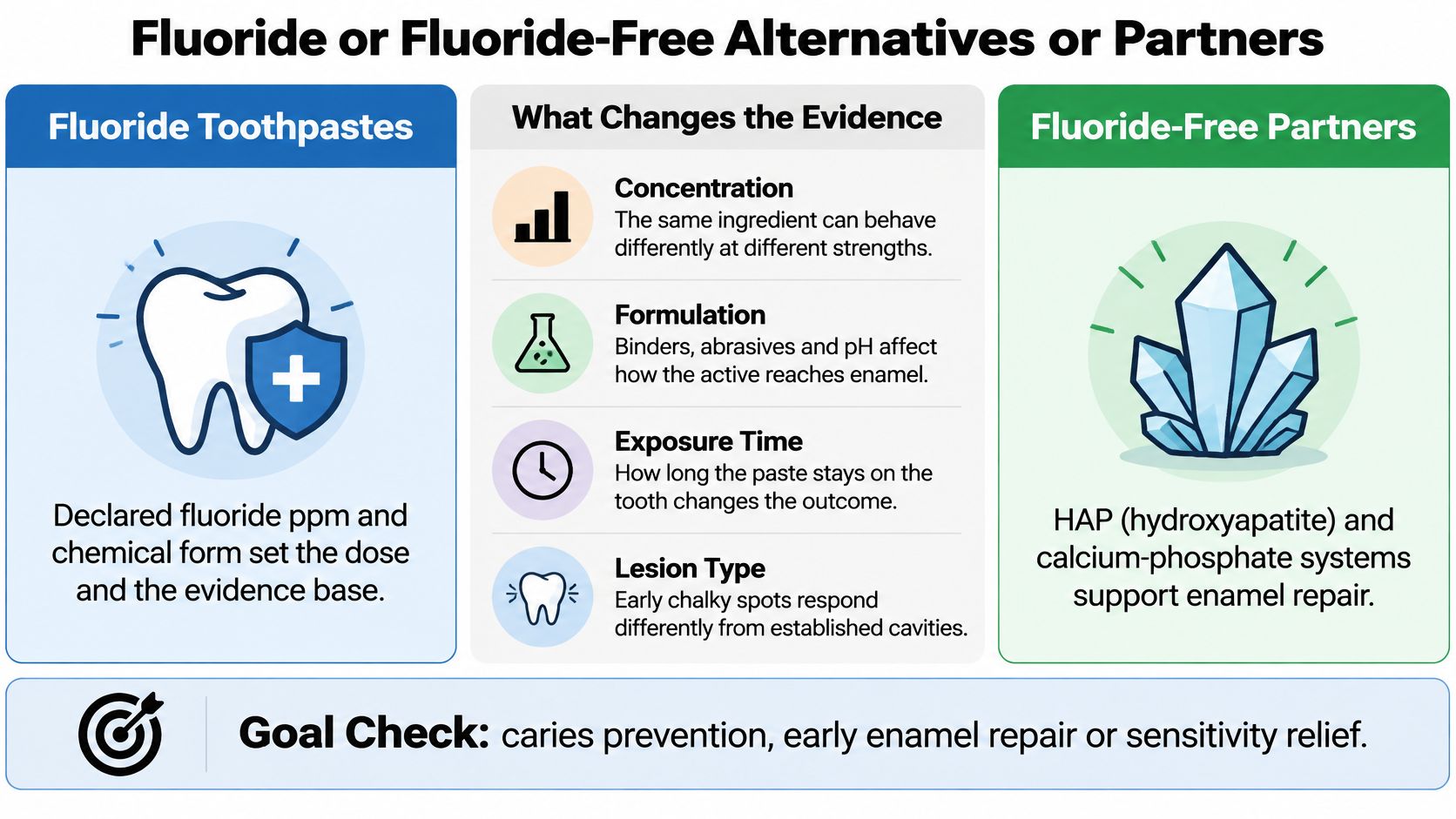
A 2025 Europe PMC systematic review and meta-analysis concluded that hydroxyapatite-based, fluoride-free toothpaste may prevent caries progression and remineralize initial lesions, although pooled comparisons with fluoride were statistically mixed. That supports considering hydroxyapatite without assuming every fluoride-free formula performs equally well or matches fluoride for every outcome.
Fluoride and calcium-phosphate ingredients such as CPP-ACP may be considered as alternatives or partners, depending on the formula and the reader's needs. Combining ingredients does not, by itself, establish a better result. For a closer look at the differences, see our fluoride versus hydroxyapatite toothpaste comparison.
Four Everyday Scenarios and Clear Verdicts
Use these scenarios to distinguish replacing fluoride from considering an additional product. A complement supports a routine; it does not automatically improve its cavity protection.
- Adult with early chalky white spots (Verdict: Complement, or Alternative only if fluoride is declined): Keep fluoride as your cavity-prevention baseline if you accept it. Discuss whether hydroxyapatite or CPP-ACP would serve a specific additional goal rather than adding products only because they contain minerals.
- Young child whose parents worry about fluoride dose (Verdict: Complement under dental guidance): Follow age-appropriate fluoride labeling and dosing. Discuss cavity risk with a pediatric dentist before adding hydroxyapatite or replacing the existing toothpaste.
- Orthodontic patient with white-spot lesions around brackets (Verdict: Complement): Brackets trap plaque and create repeated acid challenges. Maintain daily fluoride and professional hygiene visits; consider HAP or calcium-phosphate support alongside that routine, without assuming the combination guarantees greater repair.
- Shopper who avoids fluoride strictly (Verdict: Alternative with clear limits): A well-formulated hydroxyapatite toothpaste is a fluoride-free option. Judge it by its formulation and your goal, recognizing that evidence concerning initial lesions does not establish treatment for advanced decay.
The short explainer below illustrates how enamel responds to fluoride and fluoride-free brushing strategies.
Boundary check: Initial, non-cavitated lesions may respond to remineralizing routines. Once decay creates a physical break in enamel, toothpaste alone cannot rebuild the missing structure.
Non-Active Ingredients That Change Performance
Shoppers often scan for one headline remineralizing active and ignore the other fifteen lines on the tube. That shortcut backfires because supporting ingredients directly alter enamel wear, tissue comfort, and whether calcium or fluoride stays chemically free to work.
A 2025 PubMed Central clinical trial evaluating hydroxyapatite toothpastes illustrates just how complex modern formulas have become. One tested toothpaste relied on zinc carbonate hydroxyapatite, while another combined fluoro-hydroxyapatite with magnesium-strontium carbonate hydroxyapatite conjugated with chitosan. Both tubes also contained abrasives, surfactants, preservatives, acids, flavoring agents, and pyrophosphate. Every single one of those inactive or secondary components changes how the paste feels and performs in daily brushing.
| Non-Active Ingredient | Why It Matters | Who Should Check It |
|---|---|---|
| Abrasives | Remove surface stain and plaque, yet overly harsh grits can wear exposed dentin | Users with acid erosion or receding gums exposing tooth roots |
| Surfactants (foaming agents) | Spread paste and lift debris, yet harsh detergents can irritate oral tissue | Users prone to mouth ulcers, dry mucosa, or tissue irritation |
| Flavorants | Mask mineral taste, yet intense mint oils or cinnamon can sting sensitive tissue | Users with flavor sensitivities or burning-mouth reactions |
| Pyrophosphate | Controls tartar by binding calcium ions, which can cut free calcium availability | Users specifically buying a paste for maximum calcium availability |
| Milk-derived CPP-ACP | Carries a casein dairy protein as its mineral carrier | People avoiding dairy proteins or managing milk-protein allergies |
| Preservatives and acids | Stabilize shelf life and adjust tube pH | Users dealing with acid-related tooth sensitivity |
Why Identical Headline Actives Perform Differently
Can a toothpaste carry a legitimate remineralizing active and still be a poor match for your mouth? Easily. Imagine someone with acid-worn front teeth choosing a heavy whitening paste that happens to contain sodium fluoride; the coarse abrasive polishes away softened dentin faster than the fluoride can harden it. Someone else using a tartar-control paste with pyrophosphate may inadvertently bind free calcium ions when their real goal was boosting surface calcium uptake.
Dietary and comfort constraints matter just as much. Anyone who develops canker sores from strong foaming surfactants like sodium lauryl sulfate, or reacts to sharp essential-oil flavorants, will shorten their brushing time and rinse aggressively, cutting the active's contact window in half. Shoppers avoiding dairy proteins need to catch milk-derived CPP-ACP before applying it, even when the tube is marketed strictly as a dental paste.
Because the full chemical matrix decides how ions release and bind, clinical performance stays formulation-specific. Even the enhanced mineral gain seen when combining fluoride, CPP-ACP, and trimetaphosphate reflects a specific tested system, not a guarantee that any homemade mix or random ingredient list will replicate the result. If you are dealing with active cavities, severe acid erosion, or persistent sensitivity that does not calm down, schedule a dental evaluation rather than relying on ingredient lists alone.
Choose Your Formula and Check the Label
Turning dental chemistry into a quick store decision takes less than a minute once you know where to look. Use the checklist below as a visual reference the next time you compare tubes in the aisle or online.
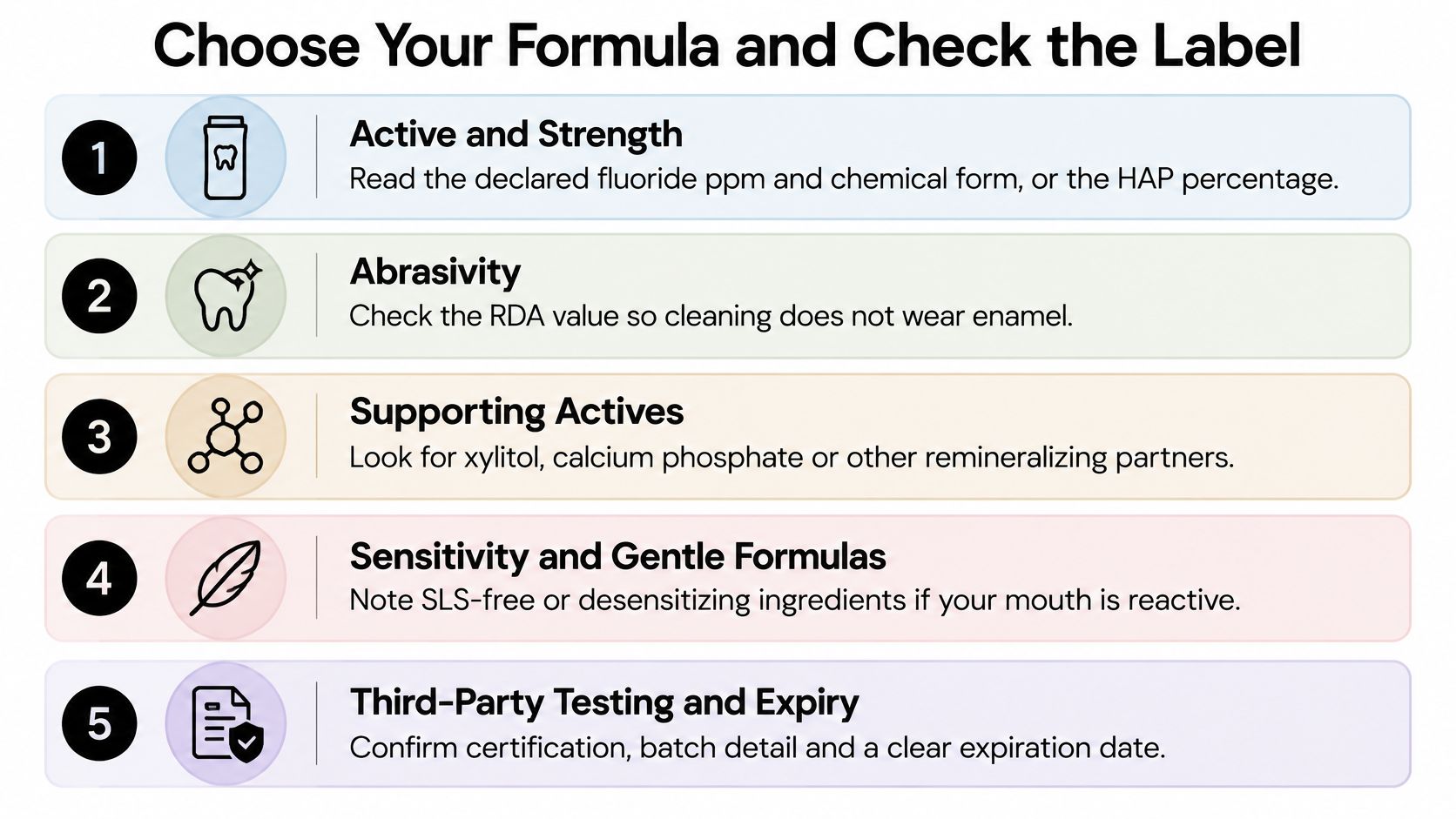
Run through these five label checks before adding a toothpaste to your bathroom counter:
- Verify the Active and Declared Strength: Read the active panel for the exact fluoride concentration in ppm and its chemical salt, or check whether a hydroxyapatite paste discloses its percentage and particle type rather than vague mineral claims.
- Match the Formula to One Primary Goal: Decide whether you need everyday caries defense, early white-spot support, or calmer sensitivity, since a plaque-fighting stannous formula solves a different problem than a calcium-phosphate paste.
- Confirm Age and Risk Guidance: Check pediatric age instructions on the box for children, and leave higher-strength prescription fluoride strictly for high-caries-risk adults under dental supervision.
- Screen the Supporting Ingredients: Scan the inactive panel for harsh abrasives if you have exposed roots, strong foaming agents or flavorants if your mouth irritates easily, milk-derived proteins if you avoid dairy, and pyrophosphate when free calcium availability is your priority.
- Confirm Lesion Status Before Shopping: If you notice a visible pit, lingering ache, severe enamel thinning, or sensitivity that persists despite gentle care, book a dental exam before trying to fix it with toothpaste.
When building a targeted routine at home, our store's product lines include Teeth Whitening (Opalescence, Zoom, PolaNight, PolaDay), Tooth Sensitivity (Fluoridex, MI Paste), Pro DenRX, Retainer Brite, and Skin Care, and we store every item in a temperature-controlled environment so active formulas arrive stable.
Brushing Habits That Protect Your Active Ingredient
Even well-designed remineralizing toothpaste ingredients need contact time to bind with tooth mineral. Brush gently twice a day with a soft-bristled toothbrush, covering every surface without scrubbing hard along the gumline.
When you finish brushing, spit out the excess foam instead of rinsing thoroughly with water, and let the thin residual film sit on your enamel before eating or drinking. The clearest strategy stays straightforward: rely on a labeled fluoride toothpaste as your baseline for routine caries prevention, layer in hydroxyapatite or calcium-phosphate actives for early non-cavitated lesions, sensitivity support, or fluoride-free preferences, and turn to a dentist whenever decay has already broken through the enamel surface.
Looking for dentist-recommended formulas that clearly state their active ingredients without guesswork? Explore professional-grade sensitivity and enamel-support options like Fluoridex and MI Paste alongside our full line of at-home oral care products, all backed by free shipping on USA orders and temperature-controlled storage, at DentalHealth.com.