
Sheer White Teeth Whitening: Ingredients, Results, Risks
What if the product that whitens your teeth also makes your old filling easier to see? That's the question most whitening pages skip, and it's the right place to start with Sheer White teeth whitening. A brighter shade on natural enamel doesn't help if a crown, veneer, or bonding stays its original color beside it.
Judge any whitening product by its chemistry, not its name. You need to know which peroxide it uses, how strong it is, how long it stays on your teeth, and what dental work you already have. Once you can read those four facts, product claims become much easier to test.
What Sheer White Is and How to Read Its Label
The name Sheer White tells you nothing about strength on its own. No formula, ingredient list, or concentration is confirmed here, so treat the brand as a label to verify, not a guarantee of a result. The same rule applies to similarly named gels, strips, trays, and paint-on products.
Consider it similar to checking a medicine box. You wouldn't buy tablets just because the front sounds reassuring. You'd check the active ingredient and dose, and whitening deserves the same habit.
The Four Items to Find
Write these down from the packaging before you buy or use anything:
- Active agent named: Is it hydrogen peroxide or carbamide peroxide?
- Concentration stated: Is there a clear percentage, not just words like professional strength?
- Wear time listed: How many minutes per session, and how often?
- Comfort ingredients listed: Does it include a desensitizing ingredient or fluoride?
The delivery format matters too. A tray, strip, paint-on gel, and in-office treatment hold peroxide against teeth differently, so two products with the same percentage don't always create the same exposure. Format plus wear time tells you how the gel contacts enamel.
If one of the four items is missing, ask the manufacturer or seller before buying. A gap on the label is a reason to pause, not a detail to guess.
Fill in all four items now. You'll use them to compare concentrations, judge sensitivity risk, and decide whether the schedule fits your routine.
Peroxide Type and Concentration Compared
Percentage only makes sense after you know which peroxide it belongs to. Hydrogen peroxide works on contact. Carbamide peroxide works like a slow drip of that same active ingredient. Same shade goal, different pace.
| Active agent | Breaks down into | Typical concentration | Typical wear pattern | Sensitivity pattern |
|---|---|---|---|---|
| Hydrogen peroxide | Acts directly on enamel and dentin | About 35% in in-office power bleaching | Short in-office sessions | Higher and faster in early sessions |
| Carbamide peroxide | Hydrogen peroxide and urea | 10% in dentist-directed custom trays | Longer, lower-intensity exposure | Lower, slower release |
A Dimensions of Dental Hygiene history of tooth whitening places in-office power bleaching at approximately 35% hydrogen peroxide, activated by heat or light, by the early 1900s. The same history records that Haywood and Heymann introduced nightguard vital bleaching in 1989, using custom trays with 10% carbamide peroxide at home under a dentist's direction.
Sheer White does not get its own concentration row, because no formula is confirmed for the name alone. Copy the agent, the percentage, and the minutes per session off that specific pack. If the label prints a percentage and never names the peroxide, you cannot tell a direct, fast exposure from a slower release.
How the Two Peroxides Differ
The American Dental Association whitening guidance lists both agents as standard whitening actives that can permeate dental hard tissues. Hydrogen peroxide diffuses through enamel and dentin and oxidizes the colored molecules sitting there. Carbamide peroxide breaks down more slowly into hydrogen peroxide and urea, so the same chemistry arrives as a longer, gentler exposure.
That release rate is the trade-off. A faster, higher-concentration hydrogen peroxide session is more likely to cause temporary sensitivity, and that discomfort often shows up early. Carbamide peroxide suits longer wear when the label is written for it, because the active ingredient arrives gradually.
Comparison studies generally find similar whitening after several applications of carbamide peroxide and hydrogen peroxide. Sensitivity is often higher in the early sessions with the hydrogen peroxide protocol. Delivery and contact time still shape the result, so one agent does not win on every schedule.
What the Comparison Means for You
Use this carbamide peroxide and hydrogen peroxide comparison to set the two agents side by side before you choose a Sheer White product. Then check the restorations. Peroxide lightens natural tooth structure. It does not lighten crowns, veneers, or tooth-colored fillings. If those pieces already match your current shade, whitening the enamel around them can leave a mismatch the product page rarely mentions.
Follow the wear time printed for that peroxide and that percentage. Extra minutes on a mild first session, or extra sessions to rush a shade change, raise irritation without a matching gain in control.
How Peroxide Lifts Stains and What Results to Expect
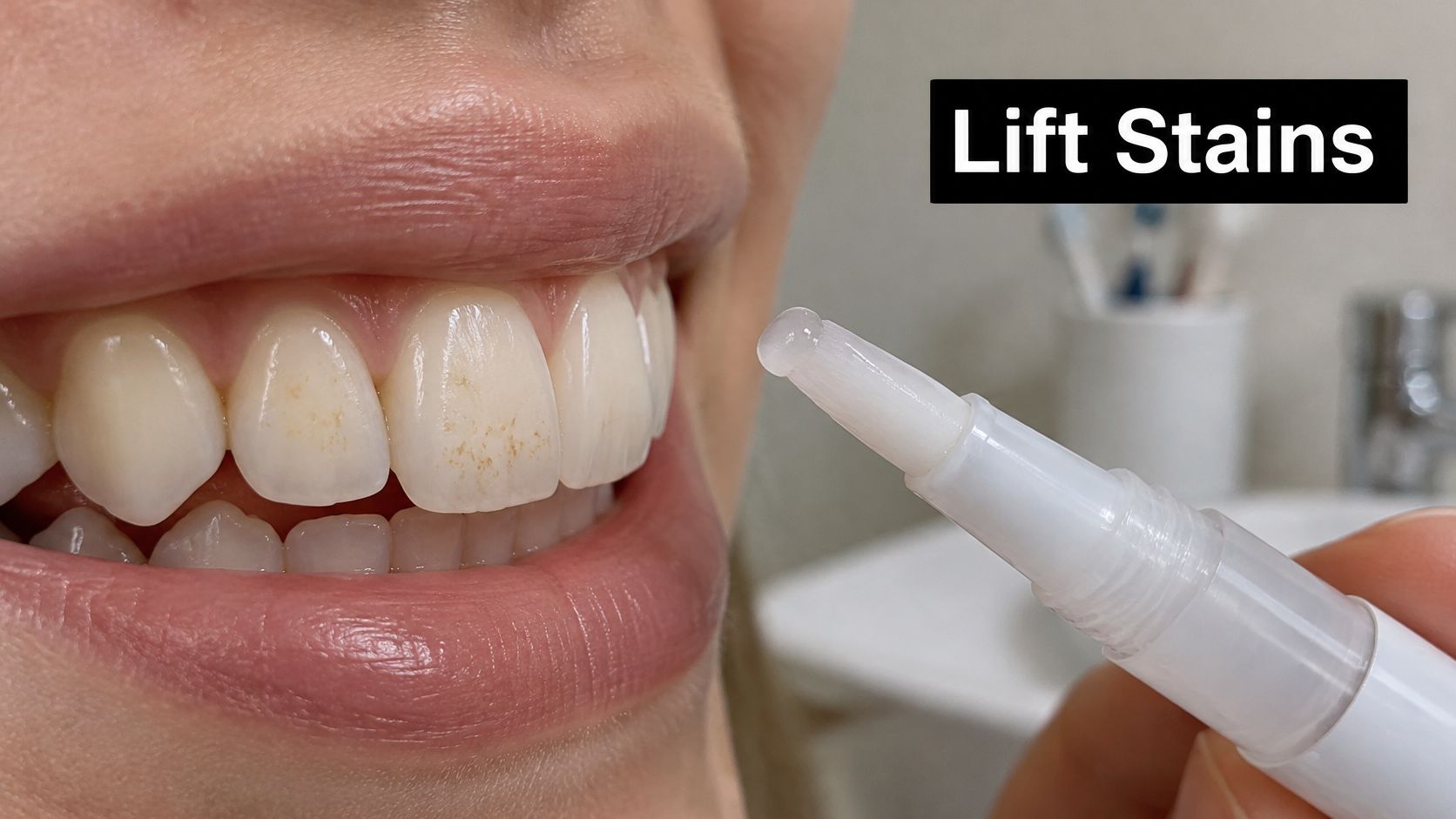
Enamel works like a sponge, not a solid sheet of glass. Coffee, tea, wine, tobacco, and food leave colored molecules in and on that porous surface. Those molecules change how the tooth reflects light.
Peroxide releases reactive oxygen that oxidizes those stain molecules into smaller, less colored fragments. As the large chromogenic molecules break apart, the tooth looks lighter. The gel changes the color of the stain. It does not coat enamel with white paint, and one pass does not scrub the color away.
Why Results Build Gradually
Each session gives peroxide a limited window to diffuse and react. Repeated, correctly timed sessions build the change. One very long session mainly raises the chance of irritation. Consistent wear beats extra contact time.
Delivery changes the pace. In-office systems emphasize rapid application under supervision. Tray-based systems emphasize controlled exposure over repeated sessions. Stain depth matters as much as gel strength, so the same concentration can look fast on one mouth and slow on another.
Judge any Sheer White product by its peroxide chemistry and the wear schedule on the label, not by the brand name. A higher percentage does not override a short contact window. A milder percentage still needs the full course.
- Extrinsic stains: Color from coffee, tea, wine, and tobacco sits mainly on or near the surface and usually responds faster.
- Intrinsic discoloration: Color inside the tooth structure is deeper, so it may respond slowly or need professional care.
- Uneven stains: Different teeth can lighten at different rates, especially where enamel thickness varies. Restorations keep their original shade while enamel lightens, which is the shade-mismatch risk most product pages skip.
What One Trial Can and Cannot Tell You
A 2024 randomized controlled trial published in BDJ Open included 39 participants, with 13 participants in each of three groups. The groups compared 20% carbamide-peroxide at-home whitening, ready-to-use gel trays, and paint-on gel.
That design is useful because it compares delivery formats, not just one gel against nothing. The trial's value is in that comparison, so results depend on the delivery method, wear schedule, and stain type.
Measure it yourself: Photograph your teeth on day 0, at mid-course, and at the end under the same lighting. Compare the photos against a shade guide in the same room each time.
Count the result as a success only if you followed the wear schedule and managed sensitivity without pushing through pain. A lighter photo after overuse means the routine needs adjusting.
Sensitivity, Restorations and Who Should Avoid It
Whitening can change the shade of natural teeth, but crowns, veneers, fillings, implants, and sealants do not lighten in the same way. The result can be a visible mismatch between natural teeth and existing dental work.
ADA guidance on whitening and restorations explains that fillings, crowns, implants, and some stains cannot be changed by tooth whitening. Decay and gum disease may need attention first, and receded gums can leave areas more vulnerable to irritation. If dental work shows when you smile, ask a dentist about shade matching before whitening.
Your Pre-Treatment Checklist
Check these points before choosing a product:
- Visible restorations: Do you have veneers, bonding, crowns, or front fillings that show when you smile?
- Untreated problems: Do you have cavities, sore or bleeding gums, or known gum disease?
- Recession: Are any roots exposed, or do certain teeth already react to cold?
- Stain type: Does the color look like surface staining, or does one tooth look dark from within?
- Decision point: If you answered yes to any of the first three questions, consult a dentist before use.
Temporary tooth sensitivity and gum irritation can occur with peroxide whitening. A brief zing after treatment differs from pain that lingers, spreads, or keeps returning. If symptoms persist, pause whitening and seek professional advice rather than doing another session to test them.
For practical suggestions on managing sensitivity, see our teeth whitening sensitivity relief guide. Aggressive or prolonged bleaching can irritate teeth and gums, so following the product's schedule is the safer approach.
Follow the label's schedule. Pause use and seek advice if symptoms persist.
Adults with orthodontic attachments, aging fillings, or several restorations should discuss shade matching with a dentist before treatment. Whitening may make nearby natural teeth lighter while leaving restorations unchanged, creating a mismatch that could require dental work to address.
How to Use Sheer White Step by Step
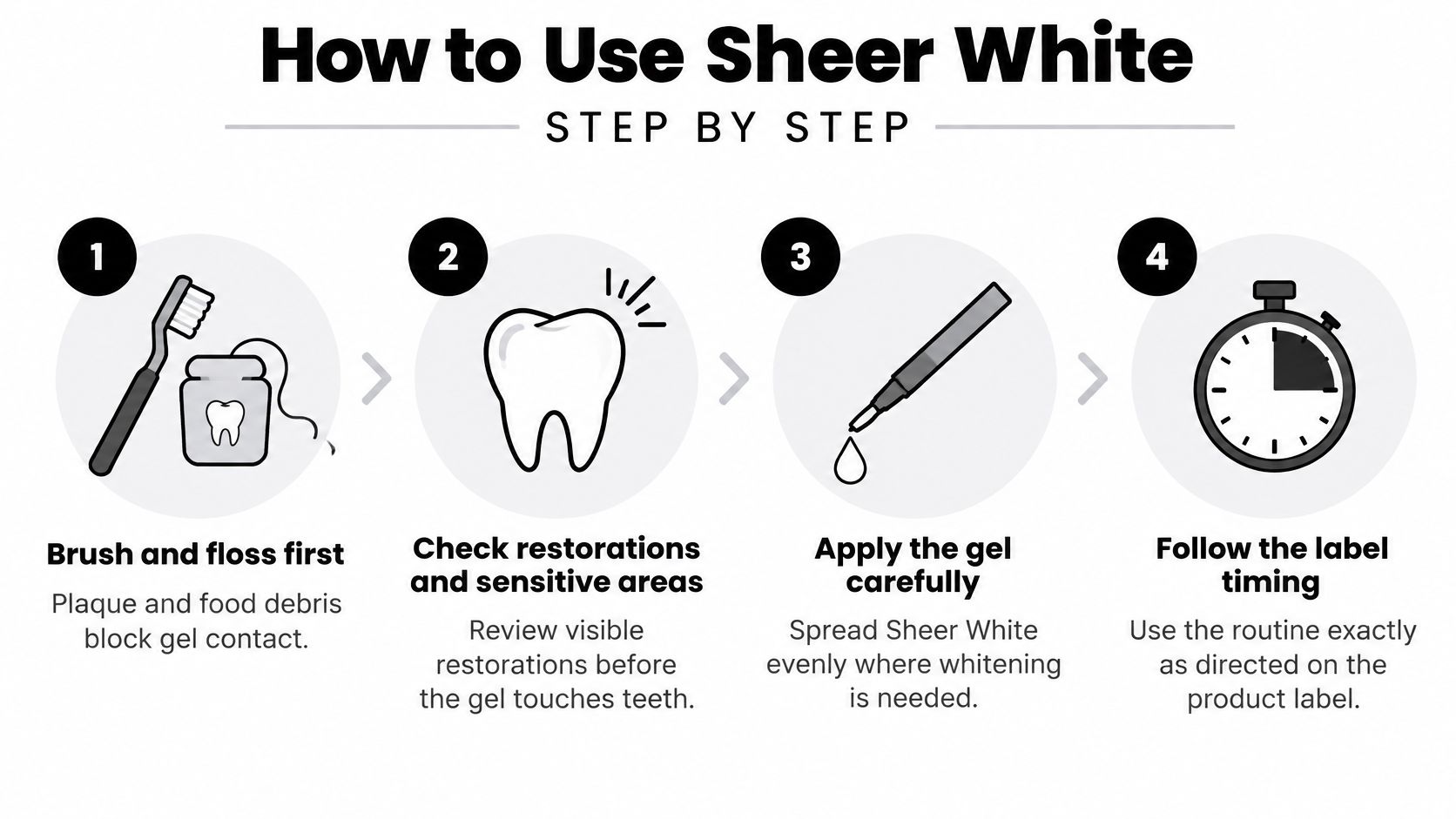
A careful routine does two jobs at once. It gives the gel clean, even contact with enamel, and it keeps peroxide away from lips and gums where it doesn't belong. Follow the product label where its directions differ from a general routine.
The Routine in Order
- Brush and floss first: Plaque and food debris block gel contact, so clean teeth give the peroxide a more even surface. Don't scrub hard right before treatment if your gums already feel tender.
- Check restorations and sensitive spots: Look for visible crowns, veneers, bonding, and exposed roots before the first use. Note any tooth that already reacts to cold water.
- Apply only the stated amount: Use the quantity the product directs, with one session per syringe where the product is designed that way. More gel mainly increases overflow onto soft tissue, not whitening speed.
- Protect lips and gums: Rub petroleum jelly onto lips and gums before each session where the product directions call for that protection. Keep the barrier thin so trays or strips still sit properly.
- Wear it for the stated time only: Set a timer and stop when it ends, because extending contact time raises sensitivity risk. Don't fall asleep with a product unless its label specifically directs overnight wear.
- Rinse and brush gently afterward: After treatment, rinse the mouth with tepid water and brush gently with a mild toothpaste. Cold water can feel harsh on freshly treated teeth, so tepid water is the safer choice.
- Clean and dry the trays: Rinse the trays and let them dry thoroughly before storing them clean. A damp, closed case traps residue and odor.
Small Habits That Prevent Uneven Results
Apply gel in a thin, even line rather than filling the whole tray. Seat the tray slowly and wipe away any gel that squeezes onto gums with a clean fingertip or cotton swab. If gel keeps overflowing, you're using too much.
Keep to the label's frequency even when you like the early change. Reduce frequency if sensitivity appears, and don't stack a second whitening product on the same day to speed things up. Your goal is repeatable sessions you can finish comfortably.
Write down each session date, wear time, and any sensitivity you notice. That short log helps you spot patterns and gives your dentist useful information if you need advice.
Alternatives and What They Cost Per Session
A per-session price helps compare whitening options, but only if the calculation uses the number of treatments in the package. The table gives supported averages and shows how to calculate costs when the package price is known.
| Option | Typical cost per session | Evidence from research | Best suited for |
|---|---|---|---|
| At-home whitening treatment | $36.97 average | 2024 at-home carbamide trial | Gradual change at home |
| Professional in-office whitening | $825.79 average | Supervised power bleaching protocol | Faster change under supervision |
| Whitening toothpaste | Tube price divided by brushing sessions; the tube price and number of uses determine the figure | 71% stain recovery after 10,000 strokes in a 2024 lab study | Maintenance between treatments |
| Sheer White (per label) | Pack price divided by the number of sessions in the pack; the package price and session count determine the figure | Compare its labeled peroxide type and concentration with the carbamide peroxide treatments discussed above | Users who can verify the label and follow timing exactly |
A 2026 survey by Self Financial of 1,079 U.S. adults found that at-home teeth-whitening treatments averaged $36.97 per session, while professional whitening averaged $825.79 per session. These are survey averages, not guaranteed prices. Compare how many sessions each price buys before judging value.
Where Toothpaste Fits
Whitening toothpaste mainly targets surface stains. It is not a substitute for peroxide gel when the goal is a clear shade change. A 2024 American Journal of Dentistry laboratory study summary reported a 71% recovery rate after 10,000 brushing strokes, compared with 48% for regular toothpaste and 43% for a reference slurry.
Those lab results do not establish how much shade change to expect from brushing at home. Whitening toothpaste may suit maintenance between treatments, but it should not be expected to correct deep discoloration or match a restoration. To estimate its cost per session, divide the tube price by the number of brushing sessions the tube provides.
For a whitening product sold as a pack, divide the pack price by the number of sessions it contains. That gives a useful comparison, but it does not make products equivalent: peroxide type, concentration, and wear schedule still matter. See this comparison of at-home and professional teeth whitening for more on differences in supervision and timing.
Choose an option that fits your stain type, existing dental work, and the schedule you can follow.
Visible front restorations can create a shade mismatch because whitening changes natural teeth, not the color of crowns or fillings. Consider that risk when comparing the treatment cost with the possible cost of addressing a mismatch afterward.
Your Pre-Purchase Decision and Shopping Plan
Buy only a product whose label states the active agent, concentration, wear time, and whether it includes a desensitizing ingredient or fluoride. Skip any product that hides one of those facts behind general claims. You can't manage sensitivity or compare value if you don't know what you're putting on your teeth.
Take a baseline photo before the first session. Use the same room, lighting, angle, and distance for every later photo, and avoid filters that change color. A reliable starting picture prevents you from judging progress by memory after a few days.
When to Book a Dentist First
Book a check before whitening if you have visible restorations, cavities, gum recession, exposed roots, or persistent sensitivity. Your dentist can confirm whether whitening should wait and whether restoration replacement may be part of the plan. That conversation is especially important when front teeth don't all have the same natural structure.
Once the label checks pass, compare products on published label data rather than shade promises. Our store's product lines include Teeth Whitening (Opalescence, Zoom, PolaNight, PolaDay), Tooth Sensitivity (Fluoridex, MI Paste), Pro DenRX, Retainer Brite, and Skin Care. DentalHealth.com offers free shipping on all USA orders, so you can compare the gel and sensitivity products you need in one order.
Choose the product whose label you can verify and whose schedule you can follow exactly. That's the safest test for Sheer White teeth whitening or any alternative beside it.
Ready to compare verified whitening gels and sensitivity care side by side? Visit DentalHealth.com to shop professional-grade whitening lines including Opalescence, Zoom, PolaNight, and PolaDay, plus Fluoridex and MI Paste for sensitive teeth, with free shipping on all USA orders.