
Teeth Whitening Gel Toothpaste: Does It Really Work?
If a tube says "whitening gel" on the front, what exactly is doing the whitening? Walk down any oral care aisle and you'll see whitening gel, peroxide gel, stain-removal gel, all promising a brighter smile in the same confident typeface. Only some of them contain anything that can change the color of a tooth. The rest polish.
That's the gap most shoppers never close, because the word gel describes a texture, not an ingredient. A teeth whitening gel toothpaste can be a mild abrasive paste with no bleaching agent at all, or a low-strength peroxide formula, and those two products behave nothing alike on your teeth.
This guide separates the two claims you're really being sold: the polishing claim and the bleaching claim. Once you can spot which one a product is making, you'll know whether it can plausibly change your shade, how long that takes, and what it can't do no matter how much you brush. The honest version is more useful than the marketing version.
Gel Toothpaste and Peroxide Gel Side by Side
Here's the short answer. A whitening gel toothpaste is a maintenance and surface-stain product you brush with for a couple of minutes. A peroxide whitening gel is a bleaching product that sits on the teeth in a tray or strip for a much longer stretch. They share a squeeze tube and a vocabulary, not a job.
| Feature | Whitening gel toothpaste | Peroxide whitening gel |
|---|---|---|
| Main active ingredient | Abrasives, sometimes low-level peroxide | Carbamide or hydrogen peroxide at higher concentrations |
| Stains targeted | Mainly extrinsic surface stains | Surface stains and some intrinsic discoloration |
| Contact time | A few minutes of brushing, twice daily | Short treatments up to overnight in trays |
| Expected change | Gradual, modest, maintenance-level | Noticeable shade change over days to weeks |
| Supervision | None needed | Label instructions, with a dentist for stronger products |
Read the table one row at a time. Active ingredient decides the mechanism: abrasives scrub, peroxide oxidizes. Stain targets follow from that, since surface film and color locked inside the tooth aren't the same problem. Contact time explains the gap in results, because minutes of brushing can't match an hour in a tray. Expected change is the realistic version of the promise on the box. Supervision is the practical difference between a product you buy without asking anyone and one where concentration, gum protection and fit start to matter.
Plenty of tubes labeled whitening gel contain abrasives and either a very low level of peroxide or none at all. That's not a scandal, it's just a different product category doing a different job. The gel texture tells you nothing about bleaching power. The ingredient list and the disclosure on the label tell you everything.
The tube test: Turn the box over. If no peroxide is named with a percentage, you're holding a polish, not a bleach.
Use the comparison as a quick reference whenever a product claims to whiten. The claim alone never reveals which mechanism is behind it, but the ingredient panel always does. Start there, and the next sections walk through how to read abrasivity numbers and brushing instructions so the choice becomes deliberate instead of hopeful.
How Peroxide and Abrasives Change Tooth Color
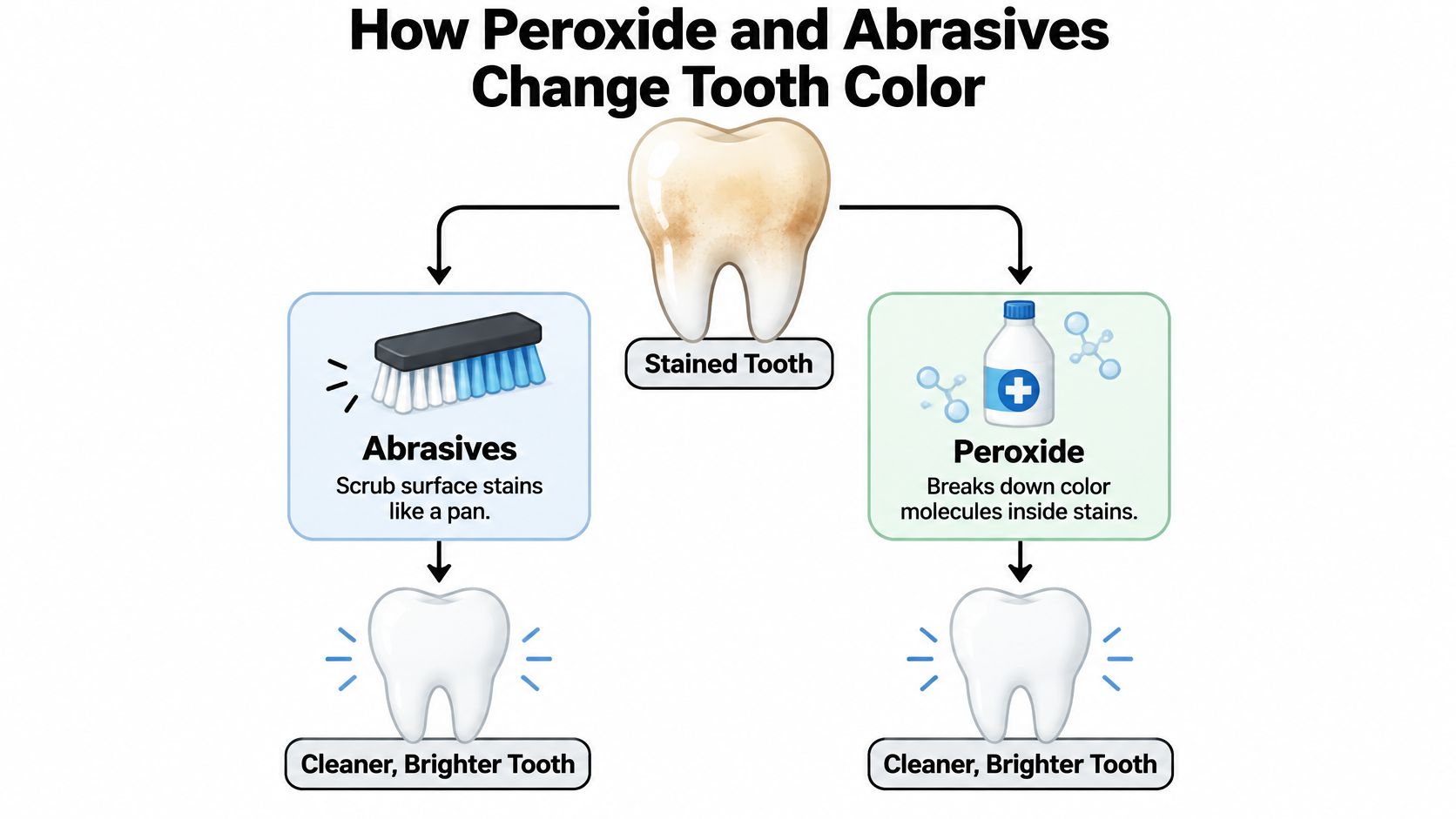
What does “whitening gel” do: polish the tooth's surface or bleach its color? The answer depends on the ingredients, not the gel texture.
The polishing mechanism
Abrasive particles in whitening toothpaste act like a gentle scouring pad, polishing away deposits on the enamel surface. This can make teeth look brighter by removing surface film. It does not change color within the tooth. The American Dental Association's whitening overview explains that whitening toothpastes mainly affect surface stains and generally do not substantially change intrinsic tooth color.
The bleaching mechanism
Peroxide compounds, such as hydrogen peroxide or carbamide peroxide, work differently. They oxidize color-causing molecules, which can reach beyond the surface. A critical review of whitening research found that some low-peroxide toothpastes produced statistically significant whitening, while other studies found only small changes within statistical error.
The results can be difficult to interpret. A quick improvement may come from polishing away surface deposits rather than bleaching color within the tooth. Toothpaste is generally better suited to surface stain removal or maintenance than to the stronger whitening associated with peroxide treatments used under dental supervision.
Label rule: A product that names peroxide and gives its concentration contains a bleaching ingredient. “Gel” or “whitening” alone does not tell you whether a toothpaste bleaches or only polishes.
Which Stains Each Product Can Remove
Teeth don't stain in one way, so no single product reaches every stain. Sort the problem into two piles first, and the product decision mostly makes itself.
Stains on the outside
These sit on the enamel surface and respond to both polishing and bleaching. Match the source to the approach:
- Coffee and tea: daily pigments that build slowly, well suited to a whitening gel toothpaste used consistently.
- Red wine and dark berries: strong chromophores that respond to polishing and to peroxide, depending on how long they've been there.
- Tobacco: the heaviest surface staining a typical person encounters, and the one where a polishing paste plus a professional cleaning does the most visible work.
- Colored foods and sauces: tomato-based sauces, cola and heavily spiced dishes all leave film that brushing lifts before it sets.
Stains inside the tooth
Intrinsic discoloration sits within the dentin or enamel structure, and it responds mainly to peroxide, often at concentrations that need supervision. The usual causes are aging, medication taken during tooth development, and trauma to a single tooth. No abrasive reaches these, and no whitening gel toothpaste will scrub them out.
One case confuses people constantly. A uniform yellow cast across the whole mouth often isn't stain at all, it's enamel thinning with the yellow dentin showing through. Toothpaste doesn't thicken enamel, so that shade stays put regardless of which tube you buy. If you want the longer breakdown of which discoloration types respond to which treatment, our guide to the stains whitening can and can't fix sorts them by cause.
A simple test: If the color wipes away with a few weeks of steady brushing, it was surface stain. If a tooth looks grey or dark all over, the problem sits deeper than any brush can reach.
That single test saves a lot of wasted money. Most disappointment with whitening toothpaste comes from asking a polishing product to fix a bleaching problem.
Realistic Results and How Long They Last
The assumption worth testing is this: a whitening gel toothpaste will do what a tray of peroxide gel does, only slower. The evidence says it often does something different, not something slower.
A clinical study of a whitening toothpaste containing 3% carbamide peroxide and 5% lactoperoxidase reported clinically satisfactory shade modification after three weeks, which sounds like a win until you read the comparison. The whitening formulation did not differ significantly from placebo or from non-whitening dentifrices. Its reported relative dentin abrasivity was 56, so low abrasivity didn't translate into a bleaching advantage either.
That result is the honest picture of the category. It doesn't mean whitening toothpaste is useless. It means the visible change is often modest and frequently comes from polishing. When a study can't separate a whitening paste from a plain one, a dramatic before-and-after photo is telling you something other than what the product did.
Why contact time decides the outcome
Brushing gives peroxide a couple of minutes against a wet, saliva-coated surface. A tray holds gel against the enamel for 30 minutes or through the night, which is why gel products built for trays produce a faster, larger shade change. Toothpaste isn't a weaker version of a tray. It's a shorter exposure with less active ingredient, and the arithmetic rarely works in its favor.
Results also fade for a plain reason. The pigments come back. Coffee, tea and smoking keep depositing color, and no toothpaste blocks that. Consistent brushing slows the return, which is exactly the maintenance role a whitening toothpaste plays well. If you want the full picture of what a realistic refresh schedule looks like, read how long teeth whitening lasts before you decide a product failed.
How to measure your own progress
Skip the mirror memory test. Take a photo in the same spot, with the same light, at the same time each week, and hold it next to a shade guide. Two things become obvious fast: whether anything is changing, and whether the change stopped after week one, which is the signature of polishing rather than bleaching.
Check before you buy: Look for a disclosed peroxide concentration, clear exposure instructions and an independently assessed abrasivity value. Gel texture is not evidence of peroxide delivery or clinical effect.
Reading Abrasivity and Peroxide Labels
A product labeled “gel” may bleach teeth, polish surface stains, or do both. Check its ingredients and claims separately: peroxide indicates bleaching, while abrasives help scrub away surface stains.
| RDA value | What it tells you | What to do |
|---|---|---|
| 100 | Reference abrasive used as the baseline for comparisons | Use it only as a reference point |
| 56 | Example from a 3% carbamide peroxide whitening toothpaste study | Low abrasivity, without a matching whitening advantage |
| 250 or below | Generally considered compatible with safe and effective daily use | Use with a soft brush and light pressure |
| Above 250 | Higher dentin wear risk, especially on exposed roots | Consider a lower value if you have sensitivity or recession |
What RDA actually measures
The American Dental Association's guidance on toothpastes says lifelong use of toothpaste with an RDA of 250 or below produces limited dentin wear and virtually no enamel wear when brushing technique is proper. RDA measures wear on dentin, which is softer than enamel. It is a safety measure, not a whitening score: a lower number does not necessarily mean a product whitens better.
Abrasive ingredients help polish stains, but brushing pressure and exposure of softer surfaces matter too. Choose a toothpaste with a disclosed RDA when possible, and follow its brushing instructions.
Three label checks, in order
1. Find a named peroxide and its concentration. Peroxide is the bleaching ingredient. For reference, Lumibrite 22% Teeth Whitening Gel contains 22% carbamide peroxide. A toothpaste without a stated peroxide concentration may still polish surface stains, but the word “gel” alone does not establish that it bleaches.
2. Look for a disclosed RDA value. A published value gives you a point of comparison. If the number is not listed, you cannot compare that product's abrasivity by RDA.
3. Follow the brushing or treatment instructions. Longer exposure does not necessarily mean more whitening, and using a product beyond its directions can increase sensitivity or gum irritation.
The guide to whitening gel ingredients explains how to read ingredient labels. DentalHealth.com offers whitening gels and toothpastes for whitening and sensitivity, so you can compare product descriptions and instructions.
If your teeth are sensitive
Sensitivity, recession, erosion, or exposed root surfaces call for extra care. Favor a disclosed moderate or low-abrasivity formula, use a soft brush, and apply light pressure. Abrasives polish surface stains; peroxide bleaches tooth color. A more aggressive polish does not make peroxide work better.
Which Product Fits Your Situation
Match the product to the kind of discoloration and the routine you can maintain. A toothpaste and a peroxide gel do different jobs, even if both use the word “whitening.”
| Situation | Better fit | Realistic expectation |
|---|---|---|
| Maintaining whiteness after professional whitening | Whitening gel toothpaste | Helps limit surface stains; little or no shade change |
| Coffee, tea or tobacco stains on the surface | Whitening gel toothpaste | Gradual improvement with regular brushing |
| Yellow or dull shade across all teeth | Peroxide whitening gel, with dental guidance if needed | Shade change depends on the product and how it is used |
| Sensitive teeth or exposed roots | Low-abrasivity toothpaste first; ask a dentist before using peroxide | Avoids unnecessary polishing while sensitivity is addressed |
| Grey or dark intrinsic discoloration | Dentist consultation | Toothpaste and over-the-counter gels may not address the cause |
After professional whitening, toothpaste is usually for maintenance. It can help remove surface buildup as it forms, but brushing does not reproduce the bleaching effect of peroxide gel.
For surface stains from coffee, tea or tobacco, whitening toothpaste may gradually polish away some discoloration with regular use. A light touch matters: pressing harder or choosing a harsher paste does not make peroxide bleaching happen faster.
A broadly yellow or dull shade is different. Peroxide gel can change tooth color because it bleaches, while a toothpaste mainly works on surface stains. Follow the gel's directions, and ask a dentist for guidance if you have sensitivity or are unsure whether it suits you.
When a dentist should assess the tooth: Grey or dark discoloration in one tooth, especially after trauma or medication, may have a cause that whitening products cannot fix. An exam can help determine the right next step.
DentalHealth.com stocks professional-grade at-home whitening gels, including high-concentration carbamide peroxide options, alongside whitening and sensitivity toothpastes. You can compare these types of products before buying. The key distinction is whether you want to polish surface stains or bleach tooth color.