
Teeth Whitening vs Bleaching: A Practical Guide
Most advice about teeth whitening vs bleaching gets the starting point wrong. People focus on which product sounds stronger, when the key question is simpler, what kind of discoloration are you trying to change, and how much sensitivity can you tolerate? If you start there, the right choice gets much clearer.
| Question | Whitening | Bleaching |
|---|---|---|
| Main target | Surface stains | Color inside the tooth |
| Main mechanism | Removes or reduces extrinsic stain | Peroxide oxidizes chromogens |
| Best fit | Coffee, tea, tobacco, routine maintenance | Natural yellowing, deeper discoloration |
| Common trade-off | Less dramatic change | More sensitivity risk with stronger formulas |
Why the Whitening vs Bleaching Question Matters More Than You Think
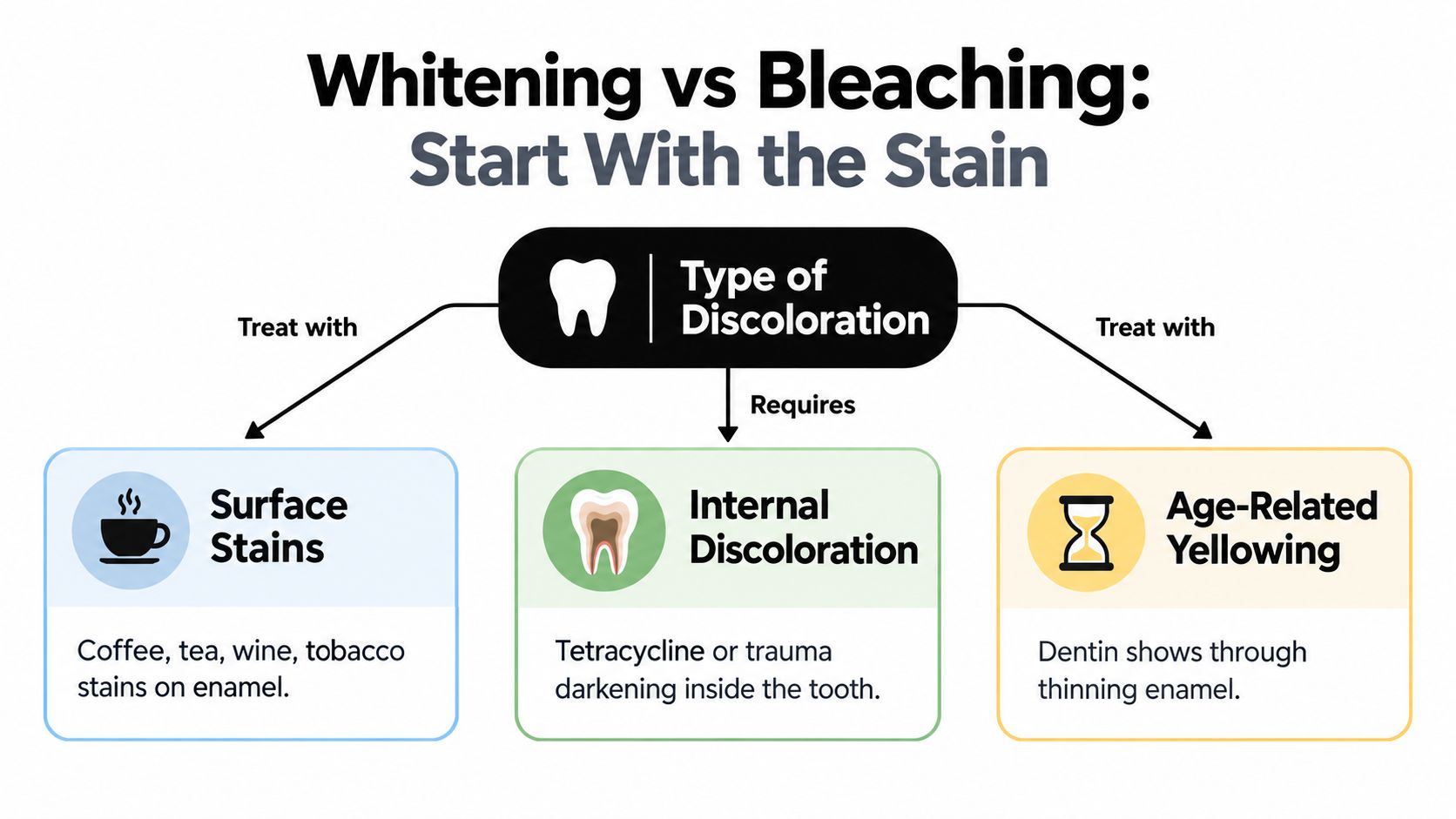
A lot of consumer language treats whitening and bleaching as if they were interchangeable. They're not, and the difference matters because the wrong product can still be useful, just not for the problem you're trying to solve. The broad category is whitening, which can mean removing surface stains from coffee, tea, tobacco, or food. Bleaching is narrower, it uses peroxide chemistry to change the color of tooth structure itself.
Start with stain origin
That distinction leads to a better decision framework. Surface stains sit on enamel and usually respond to stain removal products, including some toothpastes and similar formulas. Intrinsic discoloration lives inside the tooth and typically calls for peroxide-based bleaching. A nonvital tooth, meaning a tooth that's been injured or has lost vitality, can be a separate case and may need internal bleaching rather than a tray or strip regimen.
If you've ever bought a product labeled “whitening” and felt underwhelmed, that usually means the label described the marketing, not the mechanism. A whitening toothpaste can help lift external stain without bleaching the tooth. A peroxide gel is trying to chemically alter deeper color, which is why it tends to work differently and can cause different side effects.
Practical rule: match the product to the stain, not the slogan on the box.
Why this matters before you compare brands
The most useful comparisons always come back to active ingredient, peroxide concentration, wear time, and whether the treatment is professionally supervised. That's why one patient can do well with a simple stain-removal approach, while another needs a peroxide system that reaches deeper discoloration. It's also why restorations deserve special attention, because natural teeth and crowns or fillings don't always respond the same way.
For a plain-language breakdown of what's inside these products, see what's in teeth whitening products. That's the context that makes every later product choice make sense.
The Chemistry Behind Whiter Teeth
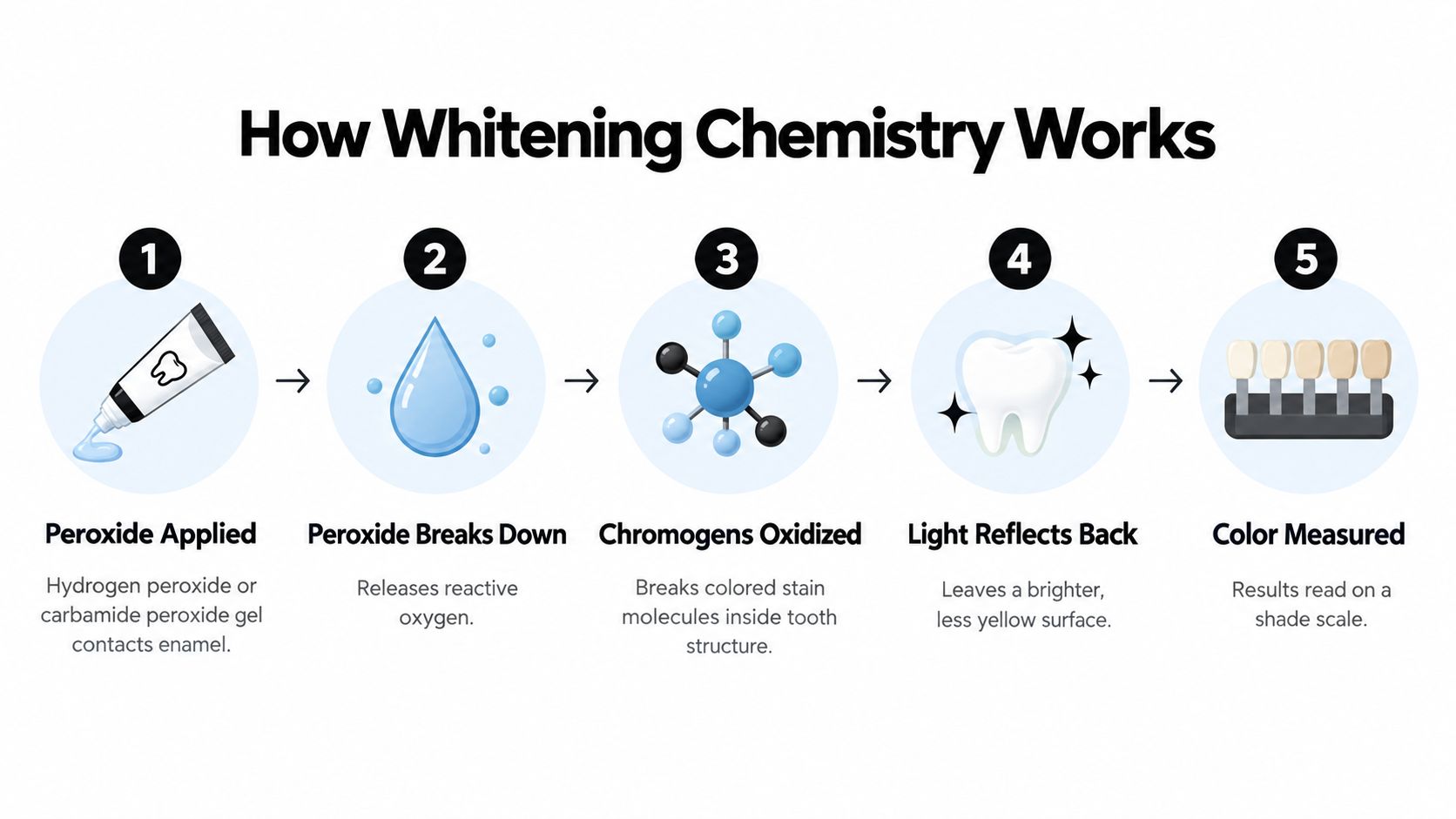
Peroxide-based bleaching works from the inside out. Hydrogen peroxide is the active bleaching agent in many systems, and it breaks down the chromogens that create discoloration. Those chromogens can sit in intrinsic staining, extrinsic staining, or both, which is why peroxide can change tooth color in a way polishing alone cannot.
Hydrogen peroxide and carbamide peroxide
Carbamide peroxide releases whitening chemistry more slowly. It breaks down into about one-third hydrogen peroxide, so 18% carbamide peroxide gives roughly the peroxide equivalent of 6% hydrogen peroxide. That kind of label difference matters, because two products can look very different on the box and still deliver related bleaching strength in the mouth.
Abrasive toothpastes work differently. They mainly remove or reduce surface stain, so they can make teeth look cleaner and brighter without changing the actual color of the tooth structure very much. That helps with coffee, tea, and other external staining, but it is a different tool from bleaching.
If a product says “whitening,” ask what is doing the work, stain removal, optical brightening, or peroxide chemistry. Those are not the same thing.
What to check on a label
Patients often bring products to the chair with the same question: why did one whiten and another barely move the shade? The answer usually sits in four label details.
- Active agent: Is it hydrogen peroxide, carbamide peroxide, or a non-peroxide stain remover?
- Concentration: Is the formula mild, moderate, or high strength?
- Wear time: How long does it stay on the teeth each day?
- Supervision: Is it dentist-directed, or is it a self-serve retail product?
Those four details tell you far more than the word “whitening” printed on the front.
They also help you match the product to the stain and the patient. Extrinsic discoloration often responds to surface stain removal, while deeper discoloration usually needs peroxide chemistry. Sensitivity history matters too, since stronger peroxide can work faster but is more likely to trigger short-term discomfort.
For a plain-language breakdown of the ingredients and delivery systems, see what is in teeth whitening products.
Comparing the Main Treatment Methods
The best whitening method depends on what you want most, speed, lower sensitivity, or easy upkeep. In-office treatment is built for fast visible change. Dentists' take-home trays are built for control and flexibility. Strips, gels, and whitening toothpastes sit lower on the intensity scale and tend to fit maintenance or mild stain reduction better than major shade change.
Whitening Method Comparison
| Method | Typical Peroxide | Supervision | Best For |
|---|---|---|---|
| In-office bleaching | Higher-strength hydrogen peroxide | Professional | Fast visible change, time-sensitive cases |
| Dentist-supervised take-home trays | Carbamide peroxide or hydrogen peroxide in moderate ranges | Professional | Controlled whitening, flexible wear |
| Over-the-counter strips and gels | Usually lower-strength peroxide systems | Minimal to none | Mild staining, budget-conscious maintenance |
| Whitening toothpaste | No meaningful peroxide bleaching in most cases | None | Surface stain removal and daily upkeep |
The in-office route can produce visible change quickly, and the ADA notes that some office protocols use 15% to 43% hydrogen peroxide, with results visible in one 30 to 60 minute appointment and sometimes equivalent to about 3 to 8 shade changes under those protocols ADA whitening guidance. Dentist-directed home trays commonly use about 10% to 16% carbamide peroxide, which acts more gradually and gives people more control over wear time ADA whitening guidance.
What each method is really good at
If you need the fastest result for a wedding or a work event, in-office whitening usually makes sense. If you want a steadier change with more opportunity to manage sensitivity, tray-based home bleaching is often the more comfortable path. If you only want to manage light surface staining, strips or toothpaste can be enough, especially as maintenance after a stronger treatment.
The delivery system often matters more than the number on the box, because wear time, tray fit, and total contact time change the result just as much as concentration does.
Whitening toothpaste deserves a realistic role in the lineup. It can help with appearance, but it's mainly a stain-management tool, not a full bleaching system. That's why people who expect toothpaste to behave like a peroxide gel usually end up disappointed.
Sensitivity, Enamel Safety, and What Stronger Formulas Actually Cost
The biggest whitening myth is that stronger automatically means better. In practice, stronger often means faster, not always more comfortable. The ADA identifies temporary tooth sensitivity and gingival inflammation as the most common adverse effects of vital-tooth whitening ADA whitening guidance.
Why concentration changes the experience
A comparative clinical study, cited in the ADA guidance, reported tooth-sensitivity rates of 44% with a 6% hydrogen peroxide protocol versus 74% with a 35% protocol. Both concentrations improved tooth color, but the higher-strength protocol produced more sensitivity under the tested conditions. That is the trade-off patients feel most clearly in the chair. Faster results do not always mean better comfort.
Review evidence points in the same direction. Concentrations around 25% to 35% hydrogen peroxide can produce whitening results comparable to higher concentrations, while higher concentrations are more likely to trigger sensitivity, as summarized in the ADA guidance above. The practical takeaway is simple, the ceiling on benefit is lower than many ads suggest.
What to do when sensitivity shows up
At-home products deserve the same caution. A systematic review found that higher concentrations such as around 20% to 22% carbamide peroxide and 14% to 16% hydrogen peroxide carried greater sensitivity risk than lower protocols, though the evidence quality was low and the studies varied. That uncertainty matters, because it supports adjusting treatment to the patient, not to the box.
Supportive care helps. I usually start with pausing treatment, then rebuilding comfort with potassium nitrate, fluoride, or CPP-ACP products, depending on the situation. If you want a practical comfort routine, how to reduce teeth sensitivity after whitening is a useful companion.
Light activation also deserves a reality check. Routine LED, halogen, or laser activation generally has not shown meaningful extra whitening in the evidence summarized in recent reviews, and it may add sensitivity instead. If a system charges extra for light alone, the question is whether it changes the outcome enough to justify the discomfort.
Which Option Fits Your Situation
The right answer changes with the stain, the tooth, and the patient. Coffee and wine staining isn't the same as age-related yellowing. A single dark tooth isn't the same as a mouth full of evenly discolored teeth. And a smile with crowns or veneers needs a different sequence than one made entirely of natural enamel.

Five common situations
- Heavy coffee or wine staining: Start with stain-removal products or dentist-supervised trays if the discoloration has settled in. Surface stain usually responds first, and a peroxide tray can be a good next step if polishing alone isn't enough.
- Natural yellowing with age: Peroxide bleaching is usually the more relevant choice, because age-related color change often involves deeper structure, not just the surface.
- Pre-existing tooth sensitivity: Choose slower-release, lower-concentration bleaching and shorter wear schedules. That usually gives you a better chance of finishing treatment comfortably.
- A single dark tooth: Get a dental diagnosis first. A nonvital tooth may need internal bleaching rather than a standard tray or strip.
- Crowns, veneers, or fillings: Whiten the natural teeth first if shade matching matters. Restorations don't always track with tooth color in the same way, so whitening after restorative work can leave a mismatch.
There's one more practical point many product pages skip. Whitening can change natural tooth shade, but restorations may not follow the same pattern. That means someone can get a successful bleach result and still feel unhappy if a crown or filling now looks darker by comparison. The order of treatment matters, especially if cosmetic dentistry is already part of the plan.
A simple decision rule
If the stain is on the surface, start with whitening. If the color is inside the tooth, think bleaching. If the tooth is nonvital or the smile already contains restorations, get a dental exam before you buy anything.
That's the point where the product choice stops being generic and starts being personal. The right method is the one that matches the stain origin and your tolerance for sensitivity, not the one with the flashiest promise.
Professional At-Home Products Worth Considering
At-home whitening works best when the formula, tray, and wear schedule fit the job. That's why the main comparison is about agent, concentration, and delivery system, not brand hype. Among professional at-home options, the fit varies by how fast you want change and how sensitive you are.
Professional teeth whitening at home is the right lens for comparing these products, because it keeps the focus on supervision and protocol rather than packaging.
Product fit by use case
- Opalescence: Commonly chosen when a patient wants a tray-based system with flexible wear options and the ability to tailor the pace of change.
- Zoom: Often selected by people who want a recognizable professional brand and a straightforward whitening regimen.
- PolaDay and PolaNight: Useful when day and night wear schedules need to be matched to tolerance, with PolaDay CP 35% representing a higher-concentration carbamide peroxide option for more intensive tray-based use.
- GLO: Fits people who want a device-driven home routine and a more structured delivery format.
For support products, Fluoridex sensitivity toothpaste and MI Paste can sit alongside whitening rather than compete with it. One helps with sensitivity management, the other supports remineralization-focused care, which matters if your whitening routine is making teeth feel more reactive.
Dentist-recommended brands usually win on disclosure and fit, not because they're magical, but because the active agent, concentration, and wear schedule are clearer from the start.
The best at-home setup is rarely the one that looks strongest. It's the one you can complete without backing off halfway through.
Choosing Well and Getting the Most from Your Routine
If you remember one thing, make it this. Match the product to the discoloration and your sensitivity risk first, then compare speed. That order keeps you from buying a “strong” option that's wrong for your teeth.
A whitening toothpaste can help with surface stain, but it won't behave like peroxide bleaching. Charcoal products are mainly stain-removal at best, and LED gadgets don't automatically outperform a well-matched peroxide regimen. A dark tooth that stays dark after cleaning needs diagnosis, not guesswork.
For maintenance, you keep results longer when you use a lighter touch, stay consistent with daily hygiene, and return to a lower-intensity routine rather than repeating strong bleaching too often. The best whitening plan is the one you can repeat safely.
If you want professional-grade at-home whitening, sensitivity support, or remineralization products in one place, visit DentalHealth.com. You can compare whitening gels, trays, Fluoridex, and MI Paste, then choose a routine that fits your stain type and comfort level.