
Tooth Builder Toothpaste: What It Does and Who Needs It
The usual advice is to grab any tube that says it rebuilds enamel and expect the tooth to grow back. That advice treats a marketing phrase as if it were a clinical category.
Tooth Builder toothpaste is a brand-style name, not a standard class of medicine. Two tubes can share those words and still use different actives, different fluoride levels, or no fluoride at all. What a paste can do depends on the ingredient panel, how early the enamel change is, and whether a dentist has already ruled out a cavity.
A paste can help minerals return to enamel that is weakened but still intact. It cannot regrow a piece of enamel that acid or a drill has already removed, and it cannot fill a hole. A faint white mark may still be in the window where toothpaste matters. A pit you can feel with your tongue is a reason for an exam, not a new tube.
Sort these pastes by the job each active ingredient has been tested to do. The name on the front is the least useful line on the package.
Tooth Builder Toothpaste Next to Other Remineralizing Options
A toothpaste labeled “tooth builder” does not identify a standard formula. Compare its active ingredients and fluoride concentration instead. Conventional anticaries toothpastes in the United States generally contain 1,000–1,500 ppm fluoride, commonly as sodium fluoride, sodium monofluorophosphate, or stannous fluoride. The American Dental Association's toothpaste guidance reports that fluoride dentifrice prevented approximately 16%–31% of caries compared with placebo or no dentifrice in pediatric and adolescent studies.
A product's “rebuilds enamel” claim refers to supporting remineralization of early lesions that have not formed a cavity. It does not mean the paste can replace enamel that has been lost or fill a hole.
For patients at high risk of root cavities, a dentist may prescribe a higher-fluoride toothpaste to use instead of a standard over-the-counter product. Calcium-phosphate and hydroxyapatite ingredients are other options, but they should not automatically be considered equivalent to fluoride for caries prevention, particularly for someone with high caries risk or recurring root decay.
Squigle Tooth Builder is one branded example. Check the active ingredient and fluoride level on the specific tube before comparing it with other options. The name alone does not tell you what is in the formula.
| Option | Main active ingredient | Fluoride content | Best-supported use |
|---|---|---|---|
| Tooth Builder-style toothpaste | Read the label; formulas differ | Confirm ppm on that tube | Early enamel support and sensitivity, not cavity filling |
| Standard fluoride toothpaste | Sodium fluoride, sodium monofluorophosphate, or stannous fluoride | 1,000–1,500 ppm | Default caries prevention for most adults and children |
| Hydroxyapatite-only paste | Hydroxyapatite | Often none; verify the panel | Early mineral loss and sensitivity, with the fluoride comparison still debated |
| MI Paste | CPP-ACP | Confirm the version on the box | Early white spots and enamel erosion support |
| Prescription fluoride toothpaste | Sodium fluoride | 5,000 ppm | Elevated root-caries risk, dentist-directed use |
How to read the comparison
Fluoride has an established role in caries prevention. Other ingredients may be selected for more specific goals, such as supporting early white spots or addressing sensitivity. Compare the evidence and intended use of fluoride and hydroxyapatite toothpastes rather than treating every “builder” paste as the same product.
Practical rule: Match the active ingredient to the claim. Read the Drug Facts panel rather than relying on the front of the tube.
Before buying, check three details:
- Named active ingredient: Hydroxyapatite, CPP-ACP, calcium-phosphate salts, and fluoride salts are different ingredients.
- Fluoride ppm: Check the stated concentration. A fluoride-free paste and one containing 1,000–1,500 ppm fluoride are different tools.
- Scope of the claim: Support for an early enamel change is not treatment for a cavity.
How Remineralizing Toothpastes Work on Enamel
Picture enamel as a brick wall that gets chipped every time you eat. Acids from food and from plaque bacteria dissolve calcium and phosphate out of the surface. Saliva tries to patch those chips with the same minerals. That back-and-forth is demineralization and remineralization. A remineralizing paste tips the balance toward the patch, but only while the lesion is still early and the surface has not caved in.
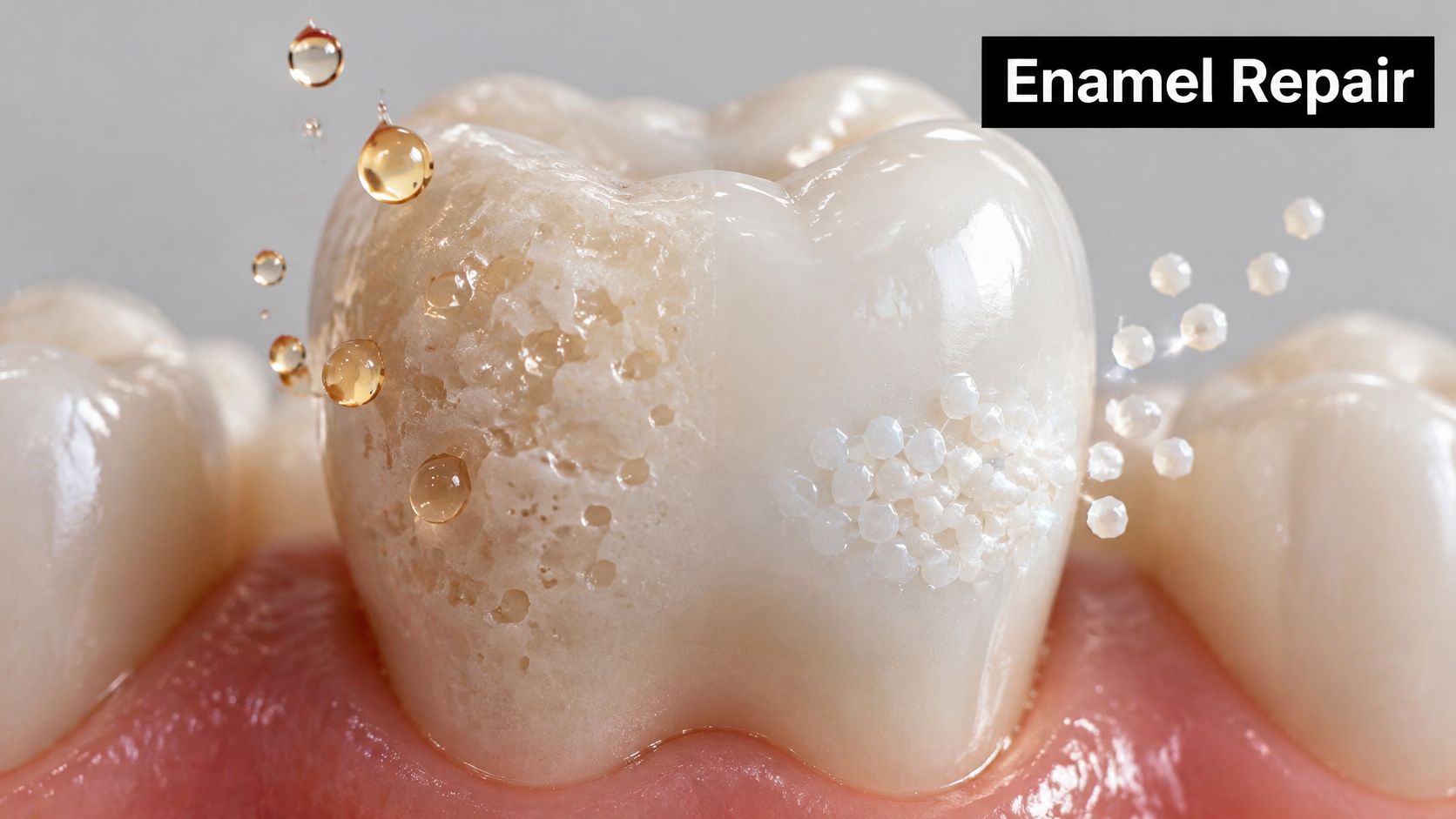
Say you sip a sweet coffee and then brush an hour later. The acid has already started lifting mineral from the outer enamel. Saliva is buffering that acid and carrying calcium back. A paste adds a concentrated dose of the mineral, or of fluoride, during that repair window. Miss the window, and a soft white change can become a hole that no paste will close.
Fluoride changes the crystal
Fluoride is the benchmark because it joins the enamel crystal and helps form a mineral that later acid has a harder time dissolving. That is a chemical change in the tooth, not a coating you can scrape off at the next meal. A clear walk-through of how fluoride strengthens teeth is worth reading before you swap a fluoride paste for something fluoride-free.
Hydroxyapatite fills surface defects
Hydroxyapatite is the mineral enamel is already made of. In a hydroxyapatite-based formula, particles can occupy superficial defects, supply calcium and phosphate, and raise resistance to the next acid challenge. That is biomimetic deposition, a surface patch made of material the tooth already uses. It is not a new layer of enamel grown from the inside out.
In a randomized clinical study of 40 adults, a biomimetic hydroxyapatite toothpaste produced statistically significant reductions in dentin-hypersensitivity measures after three months, while the fluoride control contained 1,450 ppm fluoride, and erosion scores did not significantly change during follow-up, as reported in a clinical comparison of hydroxyapatite toothpaste. A separate randomized, double-blind 30-day study found hydroxyapatite and brushite-forming pastes increased enamel acid resistance and remineralization versus a non-remineralizing paste. A short trial in 6–18-year-olds saw DIAGNOdent readings drop after one month of zinc-hydroxyapatite, but that result does not establish prevention of cavitated decay.
This short clip shows the mineral cycle in plain visuals, which makes the limits of a surface paste easier to see.
These effects are surface-level and, in the trials above, measured over weeks to a few months. That is why the pastes are most defensible for early mineral loss, exposed dentin, or sensitivity, and why they cannot replace a filling. Check whether the formula also contains fluoride, brush with low pressure, and get a diagnosis for pain that lingers, a visible pit, or a spot you can see getting larger.
What the Evidence Can and Cannot Prove
A toothpaste can improve a mineral measurement in a laboratory without proving it prevents decay during years of everyday brushing. Much remineralization research uses laboratory conditions or short-term tests, while evidence from long-term randomized trials remains limited.
Laboratory studies often create artificial challenges to test how treatments affect enamel. Those results can show changes under controlled conditions, but they cannot establish protection against real-world decay. Reviews of hydroxyapatite and other biomaterials describe promising findings while noting that much of the evidence is in vitro or short term.
Who should treat the gap as a warning
The evidence gap matters especially for adults with high caries risk, dry mouth, frequent sugar exposure, or existing cavities. Reduced saliva means less natural repair between acid attacks, and an established cavity is beyond what toothpaste can close. A favorable laboratory result is not a sound reason to drop a fluoride routine when decay risk is high.
What a paste can reasonably be asked to do
Early white spots and sensitivity are closer to the outcomes examined in remineralization studies. A suitable paste may help address those concerns, but fluoride remains the better-established choice for decay prevention. For a visible lesion or ongoing pain, a dentist can assess what is happening and whether treatment beyond toothpaste is needed.
Choose and Verify the Right Toothpaste Before You Buy
“Tooth builder” is a marketing label, not a standard product category. Hydroxyapatite, CPP-ACP, calcium-phosphate systems, and fluoride are not interchangeable: each has been studied for different outcomes, so choose by the problem you want to address.
| Situation | Starting point | Reason |
|---|---|---|
| Early white spots on enamel | Fluoride toothpaste plus a CPP-ACP remineralizing paste | CPP-ACP combined with fluoride is among the better-supported options for early white spots |
| Active or recurrent decay risk | Fluoride toothpaste, with prescription 5,000 ppm if root risk is high | Fluoride has the most established caries-prevention evidence |
| Orthodontic brackets and lesions | Fluoride-containing remineralizing paste | Fluoride is the default, and the orthodontist confirms the plan |
| Dentin sensitivity | Hydroxyapatite or fluoride desensitizing paste | Both formulas have trial support for reducing sensitivity |
| Fluoride avoidance | Hydroxyapatite-based paste with a confirmed fluoride-free label | Caries evidence is thinner, so dentist monitoring matters |
Early white spots
For early white spots, CPP-ACP combined with fluoride is among the better-supported options. Pair a fluoride toothpaste with a CPP-ACP paste such as MI Paste, rather than relying on a broad “builder” claim. DentalHealth.com's Tooth Sensitivity line includes Fluoridex and MI Paste for readers whose dentist has recommended a fluoride or CPP-ACP paste.
Active or recurrent decay
A 2025 systematic review found hydroxyapatite and fluoride toothpastes had no significant difference in caries progression, with a pooled risk ratio of 0.98 (95% CI 0.85–1.12). Another meta-analysis found hydroxyapatite performed better than placebo but was not significantly better than fluoride, with a pooled odds ratio of 1.10, as summarized in a hydroxyapatite and fluoride evidence review. These findings do not establish one ingredient as superior. Fluoride remains the starting point when decay is active or recurring. If root surfaces are at risk, ask a dentist whether a prescription-strength fluoride paste is appropriate.
Braces, sensitivity, and skipping fluoride
White marks around brackets can be hard to spot until the wires come off. Use a fluoride-containing remineralizing paste, and ask the orthodontist whether a separate CPP-ACP paste belongs in the routine.
For dentin sensitivity, both fluoride and hydroxyapatite pastes have trial support. Choose one you can use consistently. If the sting comes from a cracked tooth or decay, toothpaste alone will not treat the cause.
If you avoid fluoride, check the label to confirm the paste is fluoride-free and understand that the evidence for preventing decay is thinner. Arrange dental monitoring rather than assuming a substitute offers the same protection. Children, people with dry mouth, and anyone with new cavities should discuss a fluoride-free routine with a dentist.
What to verify before you pay
- Confirm the named active. Look for hydroxyapatite, CPP-ACP, or the fluoride salt on the label.
- Check the fluoride ppm. Note the concentration so you can compare products accurately.
- Match the claim to the lesion stage. A claim about supporting a non-cavitated spot differs from a claim that a paste repairs cavities.
- Compare price per 100 grams, not per tube. Tube sizes vary, so the unit price gives a fairer comparison.
If you have a high risk of decay, ask a dentist or hygienist which formula fits your needs. Then follow their guidance and schedule a check to see whether the spot remains stable.
How to Use Tooth Builder Toothpaste Step by Step
Read the label before you build a habit around Tooth Builder toothpaste. Fluoride content decides whether this tube is your only paste or a partner to a separate fluoride brush.
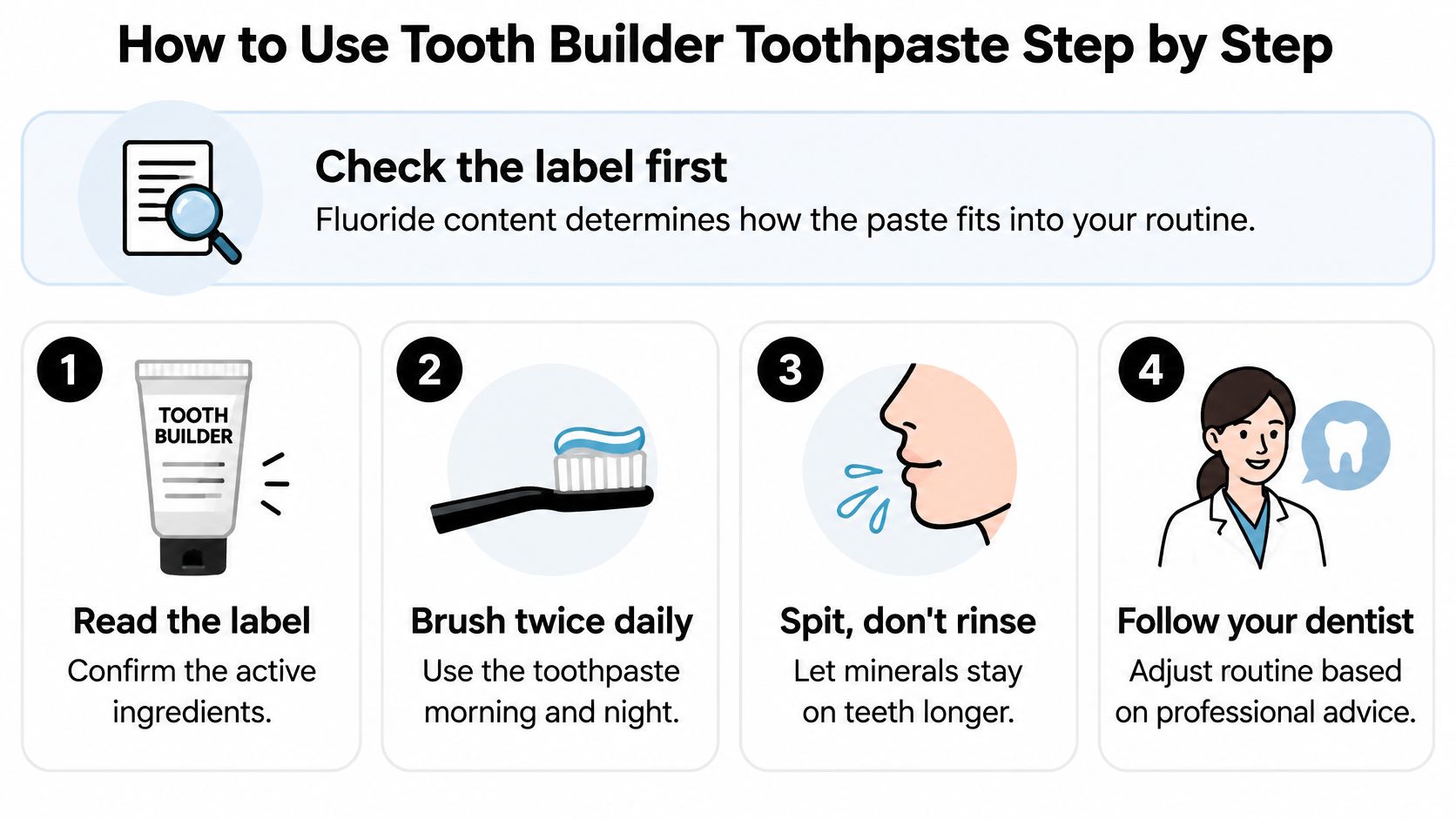
- Read the label and confirm the active and any fluoride ppm. You need the salt name and the number, not the slogan. The common slip is buying a second tube because the first one "felt different," without noticing one has fluoride and the other does not.
- Brush twice a day for two minutes with a soft brush. Two minutes is long enough to reach the gumline on every tooth. A hard brush does not clean better. It scrapes dentin that is already sensitive.
- Use a pea-sized amount. That covers a small brush head without a ribbon of paste down the handle. Extra paste mostly becomes foam you spit out.
- Use short, light strokes. Pressing harder to "feel clean" abrades enamel and can open more dentin. If the bristles splay within a few weeks, you are pressing too hard.
- Spit, and skip the immediate water rinse. Rinsing washes the active off the surface you just spent two minutes coating. The usual slip is swishing a full glass of water because the flavor feels strong.
- Wait at least 30 minutes before eating or drinking. Acid from a snack undoes the mineral you just left on the tooth. Brushing right after orange juice or soda has the same problem in reverse, because the enamel is softened.
- Keep the routine for several weeks, then let a dentist or hygienist check the result. Sensitivity and white spots are poor things to grade by feel alone. Stopping after four days because nothing dramatic happened is the most common way a sound plan fails.
What steady use looks like
A successful stretch is quieter, not dramatic. Cold drinks bother you less, and a white spot stops spreading by the next visit. If the spot grows, or if pain shows up when you are not eating, the paste has done what it can. The next move is an exam, not a third brand.
Common Mistakes and Symptoms That Need a Dentist
Three ideas cause most of the disappointment with these pastes.
- "It regrows lost enamel." It does not. Intact but weakened enamel can take up mineral. Enamel that is gone stays gone.
- "It fills a cavity." A hole needs a dentist. Brushing a pit every night does not seal it.
- "It replaces checkups." A comfortable month is not a diagnosis. Decay, cracks, and gum disease can sit under a pleasant routine.
| Symptom | Likely meaning | Next action |
|---|---|---|
| Sensitivity lasting more than a few weeks | Exposed dentin or another cause | Use a desensitizing paste and book a dentist check |
| Visible pits or holes in enamel | A cavity, which toothpaste cannot reverse | Book a dentist exam now |
| White spot that stays the same or grows | The lesion may have moved past the early stage | Dentist evaluation at the next visit |
| Pain with hot or cold after switching paste | An abrasive or irritating product, or ongoing sensitivity | Switch back to a gentle paste and check with a dentist |
| Exposed root surfaces or gum recession | Recession leaving dentin bare | Dentist review for gum and root care |
Whitening gels and gritty "stain remover" pastes can make sensitivity worse while you are trying to remineralize. So can scrubbing the gumline until it recedes. If you are treating a white spot, read a practical guide to white spot lesion treatment and keep the brushing gentle.
Any symptom that is still there after a few weeks of consistent use is a reason for a professional diagnosis. It is not a reason to rotate through another three tubes.
DentalHealth.com carries professional-grade sensitivity and remineralizing pastes, including Fluoridex and MI Paste, plus whitening systems from brands dentists already use in the office. If you are matching a formula to early white spots, sensitivity, or a fluoride plan your dentist set, browse the Tooth Sensitivity and whitening lines and read the product details before you buy. Visit DentalHealth.com to compare those options and order with free shipping on USA orders.