
What Is Zoom Whitening for Teeth: A Complete Guide
You want a brighter smile for a wedding, a photo session, or just more confidence when you speak, but the whitening aisle offers strips, trays, gels, lamps, and competing professional systems. The question isn't just whether whitening works. It's which treatment can improve your shade while keeping sensitivity, dental restorations, and long-term maintenance under control.
So, what is Zoom whitening for teeth? It's a professional, in-office bleaching system that uses a high-concentration hydrogen peroxide gel, with the option of light activation depending on the protocol. Unlike a generic cosmetic product, Zoom has been evaluated in clinical comparisons, which makes its results and trade-offs easier to discuss realistically.
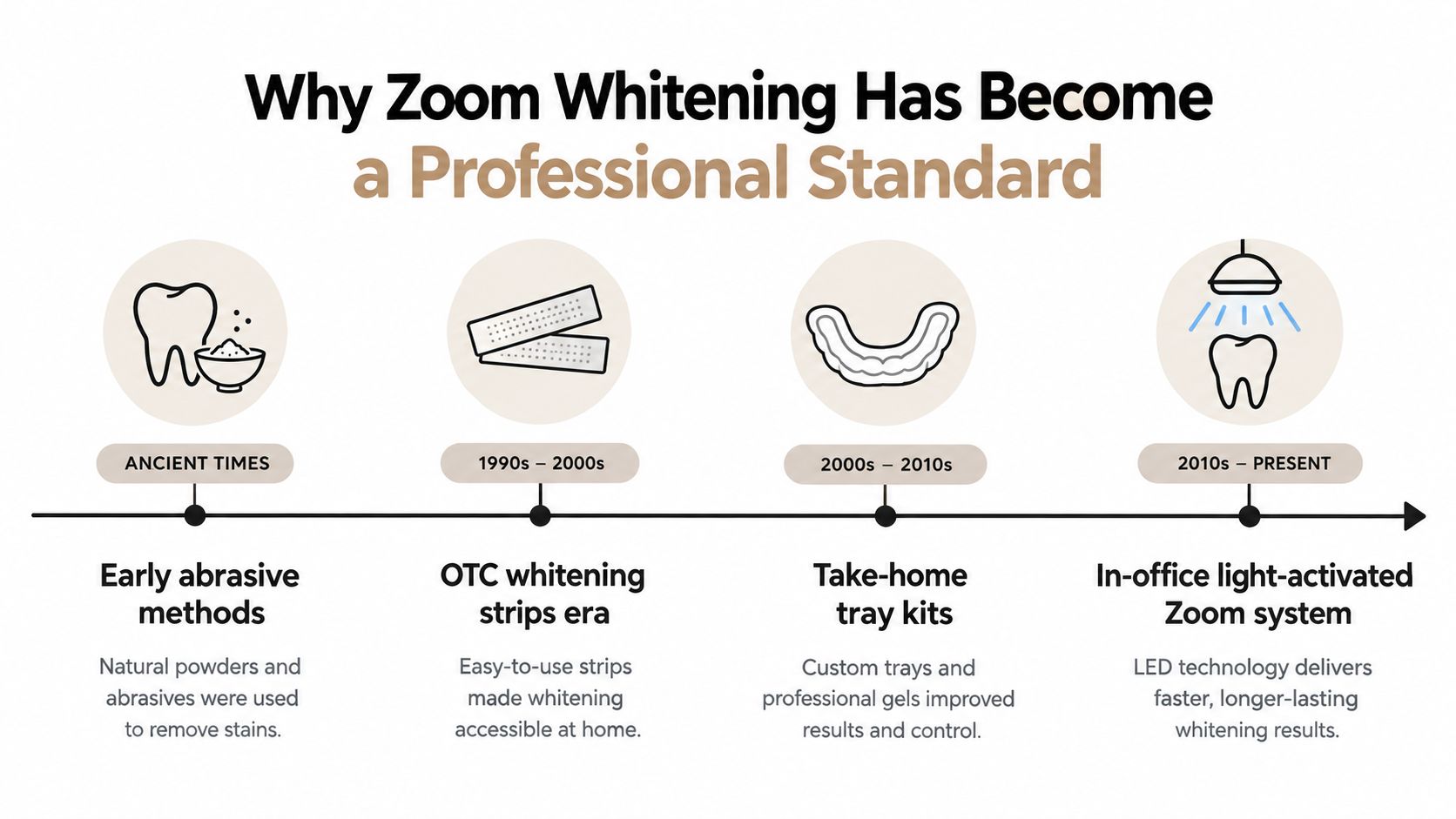
Why Zoom Whitening Has Become a Professional Standard
A patient often arrives expecting a simple answer: “Will Zoom make my teeth white?” A better consultation starts with a different question: What caused the discoloration, and how quickly do you need to change it? Surface stains, naturally darker tooth color, and deeper internal discoloration don't all respond in the same way.
Zoom became prominent because it brought a standardized, professionally supervised approach to chairside bleaching. The system uses peroxide directly on the teeth while the dental team protects the gums and monitors the treatment. That separates it from many over-the-counter products, where the concentration, fit, application, and exposure time may be less individually controlled.
From peroxide bleaching to chairside treatment
Professional whitening didn't appear overnight. Earlier peroxide techniques and custom-tray approaches created the foundation for modern bleaching, while nightguard vital bleaching introduced in 1989 helped establish peroxide whitening as a mainstream dental procedure. Later research examined light-activated, in-office systems, including Philips Zoom, within a more structured clinical setting. This broader history is reviewed in the clinical literature on the development of dental bleaching.
The important point is that Zoom is not a lamp marketed merely as a shortcut. Philips Zoom WhiteSpeed has been tested using 25% hydrogen peroxide against another chairside system using 38% hydrogen peroxide. In one randomized clinical trial, Zoom produced an average improvement of 6 to 9 shade changes and performed better than the comparison system at several measured points, including immediately after treatment, Day 2, and Day 7, with reported statistical significance of p < 0.0001 or better in those comparisons. Those findings appear in the randomized clinical comparison of professional whitening systems.
Practical rule: A strong professional result isn't defined by peroxide concentration alone. It also depends on diagnosis, isolation, exposure control, and how the dentist manages sensitivity.
That evidence doesn't mean every patient will see the same shade change. Existing restorations, intrinsic discoloration, enamel characteristics, and the chosen protocol all affect the visible result. It does mean patients can evaluate Zoom as a documented professional system rather than treating it as an unknown cosmetic gadget.
How Zoom Whitening Actually Works
Zoom whitening is a peroxide bleaching treatment, not a coating that paints teeth white. Hydrogen peroxide moves through enamel and dentin and reacts with chromogenic molecules, the colored compounds responsible for much of a tooth's darker appearance. Through oxidation, peroxide breaks down those molecules into smaller, less strongly colored compounds, reducing the tooth's overall body color.
The process is controlled by the clinician. The dentist selects the product and exposure protocol, protects soft tissue, and watches for signs that the gums or teeth need attention. Properly performed bleaching targets discoloration within the tooth structure. It doesn't scrub enamel away, and the goal isn't to keep increasing peroxide until the teeth reach an artificial-looking shade.
Why stronger doesn't automatically mean better
Peroxide concentration matters, but it isn't the only variable that determines the outcome. Once peroxide diffusion reaches an effective level, increasing the concentration further may not reliably produce more whitening. It can, however, increase the likelihood of pulpal irritation and sensitivity.
Moderate-certainty evidence indicates that hydrogen peroxide concentrations around 25% to 35% can provide whitening outcomes comparable to higher concentrations while reducing sensitivity. The review of peroxide concentration, whitening efficacy, and sensitivity supports a practical approach: optimize the protocol instead of assuming the strongest available gel is automatically the most effective choice.
This is why I focus on the complete treatment design rather than one number on the product label. Gum isolation, gel placement, contact time, treatment intervals, and the patient's existing sensitivity all influence comfort. A carefully controlled protocol may be more suitable than an aggressive one for someone with exposed dentin or a history of sensitivity.
What peroxide can and can't change
Peroxide can lighten natural tooth structure, but it won't change the shade of porcelain or resin restorations. It also may be less predictable for deep discoloration caused by trauma or other internal changes. A dental examination helps distinguish a stain that should respond well from a color problem that may need a different cosmetic solution.
The realistic goal is a brighter natural smile, not a guarantee that every tooth will match a shade guide or that all discoloration will disappear. A dentist should explain that distinction before treatment begins.
What to Expect During a Zoom Whitening Appointment
The appointment should feel structured, not mysterious. A responsible provider begins by checking whether whitening is appropriate, identifying obvious dental problems, and recording the starting shade. If a cavity, gum problem, crack, or another source of discomfort needs attention, whitening may need to wait.
The treatment sequence
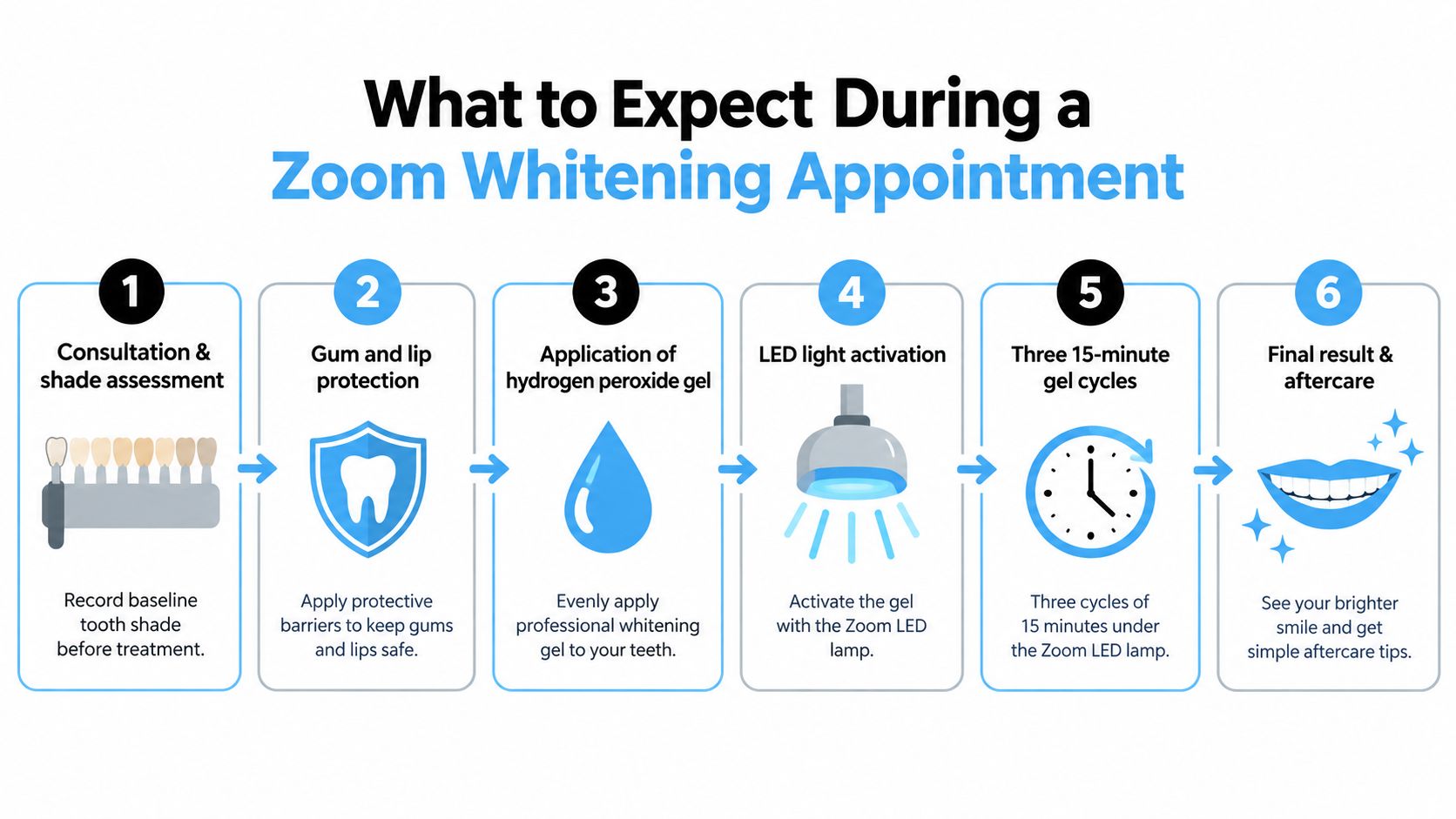
A typical professional appointment includes these stages:
- Consultation and shade assessment. The dentist examines your teeth and records a baseline shade so the result can be evaluated against where you started.
- Soft-tissue protection. Lips and gums are isolated from the peroxide gel. This step matters because gel touching the gums can cause irritation.
- Gel application. The clinician places the whitening gel carefully on the visible natural tooth surfaces.
- Optional light activation. If the selected Zoom protocol uses WhiteSpeed LED, the lamp is positioned according to the manufacturer's instructions.
- Controlled treatment cycles. The team removes and refreshes gel according to the protocol while checking your comfort.
- Final evaluation and aftercare. The dentist removes the materials, reviews the shade, and explains how to manage sensitivity and protect the result.
You may feel cool air, pressure from the cheek and lip retractors, or brief sensitivity during the treatment. You should tell the dental team if you feel sharp discomfort or burning. The provider can assess the gel, isolation, exposure, and lamp position rather than expecting you to tolerate unnecessary pain.
Here is a visual overview of the procedure and the equipment patients may encounter:
What the light actually contributes
Light activation receives considerable attention in whitening marketing, but clinical evidence doesn't support treating the lamp as the essential source of the whitening effect. A review of light activation found that adding light to vital-tooth in-office bleaching did not consistently increase efficacy or accelerate bleaching. In a Philips Zoom study, 6% hydrogen peroxide with WhiteSpeed LED produced a statistically larger immediate shade reduction than the same peroxide concentration without LED, but the broader evidence remains mixed. These findings are summarized in the Philips clinical material on Zoom and light activation.
The practical takeaway is that light may contribute to results in a particular Zoom protocol, but it shouldn't distract from the factors that matter most for safety and comfort. Ask which gel and light protocol the dentist uses, how sensitivity is managed, and what result is realistic for your teeth. For guidance after treatment, review this Zoom whitening aftercare guide.
Zoom vs Other Whitening Options
Zoom is attractive when speed matters, but speed isn't the only reason to choose a whitening method. A patient with sensitive teeth may prefer a lower-concentration take-home system that works gradually. Someone with a fixed deadline may accept a higher sensitivity risk in exchange for an in-office appointment. Another patient may need combined treatment because a single session doesn't provide the desired control.
The comparison below focuses on practical differences rather than claiming that one method suits everyone.
| Option | Shade Improvement | Treatment Time | Sensitivity Risk | Best For |
|---|---|---|---|---|
| In-office Zoom | Strong, rapid change may be possible on natural teeth | Concentrated chairside appointment | Can be significant, depending on protocol and patient | Patients who prioritize speed and professional supervision |
| Other in-office peroxide systems | Professional whitening, with results varying by gel and protocol | Chairside treatment | Depends on peroxide concentration, exposure, and light use | Patients comparing different dental-office protocols |
| Custom take-home trays | Gradual, controlled improvement | Spread across repeated home applications | Often easier to adjust by reducing exposure or spacing applications | Patients who prefer flexibility or gradual whitening |
| Combined in-office and take-home Zoom | Initial chairside change with home maintenance or continuation | Divided between the dental office and home | Can be managed across stages | Patients seeking a staged approach and maintenance flexibility |
| Over-the-counter strips | More limited and less uniform coverage | Repeated use at home | Gum irritation and sensitivity are possible | Patients seeking a lower-commitment option |
A retrospective study of combined in-office and take-home Zoom reported whitening effects lasting up to 12 to 15 months, with 1.8% immediate sensitivity, as described in the study record on combined Zoom protocols. That result shouldn't be treated as a promise for every patient, but it illustrates why a staged plan can be worth discussing. It may provide more opportunities to adjust exposure and maintain the shade than relying on one intense appointment.
Restorations change the decision
Crowns, veneers, bridges, dentures, and other restorations don't whiten. The natural teeth around them may become lighter while the restoration remains at its original shade. That can create a mismatch, particularly when a visible front-tooth restoration was selected to match teeth that have since darkened.
If you're planning new veneers or crowns, whitening is generally discussed before the final restoration shade is selected. If you already have restorations, ask the dentist to show you how whitening could affect the contrast. You may decide that a gradual approach is more predictable, or that replacing a visible restoration is part of the longer-term plan.
Cost also varies by provider, location, diagnosis, and treatment design. Rather than choosing solely by advertised price, compare what the fee includes, how sensitivity is managed, whether follow-up is available, and whether the system matches your dental condition. This guide to how much Zoom whitening costs can help frame the questions to ask before booking.
Understanding Sensitivity and Safety
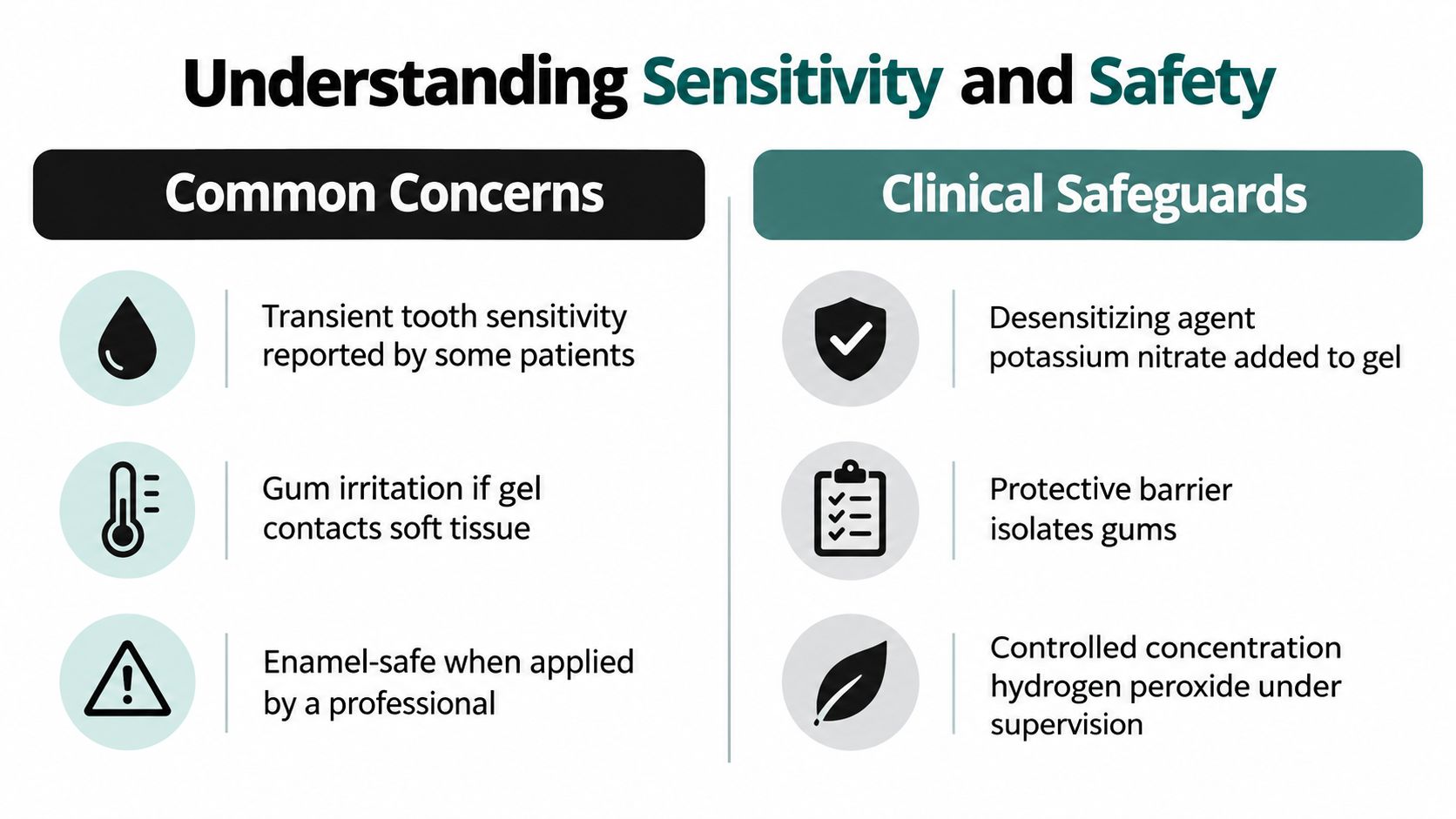
Sensitivity is the main trade-off that deserves a direct conversation. It can feel like a quick electric “zing” from cold air or drinks, or a more persistent ache after treatment. The experience isn't uniform, and studies using different protocols and patient groups have reported very different outcomes.
One study found transient tooth sensitivity in 39.4% of patients. In another trial, 98.5% of Zoom patients reported no sensitivity immediately after treatment, and 82.1% still reported no sensitivity at Day 7. Those figures come from the clinical review of whitening sensitivity and safety, and they show why “sensitivity is temporary” is an incomplete explanation.
Why patients respond differently
Sensitivity can reflect the peroxide exposure, the selected concentration, the condition of the enamel, exposed root surfaces, cracks, existing dental work, and a person's baseline response to cold. The light may also affect comfort for some patients. Clinical material has described patients finding the lamp too intense or reporting a burning sensation, which makes proper positioning and communication important.
A review published in 2025 also noted that violet-light activation may improve whitening efficacy without increasing sensitivity, but that finding doesn't eliminate the need to evaluate the individual protocol. Light settings and adjunctive approaches should be discussed with the treating dentist rather than assumed to be interchangeable.
Reducing the chance of discomfort
Before treatment, tell the dentist if cold drinks already cause pain, if you've had sensitivity after strips, or if a previous whitening session was uncomfortable. The clinician may recommend a desensitizing strategy, modify the exposure, or suggest a gradual take-home protocol instead.
During treatment, speak up about sharp pain or soft-tissue burning. Afterward, follow the practice's instructions, avoid experimenting with extra whitening gel, and contact the dentist if discomfort is severe, worsening, or doesn't settle as expected. This guide to why Zoom whitening can hurt explains the issue in patient-friendly terms.
Comfort is part of the treatment result. A shade change isn't a successful outcome if the protocol ignored the patient's sensitivity profile.
People with untreated cavities, active gum disease, cracks, or unexplained dental pain should have those problems assessed before cosmetic whitening. Whitening isn't a substitute for diagnosis, and bleaching a painful tooth can make it harder to identify the original problem.
Is Zoom Whitening Right for You
Zoom may suit you if you want a rapid change, have healthy natural teeth, and accept that some temporary sensitivity is possible. It may be less suitable if your priority is maximum comfort, if you have extensive visible restorations, or if the discoloration is unlikely to respond to peroxide alone.
Use these questions to guide the consultation:
- What is causing the discoloration? Surface staining and naturally darker teeth may respond differently from deep internal discoloration.
- Which teeth are natural? Crowns, veneers, bridges, and dentures won't change shade with bleaching.
- How sensitive are you already? A history of cold sensitivity may favor a staged or lower-intensity protocol.
- What does the appointment include? Ask about examination, gum protection, gel concentration, light use, aftercare, and follow-up.
- What maintenance will you need? A bright result still faces future staining from diet, tobacco, and normal aging.
The best choice isn't necessarily the strongest or fastest option. It's the treatment that matches your shade goal, dental condition, timetable, and tolerance for sensitivity. A professional assessment can also prevent the disappointment of whitening natural teeth only to reveal a mismatch with an existing restoration.
DentalHealth.com offers Philips Zoom take-home gels alongside professional-grade whitening products and sensitivity-care options, so you can discuss maintenance or a gradual approach with your dentist. Visit DentalHealth.com to review the available products and practical whitening guidance before choosing your next step.