
Zoom Whitening Relief Gel: What It Is and How to Use It
Cold water can feel like a small electric spark after a whitening visit. That spark is the problem Zoom whitening relief gel is meant to calm: Philips sells it in professional materials as Relief ACP Oral Care Gel, a desensitizing gel applied in whitening trays for whitening-related sensitivity.
Here is the part that trips people up. Philips documents this relief product as an amorphous calcium phosphate gel, while many guides talk about potassium nitrate and fluoride desensitizers. Those recipes are not interchangeable, so read the label on the box or syringe before assuming what is inside.
The evidence is useful but narrow: Philips has reported survey results for in-office Zoom paired with Relief ACP, not a guarantee for every tray, strength, or mouth.
What Zoom Whitening Relief Gel Is
Say you just finished an in-office Zoom visit. The peroxide gel did the color work. The gel that goes into the tray afterward is there for comfort, the way a cold pack soothes a sore muscle after a workout without undoing the training. Zoom whitening relief gel isn't a whitening agent, and it doesn't stand in for the peroxide gel.
Philips' professional materials name the product Relief ACP Oral Care Gel. It's an amorphous calcium phosphate (ACP) oral-care gel, built to support enamel mineral balance while easing discomfort during professional whitening. Sensitivity is one of the most common short-term side effects of peroxide bleaching, so that comfort step matters.
Philips reported results from a 2013 U.S. survey of 135 patients who received in-office Zoom whitening together with Relief ACP. 99% experienced "little to no sensitivity" during treatment, about 134 of 135 people. That number covers only that pairing. It isn't a rate for every peroxide strength, every brand, or every mouth.
| Feature | Detail | Context |
|---|---|---|
| Product name | Relief ACP Oral Care Gel | Name used in Philips professional materials |
| Core technology | Amorphous calcium phosphate (ACP) | Mineral-based oral-care gel |
| Intended use | Comfort during and after Zoom whitening | Targets whitening-related sensitivity |
| Applied in | Whitening trays | Placed in trays for 30 minutes in the 2019 trial protocol |
| Post-application rule | No eating or drinking for 30 minutes | Manufacturer protocol used in the 2019 trial |
| Evidence benchmark | 99% of 135 surveyed patients reported little to no sensitivity | 2013 U.S. survey, in-office Zoom with the gel |
Before you order, match the name on the package to the name in the directions. Retail boxes don't always use the same wording as professional materials.
Active Ingredients and How They Ease Sensitivity
Peroxide from the whitening gel can slip through enamel and dentin and stir up a short-lived inflammation in the pulp. The tooth then feels sharp with cold, sweet, or air. Relief formulas try to quiet that reaction. They don't bleach, and they don't repair a cracked tooth.
Each ingredient handles a different step of that reaction. Sodium fluoride works like caulk in hairline gaps in grout: it promotes mineral deposition and slows fluid moving through the tiny channels in dentin that carry sensation toward the nerve. Potassium nitrate turns down the volume on the nerve's signal, so the same fluid shift feels less loud. Amorphous calcium phosphate supplies calcium and phosphate, giving enamel mineral balance raw material to work with.
Two ingredient families show up in the research here, and they are easy to confuse. The American Dental Association identifies 5% potassium nitrate plus 2% sodium fluoride as a studied pretreatment combination, and it explains bleaching sensitivity as peroxide diffusion plus transient pulpal inflammation. Meta-analyses of potassium nitrate products suggest they can modestly reduce bleaching sensitivity, with small drops in intensity. On color change, the evidence has reached no definitive conclusion. Useful evidence, with limits.
| Ingredient | Role in the tooth | Where it appears |
|---|---|---|
| Amorphous calcium phosphate (ACP) | Supplies calcium and phosphate to support enamel mineral balance | Relief ACP, the Philips Zoom relief product |
| Potassium nitrate | Reduces nerve excitability in the pulp | ADA-referenced pretreatment at 5%, paired with fluoride |
| Sodium fluoride | Promotes mineral deposition and reduces fluid movement in dentinal tubules | ADA-referenced pretreatment at 2%, paired with potassium nitrate |
| Peroxide (in the whitening gel, not the relief gel) | Diffuses into the tooth and can cause transient pulpal inflammation | The source of the sensitivity the relief gel manages |
Read the table as two columns of evidence, not one formula. The first row is what Philips documents inside Relief ACP. The middle rows are the pretreatment pairing the ADA references in whitening research. They are different approaches to the same problem: one leans on mineral supply, the other on calmer nerves and sealed tubules.
Label check: Philips documents Relief ACP as an ACP-based gel. A guide that lists potassium nitrate and fluoride may be describing a different product. Read your tube before you assume both sets of ingredients are inside.
The gel is aimed at a short reaction in the tooth. It doesn't diagnose or treat decay, a crack, a failing filling, or irreversible pulp disease. If pain is spontaneous, stuck on one tooth, or getting worse, a desensitizer isn't the treatment.
Using Relief Gel With At-Home Whitening Trays
Relief gel was studied in trays during a Zoom protocol. The closer your setup is to that protocol, the more you can lean on those results. A loose tray or a different peroxide brand is a different experiment.
Custom trays hug the teeth and keep gel off the gums. A one-size tray often gaps at the edges, so gel spills, gums burn, and less product stays on enamel. A relief gel also doesn't replace a prescribed custom tray or the visit where a dentist checks the fit.
| Setup | Match to studied protocol | What to check |
|---|---|---|
| In-office Zoom session with relief gel in trays | Closest match: the 2019 trial protocol | Follow the clinic's gel amount and wear time |
| Zoom at-home kit with a Zoom relief product | Use only when the kit names that relief product | Use only the relief product named in the kit instructions |
| Custom-fitted trays from a dentist | Close match when the fit is good | Ask about gel amount and wear time for your tray |
| Store-bought one-size trays | Poor match | Poor seal can spill gel onto gums |
| Non-Zoom whitening gel (for example Opalescence) | Different formulation | Check the relief product's label before combining |
| Sensitivity toothpaste with no tray | Not the same protocol | Use as a separate daily habit, not as a tray substitute |
Don't pair a Zoom relief gel with a non-Zoom peroxide, or the reverse, until both labels say the mix is intended. Opalescence and similar gels have their own instructions. A sensitivity toothpaste can be a daily habit. It isn't a tray substitute. If you're choosing trays, start with how Zoom whitening trays are meant to seat before you load any gel.
Match three things before the first session: tray type, whitening product, and relief product. If one of them is unnamed on the instructions, pause and ask the provider who gave you the kit.
How to Use Zoom Whitening Relief Gel Step by Step
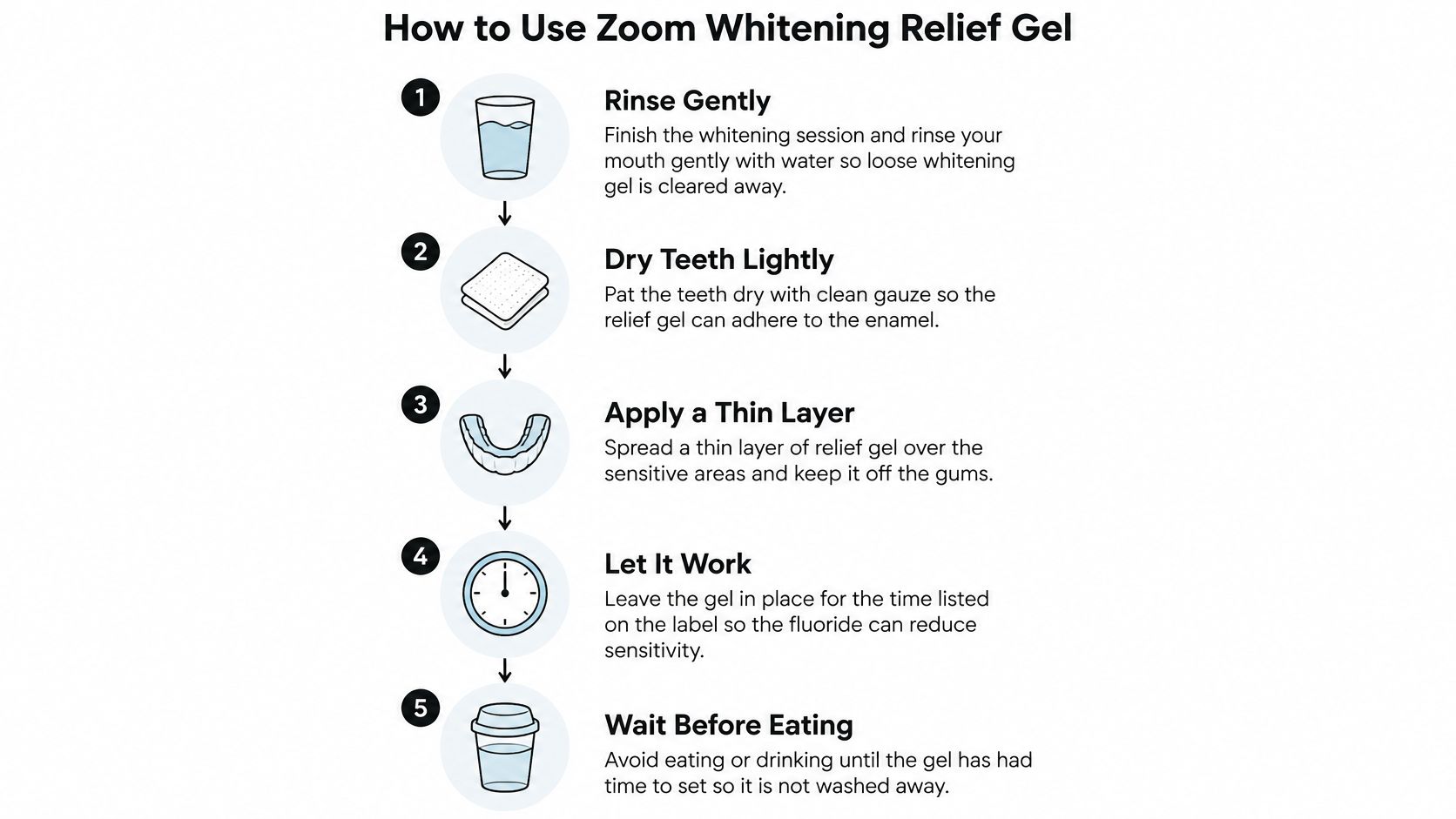
The sequence below follows the tray time and the wait used with Relief ACP in the Zoom protocol. One check before you start: Relief ACP is documented as an ACP-based gel, while many guides describe potassium nitrate and fluoride formulas, so read the name on your box instead of assuming the directions match. Your packaging wins if it prints a different amount or time.
- Finish the whitening session and rinse gently with water so leftover peroxide isn't sitting on the teeth when the relief gel goes in.
- Pat the teeth dry and read the package. You want the relief product, not a second syringe of whitening gel.
- Spread a thin, even layer in the clean tray, using the amount on the directions. An overfilled tray squeezes gel onto the gums.
- Seat the tray evenly and wipe excess with a soft tissue so the gums stay clear.
- Wear it for 30 minutes, the time used in the 2019 trial protocol, unless your product or provider prints another time.
- Remove the tray and spit out residue. Don't scrub the teeth yet.
- Wait 30 minutes before you eat or drink. The pause works like drying time on a fresh coat of paint: the gel needs contact with the enamel, and a snack or sip washes it away early.
- Brush later in the day with a soft brush. Hard pressure right after bleaching only adds irritation.
A short clip of tray seating helps if you've never loaded a custom tray. Watch the gel line stay inside the tray edge, then compare that with your own fit.
Mistakes that undo the step
- Guessing on the order. The studied protocol applies relief gel after whitening, and whether it can go on earlier is still unsettled. If you want to try relief first, ask the provider who fitted your trays rather than swapping the order yourself.
- Food or coffee right after removal: The 30-minute wait is part of the method. Rinsing it away early cuts the contact time.
- Biting the tray down hard: Pressure doesn't seat a poor fit. It pushes gel onto the gums and can make the tray rock.
If your directions change the wear time, the amount, or the order of relief and whitening, follow that sheet. A clinic protocol and a home kit aren't always identical.
What Sensitivity Is Normal and When to See a Dentist
A zing after bleaching isn't proof that the enamel is being destroyed. It's often a temporary reaction that fades across several days. The useful question is whether your pattern matches a short recovery or a problem that a gel will only hide.
A 2019 randomized trial followed 24 patients through three whitening cycles and checked them at 1 day, 2 days, and 1 week. Participants placed Relief ACP Oral Care Gel in trays for 30 minutes and then avoided eating or drinking for another 30 minutes. Pain scales were tested at a significance threshold of P ≤ 0.05. The trial report found sensitivity on the first and second days. Both the descending-light-intensity group and the high-light-intensity group recorded zero sensitivity on both scales at the 1-week check. The same article notes that bleaching-related sensitivity can last about 5 days, so the one-week mark is a practical endpoint, not a promise for every protocol.
Reading your own days
| Pattern | Usually means | Next step |
|---|---|---|
| Days 1 to 2 after whitening | Sensitivity present in the 2019 trial | Expected; follow the relief protocol |
| About day 5 | Typical duration of bleaching sensitivity | Should be fading |
| Week 1 | Zero recorded on both scales in both light-intensity groups | Pain still present needs a dental check |
| Brief cold sensitivity for a few days | Expected bleaching response | Use the relief protocol and monitor |
| Spontaneous or throbbing pain | Possible pulp problem | Dental evaluation; stop repeated desensitizer use |
| Pain on one tooth only | Possible crack, defective restoration or decay | Dental evaluation |
| Burning or irritation of gums | Gel contact with gums or tray overfill | Remove tray, rinse, and contact your provider |
Two everyday patterns show the split. Brief cold sensitivity on days 1 to 3 that gets milder each morning fits the expected course. Use the relief steps and keep watching. Sensitivity on one molar that grows stronger by day 6, or pain that starts on its own with no cold trigger, doesn't fit that course. That's a dental visit, not another tube of gel.
Twenty-four people is a small sample. Light intensity changed how early discomfort felt, so your first two days can differ from a neighbor's even with the same brand.
Relief gel doesn't find cavities, cracks, defective fillings, or irreversible pulp disease. Covering escalating pain with repeat applications can delay that diagnosis. If you're unsure how your timeline compares, how long sensitivity lasts after whitening is the comparison to make before you book another cycle.
Whether Relief Gel Changes Whitening Results
A relief gel that calms sensitivity sounds like it should leave the shade untouched. The published evidence is more qualified than that.
Research on potassium nitrate and fluoride desensitizers generally finds they reduce sensitivity without compromising whitening, though reviewers rate that evidence as moderate certainty and note limited clinical-trial data. Studies of potassium nitrate and sodium fluoride point the same direction: less sensitivity with no meaningful hit to color change. A separate systematic review of bleaching gels that already contain a desensitizer found that adding one didn't reduce the risk or the intensity of sensitivity, with moderate- or low-quality evidence for several outcomes. That review is summarized by ScienceDirect.
One caveat shapes how you read all of this. Those studies tested potassium nitrate and sodium fluoride formulas. Philips documents its relief gel as ACP-based, so the findings above may describe a different active than the one in your syringe. Check the label before assuming the results transfer.
A separate relief step and a whitening gel with a desensitizer already mixed in also aren't proven to be the same thing. Expect less discomfort, not a guarantee that every zing disappears. Sequence matters too: relief gel goes on after the peroxide step, because applying it first can undo the whitening you just did.
No sensitivity doesn't prove the enamel was untouched. A lighter shade can still show up when you use a sensitivity step.
Judge the result by the shade after treatment, not by how quiet the teeth felt on day one. Compare your outcome against typical Zoom whitening results, and have your dentist check color and enamel condition before you change anything about the routine.
Decide Whether Relief Gel Fits Your Whitening Plan
Use this list before you open a syringe.
- Confirm the system. The relief gel in these surveys and the tray trial was used with Philips Zoom, not with a random peroxide.
- Read the actives. Philips documents Relief ACP as ACP-based. Many articles describe 5% potassium nitrate with 2% sodium fluoride. If your label doesn't list what you expected, you have a different product.
- Follow the times on your box. That means the stated gel amount, tray wear, and the wait before food or drink. Don't borrow a time from a different brand.
- Watch the first week. Compare what you feel with the pattern table: early cold zings that fade are the usual course.
- Switch to an exam if pain is still there after a week, starts on its own, or sits on one tooth. Comfort gel isn't a substitute for that visit.
DentalHealth.com sells Philips Zoom whitening gels, including sensitivity-relief formulas, and also carries other peroxide brands such as Opalescence, so the product name on the page has to match the name on your instructions. Buy from a retailer that prints the exact product name, then check the box against this list before you pay.
DentalHealth.com stocks professional at-home whitening gels, sensitivity pastes, and remineralizing products that dentists often recommend for tray routines. If you're matching a Zoom kit with a relief step, browse the whitening and sensitivity shelves and compare each label with the checklist above. Visit DentalHealth.com to see current Zoom and sensitivity options, shipping details, and practical guides before you order.