
How to Fix Receding Gums at Home A Practical Guide
It's alarming to look in the mirror and see your gums pulling away from your teeth. That sight often sends people scrambling, wondering what they can do right now to fix it. But before we get into the practical steps, we have to get one crucial fact straight: gum tissue doesn't grow back on its own.
I'm not saying this to discourage you—quite the opposite. Understanding this sets a realistic and empowering goal for your at-home care. Your mission isn't reversal; it's stabilization.
By taking charge of your daily oral hygiene, you can effectively hit the brakes on gum recession, get sensitivity under control, and prevent a minor issue from becoming a major one. Think of your gums as the foundation of a house. You might not be able to rebuild a crumbled section yourself, but you can absolutely reinforce the entire structure to stop any more damage.
What’s Causing Your Gums to Recede?
To build the right defense, you first need to know what you're up against. Gum recession rarely has a single cause. More often, it's a combination of factors working together.
- Aggressive Brushing: This is probably the most common self-inflicted cause I see. Using a hard-bristled brush or just scrubbing way too hard can literally wear away that delicate gum tissue over time.
- Periodontal Disease: This bacterial infection is the main culprit in many cases. It starts when plaque hardens into tartar, leading to inflamed gums (gingivitis). If left unchecked, it escalates, destroying both gum and the underlying bone.
- Genetics: It's an unfortunate truth, but some of us are just more prone to gum issues. Your family history can play a big role, even if your oral care habits are perfect.
- Teeth Grinding (Bruxism): If you clench or grind your teeth, especially while you sleep, you're putting a tremendous amount of force on them. This constant pressure can accelerate both gum and bone loss.
The good news is that your efforts at home are incredibly powerful. A diligent daily routine is the perfect partner to professional treatments designed to halt gum disease in its tracks.
When you combine your at-home care with professional cleanings, the results are remarkable. In fact, non-surgical periodontal treatments have success rates of 80-90% in controlling gum disease and stopping recession. You can learn more about how these treatments secure your smile, but the takeaway is clear: your role is critical. Pinpointing your specific risk factors is the first step to building a routine that truly protects your smile.
At-Home Care vs. Professional Treatment for Gum Recession
It's vital to know the difference between what you can manage at home and when you absolutely need a dentist. This table breaks it down, helping you see where your daily habits fit into the bigger picture of gum health.
| Goal | Achievable at Home? | Requires a Dentist? | Key Actions |
|---|---|---|---|
| Stop Further Recession | Yes | Yes | Gentle brushing, flossing, antibacterial rinse (at home). Professional cleanings, treating underlying causes (dentist). |
| Reduce Tooth Sensitivity | Yes | No | Using desensitizing toothpaste, avoiding acidic foods, fluoride rinses. |
| Remove Tartar Buildup | No | Yes | Tartar (calculus) is hardened plaque that can only be removed by a dental professional with special tools. |
| Treat Active Gum Disease | No | Yes | A dentist must perform procedures like scaling and root planing to treat infection below the gumline. |
| Restore Lost Gum Tissue | No | Yes | Gum grafts or other surgical procedures are the only way to cover exposed roots and rebuild the gumline. |
Ultimately, your home care is about maintenance and prevention. You lay the groundwork that makes professional treatments more successful and helps prevent future problems. The two work hand-in-hand.
Mastering Gentle Yet Effective Oral Hygiene Techniques
If you've noticed your gums pulling back, you might be surprised to learn that how you clean your teeth could be part of the problem. It's a common misconception that brushing harder equals a better clean. When it comes to your delicate gum tissue, the opposite is true. An aggressive approach is often a primary cause of gum recession, so making a change here is your first line of defense.
The goal is to disrupt plaque thoroughly without causing any trauma. This requires a shift in both your tools and your technique. Your daily routine is the single most powerful tool you have to halt the progression of receding gums at home.
Rethinking Your Brushing Habits
The first step is to unlearn that aggressive back-and-forth "scrubbing" motion most of us were taught as kids. That kind of harsh brushing acts like sandpaper on your gums, slowly but surely wearing them away. Instead, your focus should be on precision and gentleness.
Start with the right tool: a toothbrush with soft or ultra-soft bristles. Medium and hard bristles are far too abrasive for anyone concerned about their gumline. Think of a toothbrush as a tool designed to sweep away bacteria, not a scouring pad for tough stains.
When you brush, aim the bristles at a 45-degree angle to where your teeth and gums meet. This specific angle is key because it allows the bristles to slip just slightly beneath the gumline to clean out the sulcus—that tiny pocket where plaque loves to hide and cause trouble. Use small, gentle circular or vibrating motions, focusing on a few teeth at a time before moving on.
Key Takeaway: The point of brushing isn't to scrub your teeth into submission; it's to gently massage and clean the gumline. Think of it as polishing a delicate surface. Proper technique will always beat brute force.
The Art of Flossing Without Harm
Flossing is non-negotiable. It cleans the roughly 40% of your tooth surfaces that your brush simply can't reach. But, just like with brushing, the wrong technique can do more harm than good. Snapping the floss down hard between your teeth can injure your gums and actually contribute to recession over time.
This flow chart helps visualize the entire journey, from understanding the problem to preventing future issues and knowing when it's time to see a professional.
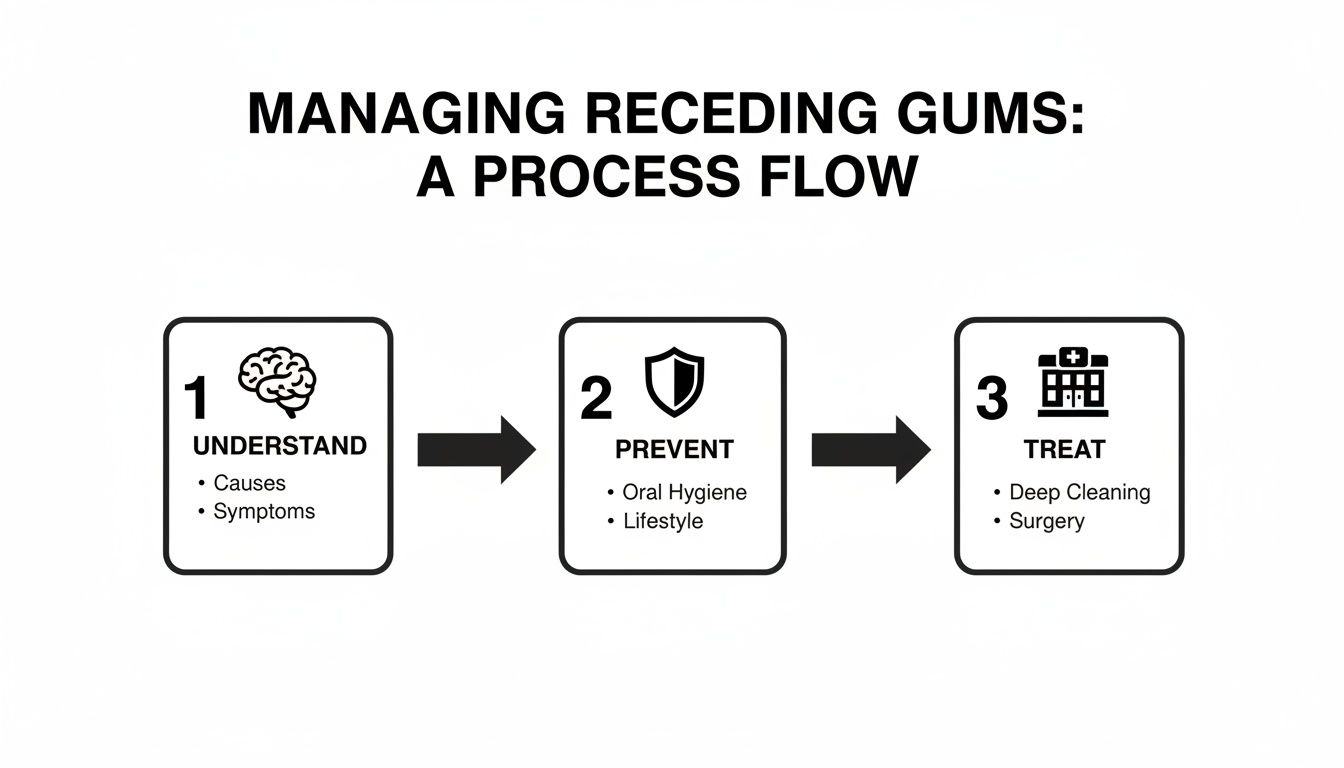
Mastering these at-home techniques is a critical first step in taking control of your gum health.
The best way to floss safely is with the 'C-shape' technique. It’s simple but incredibly effective:
- Get Ready: Take about 18 inches of floss and wrap most of it around one middle finger, leaving a small amount for the other to take up the used floss.
- Slide, Don't Snap: Use your thumbs and index fingers to gently guide the floss between two teeth.
- Form the 'C': Once you reach the gumline, curve the floss into a C-shape against the side of one tooth. This hugs the tooth surface, ensuring maximum contact.
- Go Below the Gumline: Carefully slide the floss into the space between your gum and the tooth until you feel a little resistance.
- Wipe Clean: Move the floss up and down against the side of the tooth a few times. Then, lift it over the gum tip, form a 'C' against the neighboring tooth, and repeat.
This method ensures you’re cleaning that critical area below the gumline where periodontal disease gets its start, all without causing damage. To get it right, it’s worth taking a moment to master proper brushing and flossing techniques.
Choosing a Toothpaste That Supports Your Gums
The right toothpaste is more than just a cleaner; it's a key part of your treatment plan. When gums recede, they often expose the underlying root surfaces, which are much more sensitive than enamel. Abrasive toothpastes, especially gritty whitening formulas or charcoal-based pastes, can make both the recession and the sensitivity much worse.
Look for a toothpaste specifically formulated for gum health or sensitivity. These are low-abrasion and often contain beneficial ingredients. Stannous fluoride, for example, is great for fighting the bacteria that cause gingivitis, while potassium nitrate helps calm the nerves inside your teeth to reduce that sharp, sensitive pain.
Pairing gentle techniques with the right products creates a powerful synergy that actively protects and soothes your gums every single day. If you're looking for the perfect fit to manage discomfort, check out our guide on the best toothpaste for sensitive teeth.
Choosing the Right Products to Support Gum Health
Switching to a gentler brushing and flossing routine is the foundation, but the products you use can either accelerate your progress or hold you back. Think of the right toothpaste, rinse, and other treatments as powerful allies in your mission to halt recession and manage the sensitivity that almost always comes with it.
Navigating the dental care aisle can feel like a chore, so let's cut through the noise and break down exactly what your gums need. This isn't about a one-size-fits-all approach; it's about assembling a specialized toolkit with ingredients that tackle specific problems like inflammation, exposed root sensitivity, and bacterial overgrowth.
Decoding Toothpaste Ingredients for Gum Recession
When your gums recede, they expose the root of the tooth, a surface called dentin. Unlike the tough, protective enamel covering the crown, dentin is porous and filled with tiny tubes leading straight to the tooth's nerve. This is the anatomical reason you suddenly get that sharp zing from hot coffee or a cold drink.
Your toothpaste choice is absolutely critical here. Abrasive formulas, especially those promising extreme whitening, can be far too harsh on these delicate, exposed surfaces. Instead, you need to be on the lookout for ingredients designed for protection and relief.
-
Stannous Fluoride: This is a true multitasking powerhouse. It doesn't just fight cavities; it has proven anti-gingivitis properties that help knock down the bacteria responsible for gum inflammation and disease.
-
Potassium Nitrate: If sensitivity is your main complaint, this ingredient is your new best friend. It works by calming the nerves inside the tooth, effectively blocking the pain signals that cause that all-too-familiar wince.
-
Calcium Phosphate (Amorphous): Found in specialty products like MI Paste, this ingredient is a game-changer for remineralization. It delivers crucial calcium and phosphate ions right to the tooth surface, helping to strengthen it and plug those microscopic tubules in the dentin that cause sensitivity.
If you're dealing with significant sensitivity from exposed roots, a prescription-strength toothpaste like Fluoridex can bring immense relief. Its higher concentration of fluoride provides superior protection and desensitizing action compared to what you'll find on the shelf at the drugstore.
The Role of Therapeutic Mouth Rinses
A good oral rinse should do more than just mask bad breath; it should help control the bacterial environment in your whole mouth. The problem is, many popular mouthwashes are loaded with alcohol, which can dry out your mouth and seriously irritate already-sensitive gum tissues. Ironically, a dry mouth actually creates a better breeding ground for the very bacteria you're trying to eliminate.
Your best bet is to look for alcohol-free therapeutic rinses that focus on reducing bacteria without the harsh side effects. A product like BreathRX is a perfect example. It's formulated to neutralize volatile sulfur compounds (the source of bad breath) and reduce plaque-causing bacteria, all without that familiar alcohol burn. If you want to dive deeper, we have a whole guide on finding the best mouthwash for sensitive gums.
Targeted Treatments for Specific Scenarios
Sometimes, your standard daily routine needs a specialized boost. Certain situations put you at a higher risk for gum issues, and that's when a targeted product can make all the difference.
For instance, imagine you're undergoing orthodontic treatment. Cleaning effectively around braces or aligners is notoriously difficult, which raises the risk of plaque buildup and gingivitis. In a case like this, adding MI Paste Plus (which includes fluoride) to your routine provides an extra layer of defense, helping to remineralize enamel and protect against the first signs of recession.
Or what if you want to whiten your teeth but are terrified of the sensitivity? You can still do it, but you have to be strategic. Use a desensitizing toothpaste for a few weeks before you start a professional-grade whitener like PolaDay. Then, after each whitening session, apply a remineralizing paste like MI Paste to soothe and strengthen your teeth. This lets you get the cosmetic results you want without aggravating your gums.
To help you connect the dots, this table breaks down some of the most important ingredients and where you'll find them.
Gum-Friendly Product Ingredient Guide
| Ingredient | Primary Benefit for Gums | Found In (Product Type) | Example Product Line |
|---|---|---|---|
| Stannous Fluoride | Fights plaque bacteria and gingivitis, reduces inflammation. | Toothpaste, Gels | Fluoridex |
| Potassium Nitrate | Calms tooth nerves to provide significant sensitivity relief. | Toothpaste | Fluoridex |
| Calcium Phosphate | Remineralizes and strengthens enamel and exposed dentin. | Specialty Pastes | MI Paste, MI Paste Plus |
| CPC (Cetylpyridinium Chloride) | An antiseptic that kills bacteria and helps control plaque. | Alcohol-Free Rinses | BreathRX |
By carefully choosing products with these beneficial ingredients, you transform your daily routine from simple maintenance into an active, therapeutic strategy for protecting your gums. This informed approach is one of the most powerful tools you have for managing gum recession at home.
Natural Remedies and Lifestyle Adjustments to Halt Recession
While a solid oral hygiene routine is your primary defense, certain natural remedies and lifestyle changes can offer powerful support in your quest to manage receding gums at home. These strategies work by reducing inflammation, fighting harmful bacteria, and creating an internal environment that helps your gums thrive. Think of them as a powerful backup for your brushing and flossing efforts.
One of the most talked-about at-home remedies is oil pulling, an ancient Ayurvedic practice. It involves swishing a tablespoon of oil—usually coconut oil—in your mouth for 15-20 minutes. Coconut oil is packed with lauric acid, which has proven anti-inflammatory and antimicrobial properties that can help reduce the plaque-causing bacteria that lead to gingivitis.
Ever wonder if oil pulling for receding gums actually works? A striking survey found that 78% of 450 individuals who practiced it daily for a month reported better gum health and even a visible reduction in recession—pretty compelling for a simple home remedy. You can find more details on these findings over at TotalHealthDentalCare.com.
How to Practice Oil Pulling Correctly
To get the most out of oil pulling, you have to be consistent and use the right technique. It’s definitely more than just a quick rinse.
- Get the Right Amount: Start with one tablespoon of a high-quality, cold-pressed coconut oil.
- Swish Thoroughly: Gently swish the oil all around your mouth, making sure to pull it between your teeth. Aim for 15 to 20 minutes. As you swish, the oil will mix with your saliva and turn into a thin, milky-white liquid.
- Spit Responsibly: When you're done, spit the oil into a trash can. Never spit it in the sink, as it can solidify and clog your pipes.
- Rinse and Brush: Give your mouth a good rinse with warm water, and then brush your teeth like you normally would. For the best results, try to do this first thing in the morning on an empty stomach.
Fueling Your Gums From The Inside Out
What you eat has a massive impact on your gum health. Your diet can either fuel inflammation or help fight it. Focusing on nutrient-dense foods is one of the easiest and most effective ways to support your gum tissue.
A diet rich in Vitamin C is non-negotiable. This vitamin is essential for collagen production, which is the protein that gives your gums their strength and structure. Without enough Vitamin C, this framework gets weak, making your gums much more vulnerable to disease and recession.
Pro Tip: Don't just reach for oranges! Foods like bell peppers, broccoli, strawberries, and kale are all loaded with more Vitamin C than many citrus fruits. Try to get a variety of colorful fruits and vegetables into your meals every day.
You might also want to add some green tea to your routine. It’s full of antioxidants called catechins, which help fight inflammation and control the bacterial infections tied to gum disease. A simple swap from coffee to green tea can provide a steady stream of these beneficial compounds. If you're also noticing some bleeding, check out our guide on treating bleeding gums at home for more targeted advice.
Making Critical Lifestyle Adjustments
Finally, some of the most impactful changes have less to do with what you put in your mouth and more to do with the habits you break.
- Quit Smoking: Using tobacco in any form is one of the absolute worst things for your gums. It restricts blood flow to the gum tissue, crippling its ability to heal and fight off infection, which can dramatically speed up recession.
- Manage Stress: High stress levels often lead to subconscious teeth grinding or clenching (bruxism), especially at night. This constant pressure can traumatize your gums and the bone underneath.
- Use a Night Guard: If you think you might be a grinder, talk to your dentist about a custom-fitted night guard. This simple device creates a protective barrier, absorbing the incredible force of grinding and giving your gums a much-needed break.
By combining these natural remedies and lifestyle tweaks with excellent oral hygiene, you create a holistic strategy. This multi-pronged approach gives you the best possible chance to halt gum recession and keep your smile healthy and stable for years to come.
When to See a Dentist: Recognizing the Warning Signs
While consistent at-home care is your most powerful tool for hitting the brakes on gum recession, it’s critical to recognize where its power ends. Some signs and symptoms are clear alarms that the problem has moved beyond what you can handle alone. Ignoring these red flags can lead to irreversible damage, and in the worst cases, tooth loss.
Understanding when to shift from daily maintenance to professional intervention is a key part of managing your oral health. Your efforts at home are meant to stabilize your gums, not to treat an active, advancing infection or severe structural issues.
Symptoms You Should Never Ignore
If you experience any of the following, it’s time to pick up the phone and schedule a dental appointment. These aren't just minor inconveniences; they are signals from your body that a more serious underlying problem needs an expert's eye.
- Persistent Bleeding Gums: If your gums bleed every time you brush or floss—even after being gentle for weeks—it often points to active inflammation and gum disease that isn't resolving.
- Pus Around the Gums: Seeing a yellowish or whitish fluid when you press on your gums is a definitive sign of infection. This requires immediate dental care, no exceptions.
- Noticeably Loose Teeth: Your teeth should feel firm and solid. Any wiggle or movement means the supporting bone structure is compromised, which is a very serious stage of periodontal disease.
- Constant Bad Breath: We’re not talking about morning breath. Persistent bad breath (halitosis) that doesn’t go away with brushing or rinsing can be caused by bacteria trapped deep in gum pockets where you can't reach.
- Visible Deepening Pockets: If you can literally see the gaps between your gums and teeth getting larger, it means the gum tissue is detaching. This creates deeper pockets where dangerous bacteria thrive.
These symptoms are well beyond the scope of any at-home remedy. More than 42% of adults over 30 have some form of gum disease, and these signs indicate it may be progressing. Delaying a professional check-up just allows the condition to get worse, making treatment far more complex down the road.
Crucial Takeaway: At-home care is for maintenance and prevention. Once you see clear signs of infection or instability like pus or loose teeth, you've crossed into territory that absolutely requires a professional diagnosis and treatment plan.
What to Expect During Your Dental Visit
Knowing what happens at the dentist's office can help ease any anxiety you might have. Your dentist is your partner in this, and the main goal is to get a crystal-clear picture of your gum health to map out the most effective treatment.
The visit will almost certainly start with a thorough examination. Your dentist or hygienist will use a special tool called a periodontal probe to gently measure the depth of the pockets around each tooth. Healthy pockets are typically 1-3 millimeters deep; anything deeper can be a sign of gum disease.
Based on these findings, the first line of professional defense is usually a deep cleaning, also known as scaling and root planing. Think of it as a super-charged version of a standard cleaning. It involves carefully removing hardened plaque (tartar) and bacteria from below the gumline and smoothing out the tooth roots to help the gums reattach properly.
For more advanced cases, a dentist can offer a range of professional gum treatment options to stop recession in its tracks and restore your gum health. The key is to act quickly. By recognizing these warning signs and seeking timely care, you build a powerful partnership between your diligent at-home routine and the essential treatments only a professional can provide.
Your Questions About Gum Recession, Answered
When you start taking control of your gum health, it's natural for a lot of questions to pop up. You might be wondering if a specific tool will help or hurt, or how long it'll take before you see real results. Let's tackle some of the most common questions I hear from people who are serious about stopping gum recession.
Can Electric Toothbrushes Make Receding Gums Worse?
This is a really common fear, and it makes sense. But the truth is, the right electric toothbrush can be one of your best allies. Many of today's models are built specifically to be gentler and more effective than brushing by hand, especially if you have a habit of being a little too aggressive.
The absolute game-changer is the built-in pressure sensor. If you tend to scrub, this feature is for you. It gives you a little warning—a light or a change in vibration—the second you start pushing too hard. It’s like having a tiny dental hygienist on your shoulder, coaching you to use a lighter touch. Combine that with a soft-bristled head, and you've got a tool that removes plaque far more efficiently without harming your sensitive gums.
How Long Does It Take to See Improvements at Home?
It's important to know that gum tissue doesn't grow back on its own. However, you can see and feel a big difference in your gum health pretty quickly. By sticking to a gentle, consistent routine of brushing and flossing, most people notice less bleeding, reduced puffiness, and a calmer, less angry look to their gums within just one to two weeks.
Stopping the recession from getting worse is the longer-term goal, and that takes months of dedicated care. If sensitivity is your main problem and you're using products like Fluoridex or MI Paste, you'll likely feel significant relief in about two to four weeks. The key to all of this is consistency—you have to stick with it every single day.
Remember, the first win is stopping the inflammation and bleeding. The next major milestone is stabilizing the gumline so it doesn't recede any further, and that is completely achievable with persistent at-home care.
Is It Safe to Use Whitening Products With Receding Gums?
Excellent question. The answer requires a bit of a strategic approach. When your gums recede, they expose the root of the tooth, which isn't covered in hard enamel. It's much more porous and way more sensitive. Slathering whitening gels on these exposed areas can cause a world of hurt.
But that doesn't mean you can't whiten safely. You just need to take a few precautions:
- Use Custom-Fitted Trays: Get trays made by your dentist. They're designed to hold the whitening gel precisely on your tooth enamel, keeping it off the sensitive gumline and roots.
- Apply a Protective Barrier: Ask your dentist about products that can be applied right at the gumline to shield it while you whiten.
- Strengthen Your Teeth First: Before and after whitening, use a remineralizing paste like MI Paste. This helps fortify the tooth surface and dials down sensitivity.
I always tell my patients to talk to their dentist before starting any whitening system, especially powerful ones like PolaDay, if they have any gum recession.
Will My Gums Stop Receding if I Just Start Flossing?
Starting to floss is a massive step in the right direction, but it's rarely the single magic bullet. Gum recession is usually a multifactorial problem, which is a fancy way of saying it has several different causes that all need to be addressed.
If your recession is caused by periodontal disease, then yes, flossing is absolutely critical for removing the bacteria that are fueling the infection. But what if your recession is mainly from brushing too hard, your genetics, or grinding your teeth at night? In those cases, flossing alone won't get to the root of the problem.
Think of it like a team effort. Flossing is a star player, for sure. But you need the whole team on the field to win. A complete game plan combines proper flossing with gentle brushing, a soft toothbrush, maybe a night guard if you're a grinder, and a healthy lifestyle.
Ready to build your personalized gum care toolkit? At DentalHealth.com, we offer a curated selection of dentist-recommended products, from ultra-soft toothbrushes and sensitivity pastes like MI Paste to therapeutic, alcohol-free rinses. Take control of your oral health today with professional-grade solutions delivered right to your door. Explore our collection at https://dentalhealth.com and enjoy free shipping on all USA orders.