
Zoom Whitening How Often: A Safe Schedule Guide
A full in-office Zoom session is typically repeated no more than once every 6 to 12 months, while short at-home touch-ups may be used more often under dentist supervision. Over-whitening is the risk to manage, not failing to keep your teeth at their brightest shade every day.
The popular advice, “just whiten whenever the color fades,” is too casual for peroxide treatment. Zoom whitening how often isn't a simple calendar question. The right interval depends on whether you're repeating a full chairside procedure, using a brief touch-up, or maintaining your shade with dentist-prescribed trays, and it also depends on how your teeth and gums respond.
Sensitivity should change the plan. The American Dental Association notes that temporary sensitivity can affect up to two-thirds of users, often appearing within 2 to 3 days of starting tray or strip whitening and usually resolving by day 4 after treatment ends (ADA guidance on teeth whitening). If your discomfort lasts longer, intensifies, or includes gum irritation, repeating treatment on schedule is the wrong move.
Why Whitening Frequency Is a Risk Question, Not Just a Schedule Question
A whiter smile is not a reason to keep applying peroxide. Peroxide passes through enamel and dentin to break down stain molecules, and the process can temporarily irritate the pulp and nearby soft tissues. Repeating treatment before those tissues settle raises the chance of avoidable discomfort.
The right question is not, “How often should I whiten?” It is whether the expected shade improvement justifies another exposure. Your dentist should assess sensitivity, gum irritation, enamel condition, existing restorations, and the shade you can realistically maintain before recommending a repeat.
What frequent whitening can signal
Pain does not show that the gel is working. It signals that the concentration, wear time, or frequency may exceed what your teeth and gums tolerate. People with pre-existing sensitivity, frequent product use, or stronger peroxide exposure often need a slower plan (evidence review on tooth whitening).
Peroxide strength matters too. Sensitivity risk rises as concentration increases, so a stronger product is not automatically the better choice. Your dentist can reduce exposure by choosing a lower concentration, shortening contact time, or switching from a full in-office session to a controlled touch-up.
Maintenance usually makes more sense than repeatedly starting from zero. A review found that monthly home-based touch-ups for about 3 months after an in-office treatment improved color persistence over 6 months, and identified an in-office treatment followed by monthly over-the-counter touch-ups as an effective regimen (evidence review on tooth whitening). That schedule still requires adjustment for sensitivity, restorations, and the type of staining.
Clinical rule: Choose the lowest-intensity method that keeps your shade acceptable, then lengthen the interval whenever sensitivity appears.
A full Zoom session delivers substantial peroxide exposure. A short tray touch-up is a different intervention, with less total exposure when used correctly. Set their intervals separately, and use at-home maintenance rather than repeating a full session whenever the shade fades slightly.
What a Single Zoom Whitening Session Actually Involves
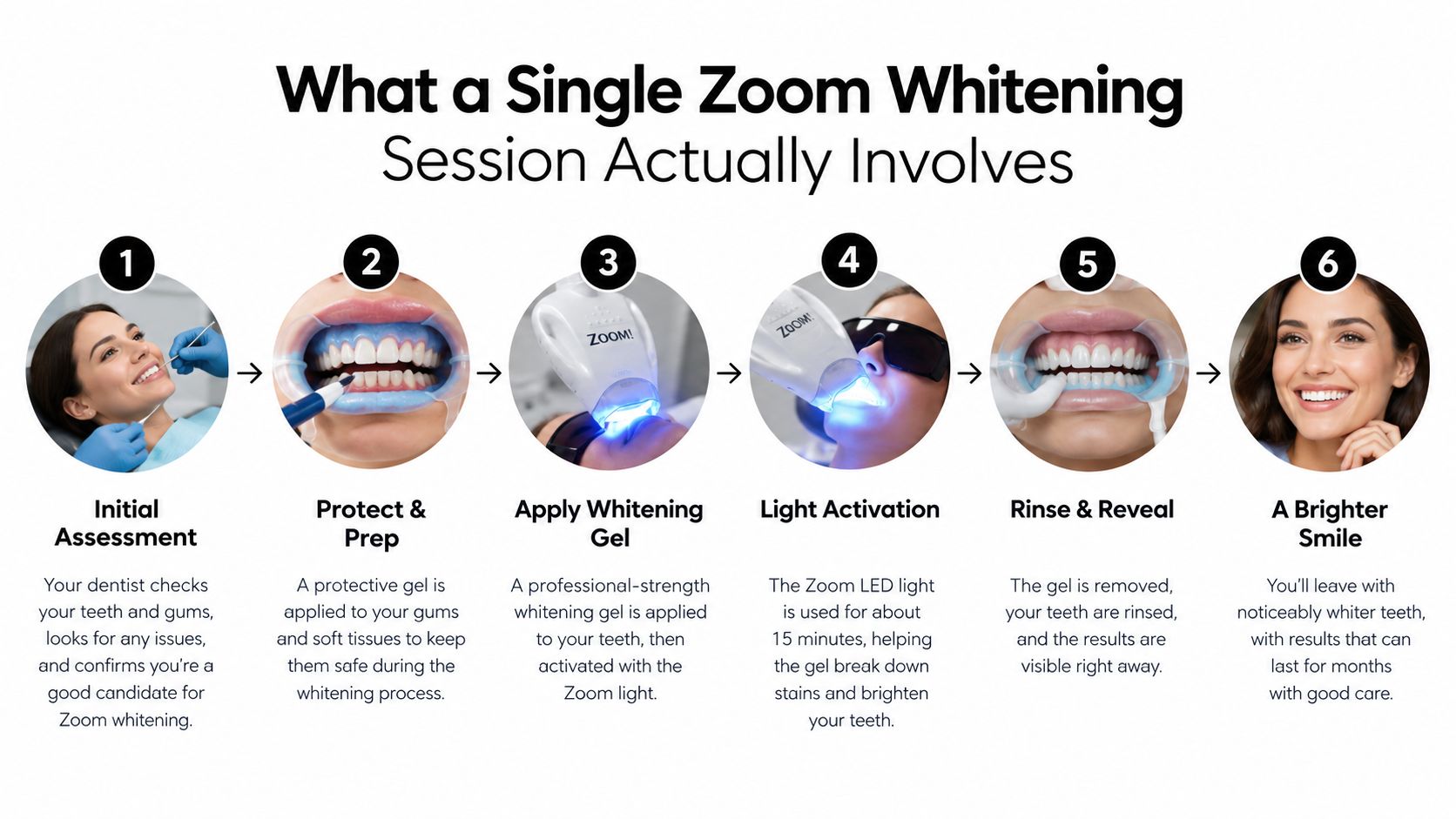
A professional appointment begins with an examination and shade assessment. Your dentist may record photographs and compare the starting shade with the result later, because immediate whiteness can look stronger while teeth are temporarily dehydrated.
The team then protects your cheeks, lips, and gums before applying whitening gel to the visible tooth surfaces. Philips describes its core in-office protocol as four 15-minute cycles, completed during one chairside appointment (Philips Zoom clinical information). The gel is activated during those cycles, with the dentist checking your comfort and the condition of the soft tissues.
Why the repeat matters
That appointment is not equivalent to wearing a lower-strength tray at home. A chairside treatment delivers concentrated peroxide in repeated applications, while take-home systems are managed through wear time and a dentist's instructions. Philips Zoom DayWhite and NiteWhite are commonly used for home maintenance, with DayWhite generally prescribed for short daily wear and NiteWhite used overnight in a dentist-directed course (Philips Zoom clinical information).
Your dentist should also check whether visible crowns, veneers, fillings, or bonding are present. Whitening changes natural tooth structure, but it won't lighten most restorative materials in the same way. Repeating treatment to force a restoration to match can create an uneven result rather than a healthier-looking smile.
For a patient-focused explanation of the appointment and aftercare, review this guide to Zoom teeth whitening. The key point is simple: before asking how often to repeat treatment, understand what you're repeating.
The Recommended Interval Between Zoom Sessions
A full in-office Zoom session should not become a routine every-few-months appointment. Set 6 months as the minimum practical interval, and choose 12 months when your last treatment caused notable sensitivity, gum irritation, enamel concerns, or difficult shade matching around restorations.
That interval gives your dentist time to confirm that another full treatment is justified. Professional evidence shows that retreatment needs vary widely. Some patients may need whitening again within 1 to 3 years, while others may go more than 10 years before repeating it. Original discoloration, lifestyle, oral health, and maintenance all affect the decision (tooth-whitening evidence report).
Which gap applies to you
A 24-hour gap applies only to consecutive at-home tray sessions when your dentist has prescribed use on separate days. It does not make another full in-office Zoom session appropriate. Chairside whitening requires attention to symptom recovery and the longer-term need for treatment.
After an in-office appointment, wait until sensitivity has settled before discussing a home touch-up. This may take several weeks. Your dentist should set the timing and product, especially if your teeth remain painful. Do not follow a box routine that conflicts with your symptoms or dental instructions.
| Treatment type | Minimum gap | Ideal gap | Best for |
|---|---|---|---|
| Full in-office Zoom repeat | 6 months | 12 months when sensitivity is a concern | A clear loss of shade that a touch-up cannot manage |
| Dentist-supervised home maintenance | As prescribed | Short, limited maintenance cycles | Preserving a professional result |
| Consecutive tray-wear days | At least 24 hours between sessions when directed | Based on your dentist's course | A prescribed home whitening regimen |
| Later full retreatment | Varies by patient | Often a longer rotation, including 1 to 3 years or more | Patients whose shade has gradually faded |
Professional oversight should determine the schedule, not personal preference. Coffee, tea, wine, and tobacco can accelerate staining, but they do not automatically justify frequent full-strength whitening. Adjust maintenance first, then consider a full repeat only when the overall shade has clearly faded and your teeth remain healthy.
Full Repeats, Short Touch-Ups, and At-Home Maintenance Compared
The safest whitening plan is not the most frequent one. Choose based on how much your shade has changed, how your teeth responded to the last treatment, and whether you need a full repeat, a limited touch-up, or simple maintenance. A full repeat fits substantial overall fading. A short touch-up fits mild staining after your dentist confirms that your teeth and gums are healthy.
Peroxide concentration is only part of the exposure. Total peroxide exposure also depends on the amount used, contact time, frequency, and whether gel reaches irritated gum tissue. A milder product can still trigger sensitivity if you wear it too long or use it more often than prescribed.
Use the least aggressive option that works
- Full in-office Zoom: Reserve this intensive treatment for a genuine change in overall shade, not one coffee stain. It needs the most recovery time and should follow a dental examination.
- Short professional touch-up: This suits mild fading when a complete restart is unnecessary. Your dentist should set the product, wear time, and timing. Treat it as a defined treatment, not an informal extra appointment.
- Custom take-home trays: These support controlled maintenance because your dentist can check the fit and prescribe the gel. Philips Zoom DayWhite and NiteWhite are commonly used formulas, but their wear instructions differ. The Philips Zoom clinical information explains the product protocols.
- Over-the-counter strips: Fit is less predictable, so gel may contact the gums unevenly. Strips still require caution if your teeth already react to whitening.
Restorations complicate every option. Crowns, veneers, and bonding do not lighten like natural enamel. Whitening natural teeth further can make the mismatch more visible rather than correcting it. Have your dentist assess the visible teeth together before choosing stronger or more frequent treatment.
A maintenance touch-up should preserve a result, not replace an examination.
Planned home maintenance after professional whitening is generally more sensible than back-to-back full procedures. Your dentist may choose another approach for intrinsic discoloration, untreated decay, gum disease, cracked teeth, or significant sensitivity. Stop and seek advice if whitening causes persistent pain or gum irritation.
How to Personalize Your Whitening Schedule Safely
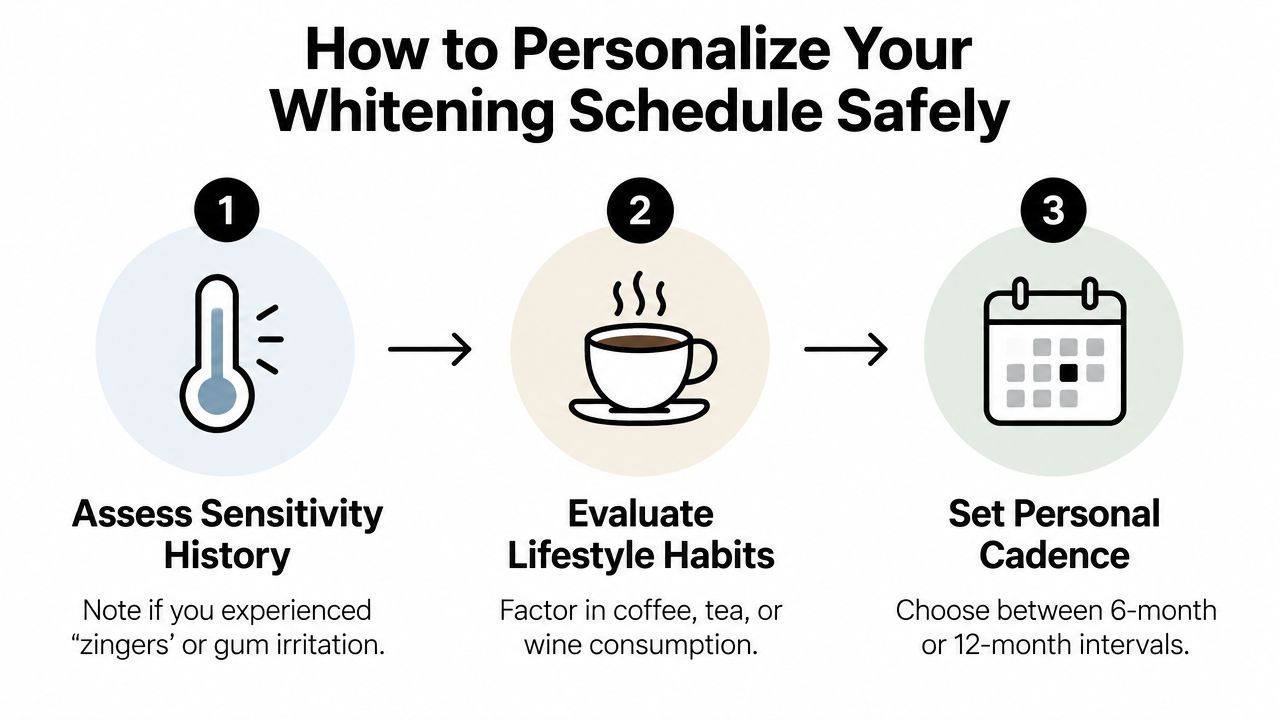
Set your whitening interval from your teeth's response, not from your social calendar. Sharp “zingers,” gum irritation, or lingering pain mean you should speak with your dentist before scheduling another session. Sensitivity is a reason to adjust the protocol, not evidence that the whitening is working better. Persistent symptoms require assessment before further peroxide exposure.
Three questions should set the cadence
First, how did your teeth respond? A comfortable session does not automatically justify repeating the same treatment. A painful session calls for a longer recovery period, a lower-intensity maintenance plan, or a dental review before another full appointment.
Second, how quickly do stains return? Coffee, tea, red wine, and tobacco can make discoloration visible sooner. Control those habits before increasing treatment frequency. Rinse with water after staining drinks, use a straw where appropriate, and maintain consistent brushing. These steps can preserve the result without another immediate chairside session.
Third, what treatment are you using? Philips Zoom DayWhite and NiteWhite follow different wear patterns, so never transfer instructions from one formula to the other. A dentist-prescribed tray also gives more consistent gel contact than a poorly fitting strip, particularly near the gumline. Your dentist should set the concentration, wear time, and interval.
Use this decision pathway:
- Assess sensitivity first. If symptoms persist or return quickly after restarting, pause treatment and arrange a dental review.
- Evaluate staining habits second. If external staining drives the change, improve daily maintenance before adding peroxide.
- Choose the lowest effective concentration third. Stronger gel is not automatically the right choice for faster cosmetic improvement.
Some patients maintain their shade comfortably with occasional home care. Others need longer intervals because their teeth react strongly. Baseline sensitivity, the treatment type, and the amount of fading should determine the plan, rather than a fixed timetable.
Common Whitening Frequency Mistakes to Avoid
Whitening more often does not guarantee a brighter result. Repeated peroxide exposure can irritate teeth and gums while producing little additional shade change. Use the lowest frequency that maintains your result, especially if sensitivity appears after treatment.
Do not treat pain as proof that whitening is working. Sensitivity signals irritation, not superior whitening. Stop the product and contact your dentist if sharp pain continues, your gums burn, or symptoms return each time you restart. Review guidance on why Zoom whitening hurts before deciding whether to continue.
Four beliefs that lead patients astray
- “I can repeat the full session whenever I notice fading.” Fading is normal. A shorter maintenance approach may be enough, while another full session should follow a dental examination.
- “At-home products don't need a schedule.” Trays and strips still expose teeth and gums to peroxide. Follow the product directions and your dentist's instructions.
- “Whitening will make crowns and veneers brighter.” Restorations generally do not respond like natural enamel. More gel can increase the contrast instead of correcting it.
- “The result should stay permanent.” Dark beverages and tobacco can restain teeth over time. Increasing treatment frequency to chase permanence can compromise comfort and tissue health.
Cosmetic procedures such as facials are scheduled around skin recovery, and whitening deserves the same discipline because peroxide exposure can provoke a direct dental response. That is the reasoning behind planning when to schedule a facial treatment rather than booking appointments whenever a result starts to fade.
Keep your target realistic: a stable, natural-looking shade that you can maintain comfortably. If fading is mild, improve daily care before adding peroxide. If sensitivity is persistent or restorations create uneven color, ask your dentist to review the plan instead of repeating treatment automatically.
Your Practical Zoom Whitening Schedule and Maintenance Plan
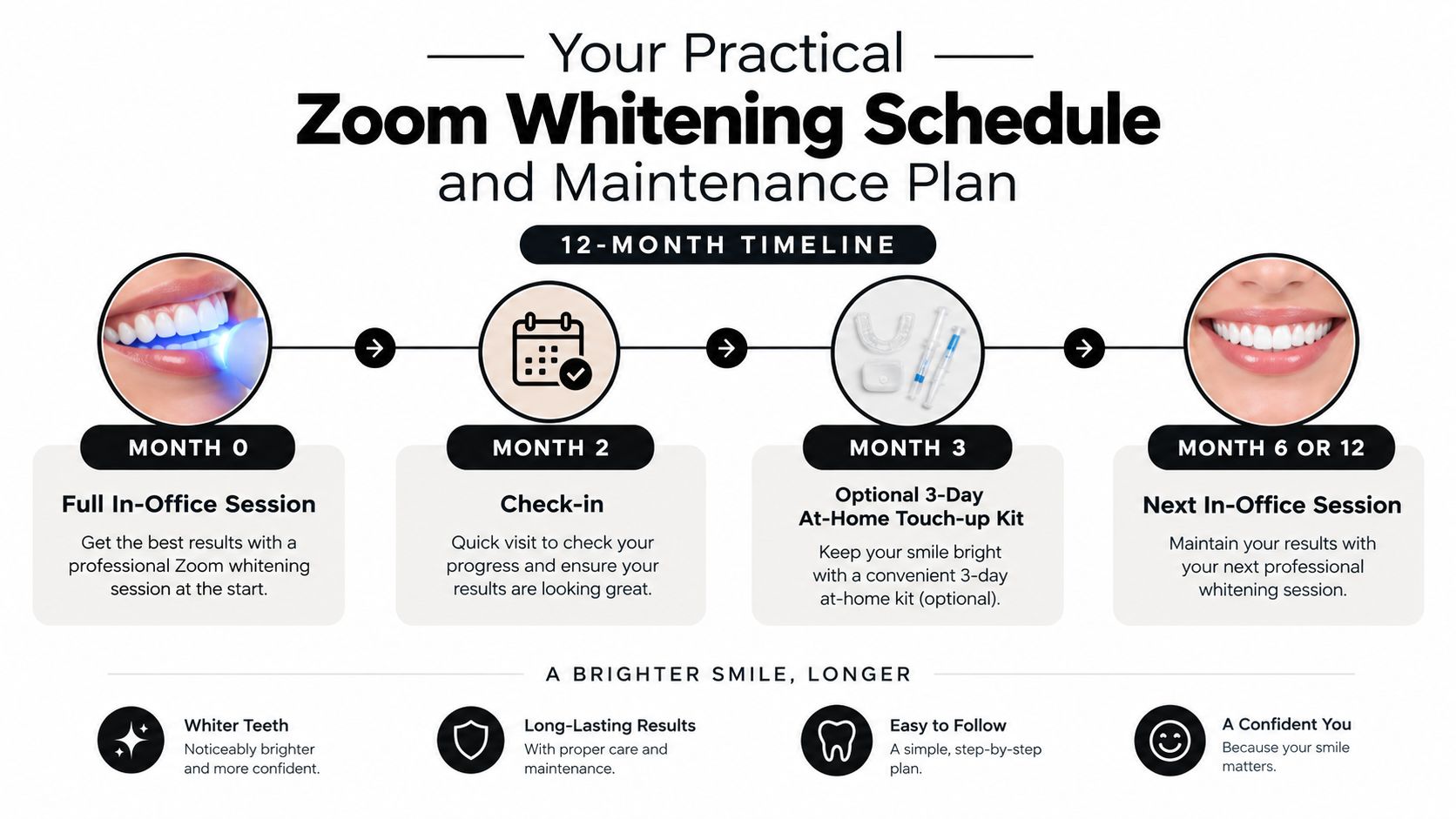
Use a conservative 12-month framework as a starting point, then let your dentist adjust it. At month 0, complete one full in-office Zoom appointment after confirming that your teeth and gums are suitable. At month 2, schedule a check-in to assess sensitivity, restorations, shade stability, and whether maintenance is necessary.
At month 6, a short at-home touch-up may be appropriate if your dentist prescribed it and your teeth are comfortable. At month 12, reassess before booking another full session. If your shade remains acceptable, don't whiten merely because a year has passed.
Daily habits that protect the result
Brush twice daily with fluoride toothpaste and clean between the teeth consistently. After coffee or red wine, rinse with water, and use a straw for suitable dark beverages to reduce contact with the front teeth. Wait 30 minutes between acidic drinks and brushing, as recommended in practical post-whitening care guidance (Zoom aftercare advice).
For product-specific maintenance, Philips Zoom NiteWhite and DayWhite are commonly dispensed take-home formulas. Follow the exact wear time and frequency supplied by your dentist, rather than extending treatment because the shade seems to be fading.
Use this checklist before your next application:
- Confirm candidacy: Have a dentist check your teeth, gums, sensitivity, and restorations.
- Treat problems first: Address cavities, gum inflammation, cracks, or leaking restorations before whitening.
- Record the baseline: Take a shade reference or photograph in consistent lighting.
- Plan one full session: Start with an annual review, not automatic repeat treatment.
- Use supplied trays only: Keep touch-ups within the instructions you were given.
- Stop for persistent zingers: If sharp sensitivity lasts beyond the expected recovery period, pause and seek advice.
- Book a sensitivity review: Don't schedule the next full session until your dentist understands the previous reaction.
For further aftercare guidance, see this Zoom whitening aftercare resource. DentalHealth.com offers professional-grade whitening gels, take-home systems, sensitivity products, and other dentist-associated oral-care brands, so you can compare maintenance supplies before your next appointment.
DentalHealth.com can help you find dentist-oriented whitening gels, Zoom take-home products, and sensitivity-care options for a controlled maintenance routine. Visit DentalHealth.com to review the available products, then confirm your schedule and product choice with your dentist before whitening again.